


Feasibility of Cooking Matters for Diabetes: A 6-week Randomized, Controlled Cooking and Diabetes Self-Management Education Intervention
- PMID: 35944873
- PMCID: PMC10909744
- DOI: 10.1016/j.jand.2022.07.020
Feasibility of Cooking Matters for Diabetes: A 6-week Randomized, Controlled Cooking and Diabetes Self-Management Education Intervention
Abstract
Background: Diabetes self-management education and support is the cornerstone of diabetes care, yet <10% of adults with diabetes manage their condition successfully. Feasible interventions are needed urgently.
Objective: Our aim was to assess the feasibility of a cooking intervention with food provision and diabetes self-management education and support.
Design: This was a waitlist-controlled, randomized trial.
Participants/setting: Thirteen adults with type 1 or type 2 diabetes who participated in Cooking Matters for Diabetes (CMFD) participated in 2 focus groups.
Intervention: CMFD was adapted from Cooking Matters and the American Diabetes Association's diabetes self-management education and support intervention into a 6-week program with weekly lesson-aligned food provisions.
Main outcome measures: Feasibility was evaluated quantitatively and qualitatively along the following 5 dimensions: demand, acceptability, implementation, practicality, and limited efficacy.
Statistical analysis: Two coders extracted focus group themes with 100% agreement after iterative analysis, resulting in consensus. Administrative data were analyzed via descriptive statistics.
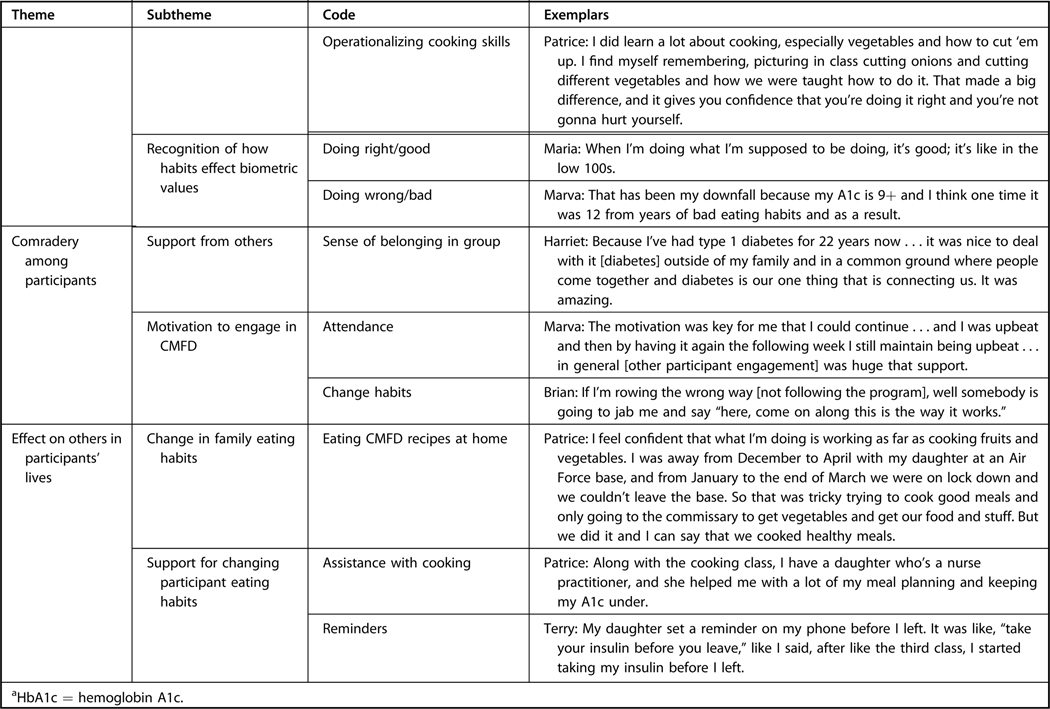
Results: Mean (SD) age of focus group participants was 57 (14) years; 85% identified as female; 39% identified as White; 46% identified as Black; and income ranged from <$5,000 per year (15%) to $100,000 or more per year (15%). Mean (SD) baseline hemoglobin A1c was 8.6% (1.2%). Mean attendance in CMFD was 5 of 6 classes (83%) among all participants. Demand was high based on attendance and reported intervention utilization and was highest among food insecure participants, who were more likely to report using the food provisions and recipes. Acceptability was also high; focus groups revealed the quality of instructors and interaction with peers as key intervention strengths. Participant ideas for implementation refinement included simplifying recipes, lengthening class sessions, and offering more food provision choices. Perceived effects of the intervention included lower hemoglobin A1c and body weight and improvements to health-related quality of life.
Conclusions: The CMFD intervention was feasible according to the measured principles of demand, acceptability, implementation, practicality, and limited efficacy.
Trial registration: ClinicalTrials.gov NCT04152811.
Keywords: Cooking; Diabetes self-management education and support; Food insecurity; Social determinants of health; Type 2 diabetes mellitus.
Copyright © 2023 Academy of Nutrition and Dietetics. Published by Elsevier Inc. All rights reserved.
Conflict of interest statement
STATEMENT OF POTENTIAL CONFLICT OF INTEREST
No potential conflict of interest was reported by the authors.
Figures



References
-
- National Diabetes Statistics Report 2020. Estimates of diabetes and its burden in the United States. Centers for Disease Control and Prevention. Accessed July 21, 2022. https://www.cdc.gov/diabetes/pdfs/data/statistics/national-diabetes-stat...
-
- American Diabetes Association. 5. Facilitating behavior change and well-being to improve health outcome. s: Standards of Medical Care in Diabetes—2020. Diabetes Care. 2020;43(suppl 1):S48–S65. - PubMed
-
- Powers MA, Bardsley J, Cypress M, et al. Diabetes self-management education and support in type 2 diabetes: A joint position statement of the American Diabetes Association, the American Association of Diabetes Educators, and the Academy of Nutrition and Dietetics. Diabetes Care. 2015;38(7):1372–1382. - PubMed
-
- Powers MA, Bardsley JK, Cypress M, et al. Diabetes self-management education and support in adults with type 2 diabetes: A Consensus Report of the American Diabetes Association, the Association of Diabetes Care & Education Specialists, the Academy of Nutrition and Dietetics, the American Academy of Family Physicians, the American Academy of PAs, the American Association of Nurse Practitioners, and the American Pharmacists Association. Sci Diabetes Self-Manag Care. 2021;47(1):54–73. - PubMed
