Randomized Controlled Trial
. 2022 Dec;10(12):3270-3275.
doi: 10.1016/j.jaip.2022.07.030. Epub 2022 Aug 6.

Peanut-Specific IgG4 and IgA in Saliva Are Modulated by Peanut Oral Immunotherapy

Affiliations
Randomized Controlled Trial

Peanut-Specific IgG4 and IgA in Saliva Are Modulated by Peanut Oral Immunotherapy

Johanna M Smeekens et al. J Allergy Clin Immunol Pract. 2022 Dec.

Abstract

Background: Antigen-specific immunoglobulin responses have yet to be studied at the oral mucosal surface during peanut oral immunotherapy (PnOIT).

Objective: We aimed to quantify salivary peanut-specific IgG4 (PNsIgG4) and IgA (PNsIgA) and total IgG4 and IgA in participants from the Immune Tolerance Network's IMPACT study, a phase 2 PnOIT trial.

Methods: Peanut-allergic children, aged 12 months to younger than 48 months at screening, were enrolled and randomized to PnOIT or placebo oral immunotherapy (OIT) for 134 weeks. Per-protocol analysis included 69 PnOIT and 23 placebo participants. Double-blind, placebo-controlled food challenges were conducted at weeks 134 and 160 to assess desensitization and remission, respectively. Saliva samples were collected at baseline and 30, 82, 134, and 160 weeks to quantify PNsIgG4, PNsIgA, and total IgG4 and IgA.

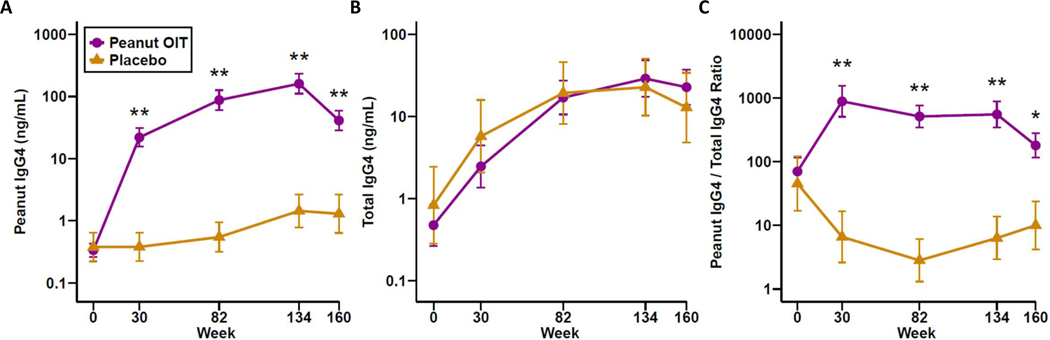
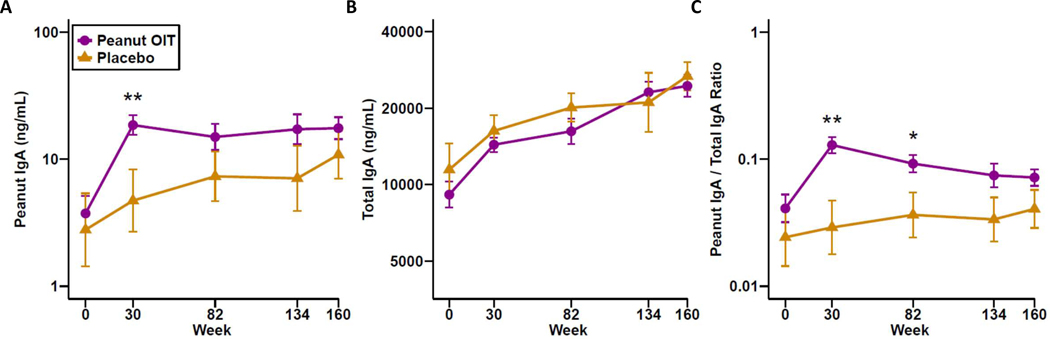
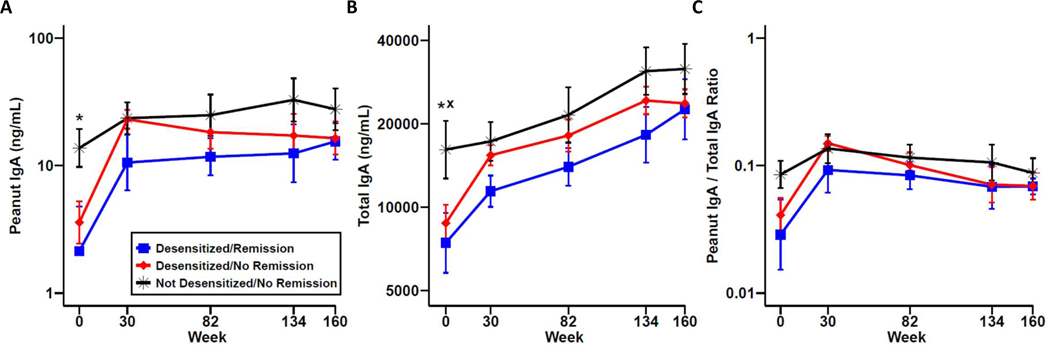
Results: Participants who received PnOIT experienced significant increases in PNsIgG4 in saliva, whereas participants on placebo did not (P < .01 at all time points). The PNsIgA/total IgA ratio was also significantly increased in participants treated with PnOIT when compared with those receiving placebo at 30 and 82 weeks (P < .05). During PnOIT, desensitized participants had increased PNsIgA that plateaued, whereas the not desensitized/no remission group did not change over time. Interestingly, when the PnOIT group was evaluated by clinical outcome, PNsIgA was higher at baseline in the not desensitized/no remission group than in the desensitized/remission group (P < .05).

Conclusions: PnOIT induces substantial increases in allergen-specific IgG4 and IgA in saliva. These data provide insight into OIT-induced mucosal responses and suggest the utility of these easily obtained samples for biomarker development.

Keywords: IgA; IgG4; Oral immunotherapy; Peanut allergy; Saliva.


Figures

Figure 1.
Figure 1.
Peanut-specific and total IgG4 in saliva. Peanut-specific IgG4 (A), total IgG4 (B), and peanut IgG4/total IgG4 ratio (C) throughout the course of peanut (purple) or placebo (gold) OIT. Data are show as means ± standard error of the mean (SEM). *P<0.05, **P<0.01.
Figure 2.
Figure 2.
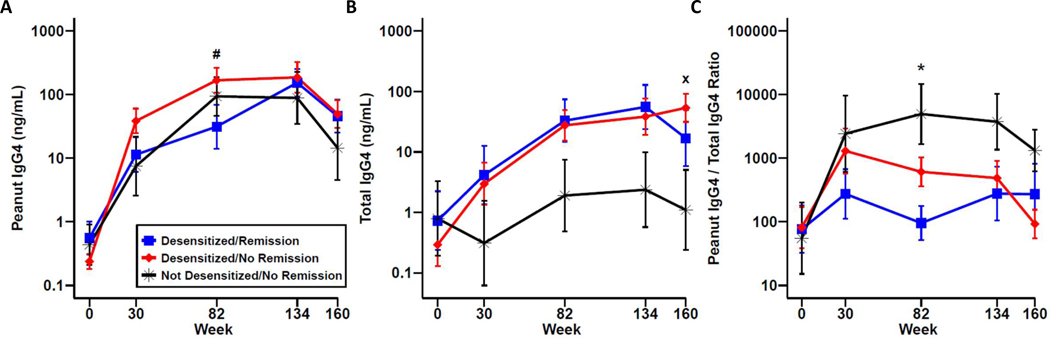
Peanut-specific and total IgG4 in saliva by clinical outcome. Peanut-specific IgG4 (A), total IgG4 (B), and peanut IgG4/total IgG4 ratio (C) in desensitized/remission (blue), desensitized/no remission (red), and not desensitized/no remission (black) OIT participants. Data are show as mean ± standard error of the mean (SEM). # P<0.05 for desensitized/remission vs desensitized/no remission; x P<0.05 for desensitized/no remission vs not desensitized/no remission; * P<0.05 for desensitized/remission vs not desensitized/no remission.
Figure 3.
Figure 3.
Peanut-specific and total IgA in saliva. Peanut-specific IgA (A), total IgA (B), and peanut IgA/total IgA ratio (C) throughout the course of peanut (purple) or placebo (gold) OIT. Data are show as means ± standard error of the mean (SEM). *P<0.05, **P<0.01.
Figure 4.
Figure 4.
Peanut-specific and total IgA in saliva by clinical outcome. Peanut-specific IgA (A), total IgA (B), and peanut IgA/total IgA ratio (C) in desensitized/remission (blue), desensitized/no remission (red), and not desensitized/no remission (black) OIT participants. Data are show as mean ± standard error of the mean (SEM). x P<0.05 for desensitized/no remission vs not desensitized/no remission; * P<0.05 for desensitized/remission vs not desensitized/no remission.
Figure 5.
Figure 5.
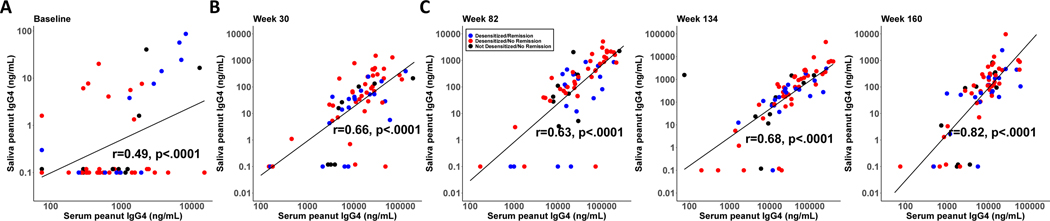
Correlations between salivary and serum peanut-specific IgG4. Correlations in the PnOIT group at weeks 0 (A), 30 (B), 82 (C), 134 (D), and 160 (E). Lines represent linear regression lines and gray bands represent the 95% confidence intervals around regression lines.

References

    1. Lieberman JA, Gupta RS, Knibb RC, Haselkorn T, Tilles S, Mack DP, et al. The global burden of illness of peanut allergy: A comprehensive literature review. Allergy. 2021;76(5):1367–84. - PMC - PubMed
    1. Jones SM, Pons L, Roberts JL, Scurlock AM, Perry TT, Kulis M, et al. Clinical efficacy and immune regulation with peanut oral immunotherapy. J Allergy Clin Immunol. 2009;124(2):292–300, e1–97. - PMC - PubMed
    1. Vickery BP, Pons L, Kulis M, Steele P, Jones SM, Burks AW. Individualized IgE-based dosing of egg oral immunotherapy and the development of tolerance. Ann Allergy Asthma Immunol. 2010;105(6):444–50. - PMC - PubMed
    1. Investigators PGoC, Vickery BP, Vereda A, Casale TB, Beyer K, du Toit G, et al. AR101 Oral Immunotherapy for Peanut Allergy. N Engl J Med. 2018;379(21):1991–2001. - PubMed
    1. Smeekens JM, Kulis MD. Evolution of Immune Responses in Food Immunotherapy. Immunol Allergy Clin North Am. 2020;40(1):87–95. - PMC - PubMed

Publication types