


Editorial
doi: 10.1093/eurjpc/zwac072.
Return to high-hazard occupations after COVID-19 infection: a cardiopulmonary assessment approach
Affiliations
- PMID: 35945898
- PMCID: PMC9384627
- DOI: 10.1093/eurjpc/zwac072
Item in Clipboard
Editorial
Return to high-hazard occupations after COVID-19 infection: a cardiopulmonary assessment approach
Eur J Prev Cardiol.
.
No abstract available
Conflict of interest statement
Conflicts of interest: none declared.
Figures
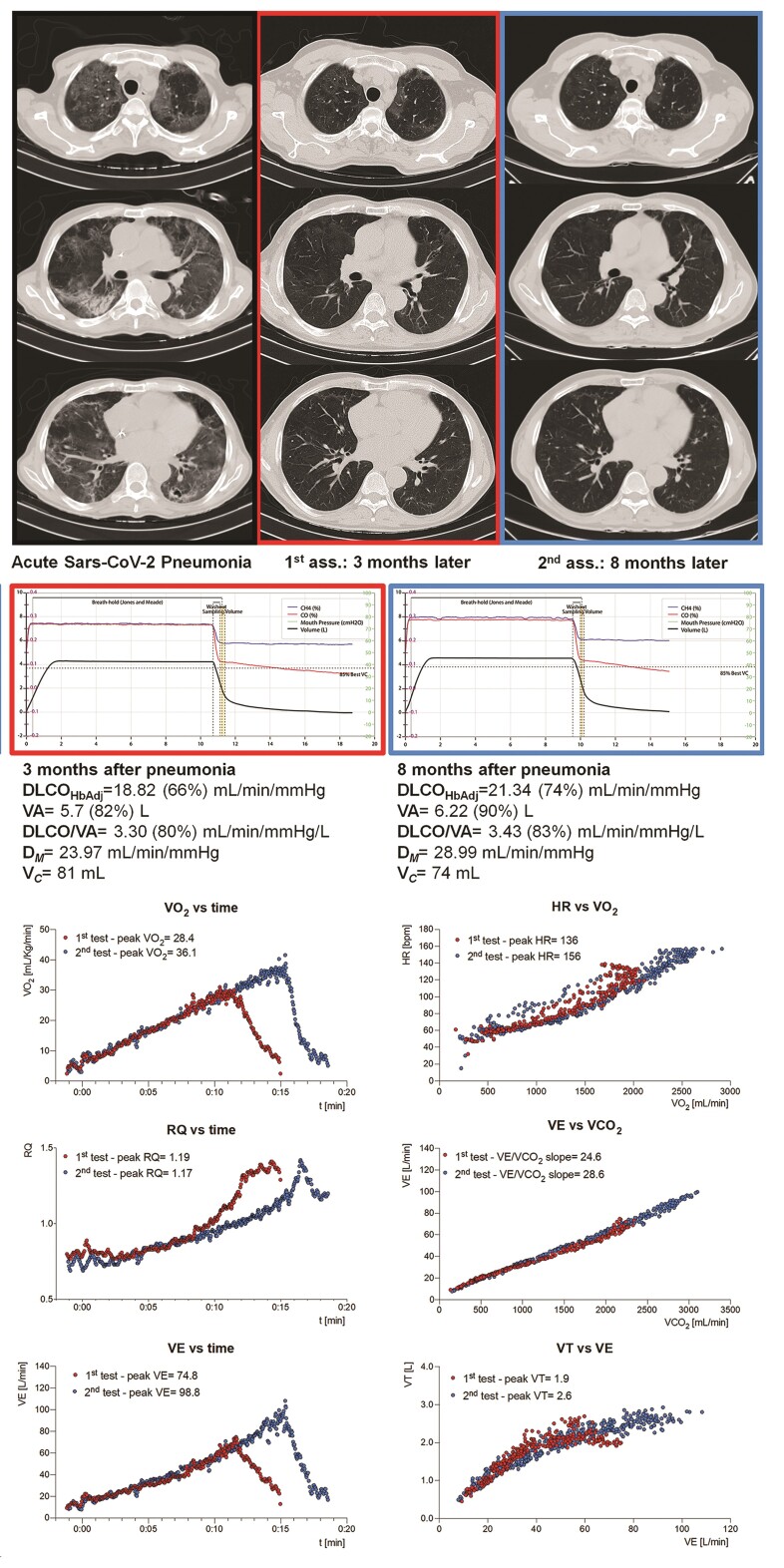
Example of post-Covid-19 assessment with CPET. From top to bottom: CT scan, DLCO and CPET. The upper panel shows the acute lung infection with typical diffuse ground glass attenuation, few cavitary lesions, peripheral consolidations, mild fibrotic lobular distortion and focal, sub-centimetric peripheral thromboembolic lesion involving inferior left lobe, followed by the progressive resolution of lung involvement. The mid-panel shows the initial mild impairment of DLCO (with reduced VA and DM) followed by a global improvement of alveolar diffusion. The lower panel presents the first and second CPET. The peak VO2 significantly improved and was associated with a better chronotropic response and greater ventilatory response. DLCOHbAdj, Haemoglobin-adjusted lung diffusion for CO; VA, alveolar volume; DM, membrane component; Vc, capillary volume; HR, heart rate; RQ, respiratory quotient; VE, minute ventilation; VT, tidal volume.
Comment on
-
Cardiopulmonary assessment prior to returning to high-hazard occupations post-symptomatic COVID-19 infection: a position statement of the Aviation and Occupational Cardiology Task Force of the European Association of Preventive Cardiology.Eur J Prev Cardiol. 2022 Oct 18;29(13):1724-1730. doi: 10.1093/eurjpc/zwac041. Eur J Prev Cardiol. 2022. PMID: 35266533 Free PMC article.
References
-
- Nalbandian A, Sehgal K, Gupta A, Madhavan MV, McGroder C, Stevens JS, Cook JR, Nordvig AS, Shalev D, Sehrawat TS, Ahluwalia N, Bikdeli B, Dietz D, Der-Nigoghossian C, Liyanage-Don N, Rosner GF, Bernstein EJ, Mohan S, Beckley AA, Seres DS, Choueiri TK, Uriel N, Ausiello JC, Accili D, Freedberg DE, Baldwin M, Schwartz A, Brodie D, Garcia CK, Elkind MSV, Connors JM, Bilezikian JP, Landry DW, Wan EY. Post-acute COVID-19 syndrome. Nat Med 2021;27:601–615. - PMC - PubMed
-
- Sudre CH, Murray B, Varsavsky T, Graham MS, Penfold RS, Bowyer RC, Pujol JC, Klaser K, Antonelli M, Canas LS, Molteni E, Modat M, Jorge Cardoso M., May A, Ganesh S, Davies R, Nguyen LH, Drew DA, Astley CM, Joshi AD, Merino J, Tsereteli N, Fall T, Gomez MF, Duncan EL, Menni C, Williams FMK, Franks PW, Chan AT, Wolf J, Ourselin S, Spector T, Steves CJ. Attributes and predictors of long COVID. Nat Med 2021;27:626–631. - PMC - PubMed
-
- Rienks R, Holdsworth D, Davos CH, Halle M, Bennett A, Parati G, Guettler N, Nicol E. Cardiopulmonary assessment prior to returning to high-hazard occupations post symptomatic COVID-19 infection : a position statement of the Aviation and Occupational Cardiology Task Force of the European Association of Preventive Cardiology. Eur J Prev Cardiol 2022 - PMC - PubMed
Publication types
MeSH terms
LinkOut - more resources
Full Text Sources
Medical
