


Risk factors for multisystem inflammatory syndrome in children - A population-based cohort study of over 2 million children
- PMID: 35945929
- PMCID: PMC9353212
- DOI: 10.1016/j.lanepe.2022.100443
Risk factors for multisystem inflammatory syndrome in children - A population-based cohort study of over 2 million children
Abstract
Background: Although severe acute COVID-19 is rare in children, SARS-CoV-2 infection can trigger the novel post-infectious condition multisystem inflammatory syndrome in children (MIS-C). Increased knowledge on risk factors for MIS-C could improve our understanding of the pathogenesis of the condition and better guide targeted public health interventions. The aim of the study was to assess risk factors for MIS-C with the aim to identify vulnerable children.
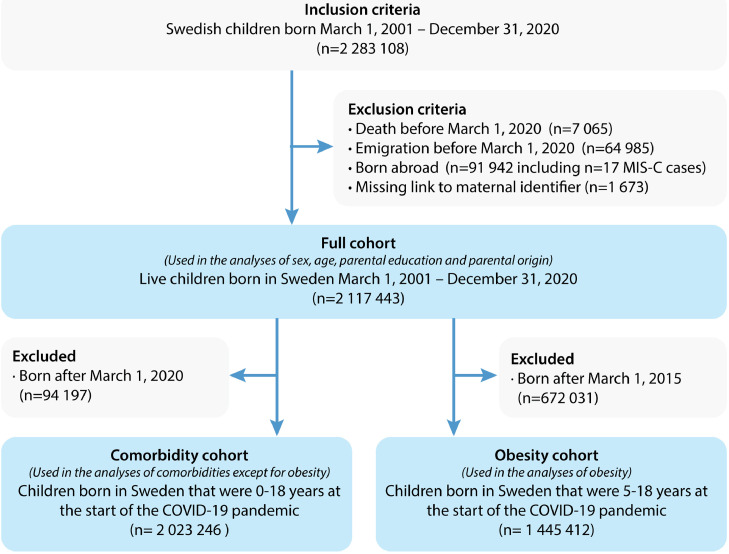
Methods: A register-based cohort study including all children and adolescents <19 years born in Sweden between March 1, 2001- December 31, 2020 was performed. Data on sociodemographic risk factors and comorbidities (sex, age, parental region of birth, parental education, asthma, autoimmune disease, chromosomal anomalies, chronic heart disease, chronic lung disease, obesity, life-limiting condition) were retrieved from national health and population registers. The outcome was MIS-C diagnosis according to the Swedish Pediatric Rheumatology Quality Register during March 1, 2020 - December 8, 2021.Hazard ratios (HRs) and 95% confidence intervals (CIs) were calculated using Cox regression analysis. Incidence rates per 100 000 person-years were calculated assuming a Poisson distribution.
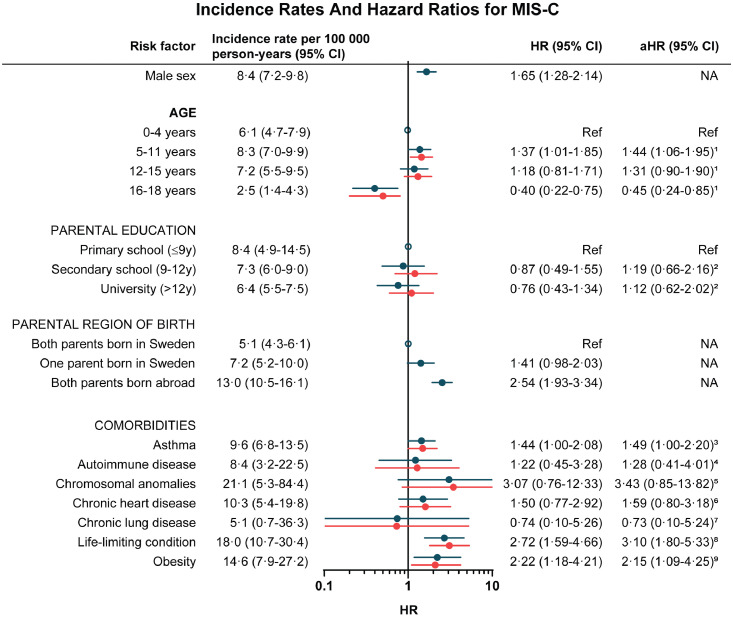
Findings: Among 2 117 443 children included in the study, 253 children developed MIS-C, corresponding to an incidence rate of 6·8 (95% CI: 6·0-7·6) per 100 000 person-years. Male sex (HR 1·65, 95% CI: 1·28-2·14), age 5-11 years (adjusted HR 1·44, 95% CI: 1·06-1·95 using children 0-4 years as reference), foreign-born parents (HR 2·53, 95% CI: 1·93-3·34), asthma (aHR 1·49, 95% CI: 1·00-2·20), obesity (aHR 2·15, 95% CI: 1·09-4·25) and life-limiting conditions (aHR 3·10, 95% CI: 1·80-5·33) were associated with MIS-C. Children 16-18 years had a reduced risk for MIS-C (aHR 0·45, 95% CI: 0·24-0·85).
Interpretation: We report increased risks for MIS-C in children with male sex, age 5-11 years, foreign-born parents, asthma, obesity, and life-limiting condition. Knowing these risk populations might facilitate identification of children with MIS-C and potentially guide targeted public health interventions. Nevertheless, the absolute risks for MIS-C were very low.
Funding: Financial support was provided from the Swedish Research Council (grant no 2018-02640), the Swedish Heart-Lung Foundation (grant no 20210416), the Asthma and Allergy Association, Ake Wiberg foundation, the Samariten Foundation, the Society of Child Care, and Region Stockholm.
Keywords: COVID-19; Cohort study; Epidemiology; MIS-C; Pediatric infectious diseases; Risk Factors.
© 2022 The Author(s).
Conflict of interest statement
Samuel Rhedin reports research grants from Ake Wiberg foundation, the Samariten Foundation, the Society of Child Care and Region Stockholm. Catarina Almqvist reports research grants from the Swedish Research Council, the Swedish Heart-Lung Foundation and the Asthma and Allergy Foundation.
Figures
References
-
- Smith C, Odd D, Harwood R, et al. Deaths in children and young people in England after SARS-CoV-2 infection during the first pandemic year. Nat Med. 2021 - PubMed
-
- WHO . Scientific Brief. 2020. Multisystem inflammatory syndrome in children and adolescents with COVID-19.
LinkOut - more resources
Full Text Sources
Miscellaneous
