. 2022 Oct;26(4):306.
doi: 10.3892/mmr.2022.12822. Epub 2022 Aug 10.

Puerarin attenuates isoproterenol‑induced myocardial hypertrophy via inhibition of the Wnt/β‑catenin signaling pathway

Affiliations

Puerarin attenuates isoproterenol‑induced myocardial hypertrophy via inhibition of the Wnt/β‑catenin signaling pathway

Xiaoying Wang et al. Mol Med Rep. 2022 Oct.

Abstract

Myocardial hypertrophy (MH) is an independent risk factor for cardiovascular disease, which in turn lead to arrhythmia or heart failure. Therefore, attention must be paid to formulation of therapeutic strategies for MH. Puerarin is a key bioactive ingredient isolated from Pueraria genera of plants that is beneficial for the treatment of MH. However, its molecular mechanism of action has not been fully determined. In the present study, 40 µM puerarin was demonstrated to be a safe dose for human AC16 cells using Cell Counting Kit‑8 assay. The protective effects of puerarin against MH were demonstrated in AC16 cells stimulated with isoproterenol (ISO). These effects were characterized by a significant decrease in surface area of cells (assessed using fluorescence staining) and mRNA and protein expression levels of MH‑associated biomarkers, including atrial and brain natriuretic peptide, assessed using reverse transcription‑quantitative PCR and western blotting, as well as β‑myosin heavy chain mRNA expression levels. Mechanistically, western blotting demonstrated that puerarin inhibited activation of the Wnt signaling pathway. Puerarin also significantly decreased phosphorylation of p65; this was mediated via crosstalk between the Wnt and NF‑κB signaling pathways. An inhibitor (Dickkopf‑1) and activator (IM‑12) of the Wnt signaling pathway were used to demonstrate that puerarin‑mediated effects alleviated ISO‑induced MH via the Wnt signaling pathway. The results of the present study demonstrated that puerarin pre‑treatment may be a potential therapeutic strategy for preventing ISO‑induced MH and managing MH in the future.

Keywords: Wnt/β‑catenin signaling pathway; cardiac hypertrophy; isoproterenol; p65; phosphorylation of NF‑κB; puerarin.


Conflict of interest statement

The authors declare that they have no competing interests.

Figures

Figure 1.
Figure 1.
Effect of PU (5–80 µM) on myocardial AC16 cell viability. Association between PU concentration and cell viability. PU, puerarin.
Figure 2.
Figure 2.
Effect of PU on transcription of ANP, BNP and β-MHC. mRNA expression levels of (A) ANP, (B) BNP and (C) β-MHC in ISO- and PU + ISO-treated AC16 cells were semi-quantified using reverse transcription-quantitative PCR. *P<0.05 and **P<0.01. CN, control; ANP, atrial natriuretic peptide; BNP, brain natriuretic peptide; β-MHC, β-myosin heavy chain; ISO, isoproterenol; PU, puerarin.
Figure 3.
Figure 3.
Effect of PU on ANP and BNP protein expression levels. (A) Representative western blotting images of ANP and BNP protein expression. (B) ANP and (C) BNP protein expression levels were semi-quantified using ImageJ. **P<0.01. CN, control; ISO, isoproterenol; PU, puerarin; ANP, atrial natriuretic peptide; BNP, brain natriuretic peptide.
Figure 4.
Figure 4.
Effect of PU on surface area of AC16 cells. Fluorescent images of (A) control and cells treated with (B) ISO or (C) PU and ISO. (D) Cell surface area was quantified using ImageJ software. Magnification, 400×. *P<0.05 and **P<0.01. CN, control; ISO, isoproterenol; PU, puerarin.
Figure 5.
Figure 5.
Effect of PU on expression of components in the Wnt/β-catenin and NF-κB signaling pathways. (A) Representative western blotting images of LRP6, c-Myc, p-GSK3β and GSK3β. (B) Representative western blotting images of p-GSK3β and GSK3β. (C) Representative western blotting images of β-catenin, Wnt5a/b, p-p65 and p65. (D) LRP6, (E) c-Myc, (F) p-GSK3β, (G) GSK3β, (H) β-catenin, (I) Wnt5a/b and (J) p-p65 protein expression levels were semi-quantified. (K) Ratio of p-p65/p-65. The blots were analyzed using ImageJ. *P<0.05 and **P<0.01. CN, control; ISO, isoproterenol; PU, puerarin; LRP6, low-density lipoprotein receptor-related protein 6; p-, phosphorylated; GSK3β, glycogen synthase kinase 3β.
Figure 6.
Figure 6.
Effect of DKK1 on expression of protein in the signaling Wnt pathway. (A) Representative western blotting images of LRP6. (B) Representative western blotting images of β-catenin, Wnt5a/b, c-Myc and ANP. (C) LRP6, (D) β-catenin, (E) c-Myc, (F) Wnt5a/b and (G) ANP protein expression levels were semi-quantified. The blots were analyzed using ImageJ. **P<0.01. DKK1, Dickkopf-1; CN, control; ISO, isoproterenol; LRP6, low-density lipoprotein receptor-related protein 6; ANP, atrial natriuretic peptide.
Figure 7.
Figure 7.
Effect of IM-12 and PU on expression of proteins in the Wnt signaling pathway. (A) Representative western blotting images of LRP6, β-catenin and Wnt5a/b expression. (B) Representative western blotting images of c-Myc and GSK3β expression. (C) LRP6, (D) β-catenin, (E) Wnt5a/b, (F) c-Myc and (G) GSK3β protein expression levels were semi-quantified. Blots were analyzed using ImageJ. *P<0.05 and **P<0.01. CN, control; PU, puerarin; LRP6, low-density lipoprotein receptor-related protein 6; GSK3β, glycogen synthase kinase 3β.
Figure 8.
Figure 8.
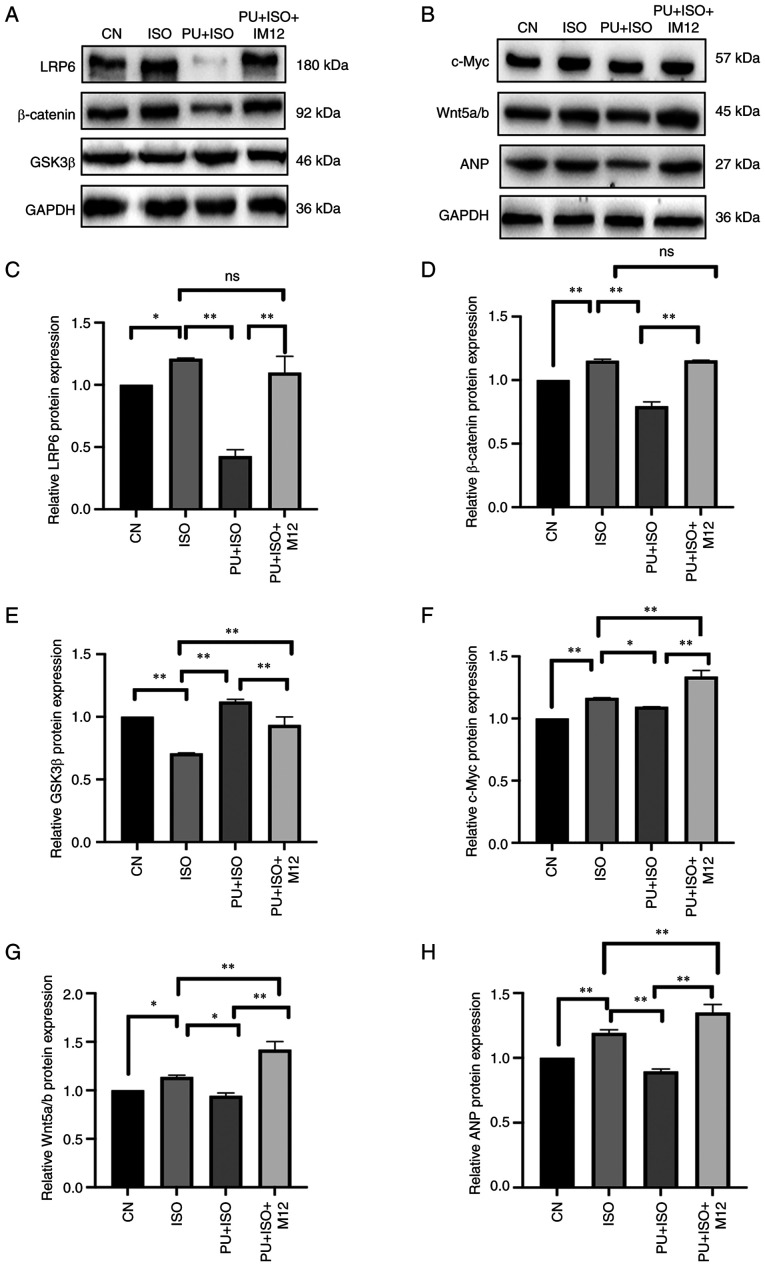
Effect of ISO, PU and IM-12 on expression of proteins in the Wnt signaling pathway. (A) Representative western blotting images of LRP6, GSK3β and β-catenin expression. (B) Representative western blotting images of c-Myc, Wnt5a/b and ANP expression. (C) LRP6, (D) β-catenin, (E) GSK3β, (F) c-Myc, (G) Wnt5a/b and (H) ANP protein expression levels were semi-quantified. The blots were analyzed using ImageJ. *P<0.05 and **P<0.01. CN, control; ISO, isoproterenol; PU, puerarin; LRP6, low-density lipoprotein receptor-related protein 6; GSK3β, glycogen synthase kinase 3β; ANP, atrial natriuretic peptide; ns, not significant.

References

    1. Roth GA, Mensah GA, Johnson CO, Addolorato G, Ammirati E, Baddour LM, Barengo NC, Beaton AZ, Benjamin EJ, Benziger CP, et al. Global burden of cardiovascular diseases and risk factors, 1990–2019: Update from the GBD 2019 study. J Am Coll Cardiol. 2020;76:2982–3021. doi: 10.1016/j.jacc.2020.11.010. - DOI - PMC - PubMed
    1. Cho YS, Moon SC, Ryu KS, Ryu KH. A study on clinical and healthcare recommending service based on cardiovascula disease pattern analysis. Int J Biosci Biotechnol. 2016;8:287–294.
    1. Nalban N, Sangaraju R, Alavala S, Mir SM, Jerald MK, Sistla R. Arbutin attenuates isoproterenol-induced cardiac hypertrophy by inhibiting TLR-4/NF-κB pathway in mice. Cardiovasc Toxicol. 2020;20:235–248. doi: 10.1007/s12012-019-09548-3. - DOI - PubMed
    1. Roth GA, Mensah GA, Fuster V. The global burden of cardiovascular diseases and risks: A compass for global action. J Am Coll Cardiol. 2020;76:2980–2981. doi: 10.1016/j.jacc.2020.11.021. - DOI - PubMed
    1. Oh T, Kim D, Lee S, Won C, Kim S, Yang JS, Yu J, Kim B, Lee J. Machine learning-based diagnosis and risk factor analysis of cardiocerebrovascular disease based on KNHANES. Sci Rep. 2022;12:2250. doi: 10.1038/s41598-022-06333-1. - DOI - PMC - PubMed