. 2023 Mar 14;7(5):845-855.
doi: 10.1182/bloodadvances.2022007536.

Longitudinal expression profiling identifies a poor risk subset of patients with ABC-type diffuse large B-cell lymphoma

Affiliations

Longitudinal expression profiling identifies a poor risk subset of patients with ABC-type diffuse large B-cell lymphoma

Findlay Bewicke-Copley et al. Blood Adv. .

Abstract

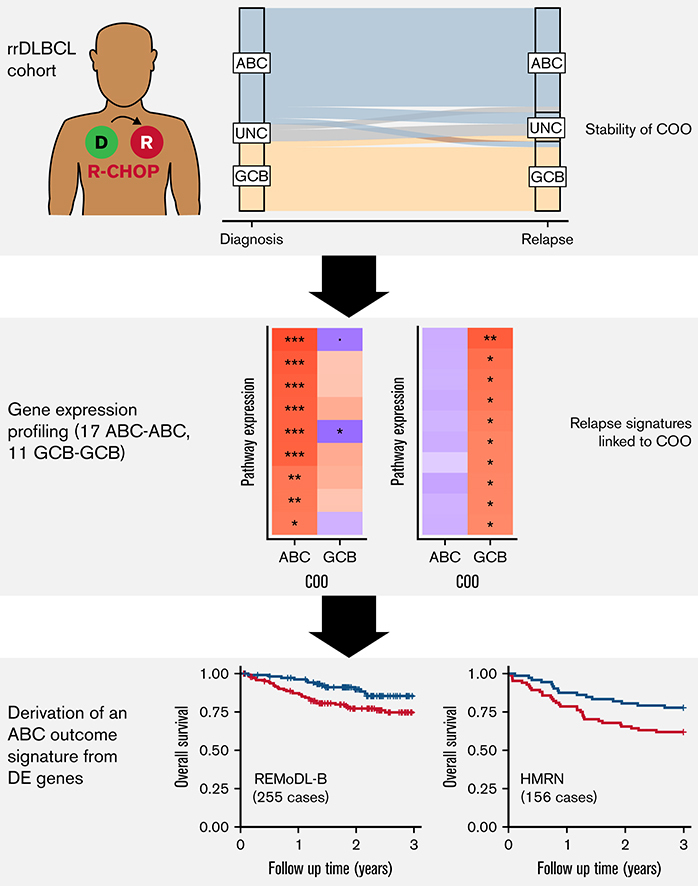
Despite the effectiveness of immuno-chemotherapy, 40% of patients with diffuse large B-cell lymphoma (DLBCL) experience relapse or refractory disease. Longitudinal studies have previously focused on the mutational landscape of relapse but fell short of providing a consistent relapse-specific genetic signature. In our study, we have focused attention on the changes in GEP accompanying DLBCL relapse using archival paired diagnostic/relapse specimens from 38 de novo patients with DLBCL. COO remained stable from diagnosis to relapse in 80% of patients, with only a single patient showing COO switching from activated B-cell-like (ABC) to germinal center B-cell-like (GCB). Analysis of the transcriptomic changes that occur following relapse suggest ABC and GCB relapses are mediated via different mechanisms. We developed a 30-gene discriminator for ABC-DLBCLs derived from relapse-associated genes that defined clinically distinct high- and low-risk subgroups in ABC-DLBCLs at diagnosis in datasets comprising both population-based and clinical trial cohorts. This signature also identified a population of <60-year-old patients with superior PFS and OS treated with ibrutinib-R-CHOP as part of the PHOENIX trial. Altogether this new signature adds to the existing toolkit of putative genetic predictors now available in DLBCL that can be readily assessed as part of prospective clinical trials.


Conflict of interest statement

Conflict-of-interest disclosure: J.F. has provided consultancy and received funding from Epizyme. K.K. is an employee and shareholder of Roche. D.W.S. and L.M.R. have IP rights to the Lymph2Cx assay. D.W.S. has provided consultancy to AbbVie, AstraZeneca, Celgene, Janssen, and Incyte, and has received research funding from Janssen, NanoString Technology, and Roche/Genentech.

Figures
None
Graphical abstract
Figure 1.
Figure 1.
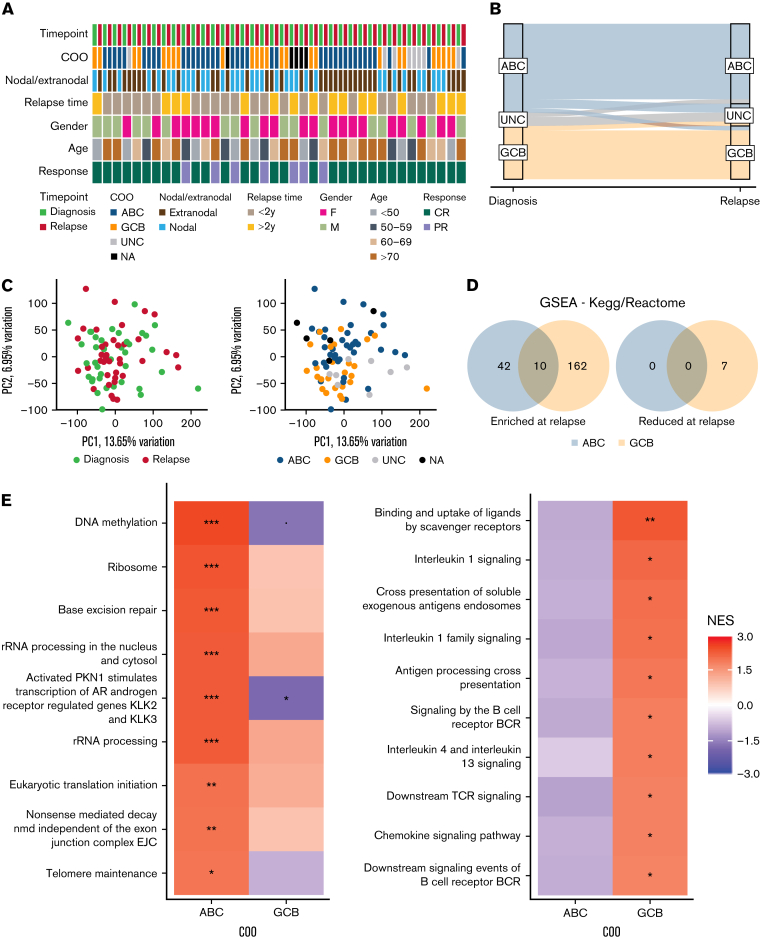
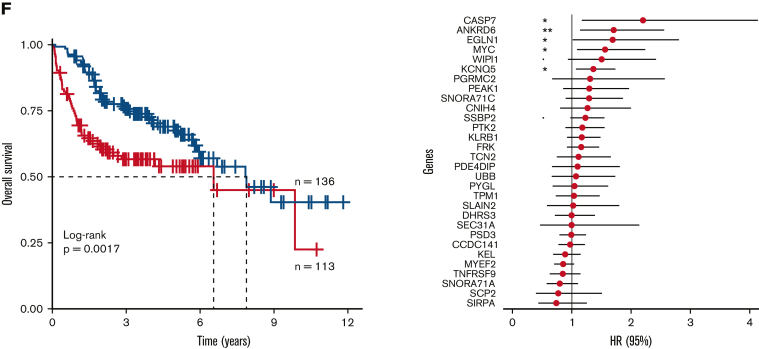
Gene expression profiles of paired diagnosis and relapse diffuse large B-cell lymphoma (DLBCL) biopsies. (A) Thirty-eight patients who underwent relapse were included in the study; the clinical features of these patients are shown. (B) COO remained stable in the majority of cases. Gene expression profiling was carried out using an Ion AmpliSeq Transcriptome Human Gene Expression Kit. (C) Principal component analysis carried out on these samples suggested poor separation based on timepoint, with a greater degree of separation observed in the COO. Diagnosis = green; relapse = red; ABC = blue; GCB = orange; UNC = gray; NA = black. (D) Differential gene expression was carried out separately for the ABC and GCB cohorts and GSEA was performed, with the number of genes sets dysregulated (false discovery rate < = 0.1) at relapse are shown. (E) Heatmaps of normalized enrichment score for examples of the dysregulated gene sets are shown. A 30-gene panel capable of stratifying ABC–DLBCL patients from a training cohort into 2 risk groups with different overall survival was discovered using PAM (F). Red = high risk, blue = low risk; ∗∗p < = 0.01, ∗p < = 0.05, p < = 0.1. COO, cell of origin; ABC, activated B-cell–like; UNC, unclassified; GBC, germinal center B-cell–like; NA, not applicable; CR, complete response; PR, partial response; GSEA, gene set enrichment analysis.
Figure 1.
Figure 1.
Gene expression profiles of paired diagnosis and relapse diffuse large B-cell lymphoma (DLBCL) biopsies. (A) Thirty-eight patients who underwent relapse were included in the study; the clinical features of these patients are shown. (B) COO remained stable in the majority of cases. Gene expression profiling was carried out using an Ion AmpliSeq Transcriptome Human Gene Expression Kit. (C) Principal component analysis carried out on these samples suggested poor separation based on timepoint, with a greater degree of separation observed in the COO. Diagnosis = green; relapse = red; ABC = blue; GCB = orange; UNC = gray; NA = black. (D) Differential gene expression was carried out separately for the ABC and GCB cohorts and GSEA was performed, with the number of genes sets dysregulated (false discovery rate < = 0.1) at relapse are shown. (E) Heatmaps of normalized enrichment score for examples of the dysregulated gene sets are shown. A 30-gene panel capable of stratifying ABC–DLBCL patients from a training cohort into 2 risk groups with different overall survival was discovered using PAM (F). Red = high risk, blue = low risk; ∗∗p < = 0.01, ∗p < = 0.05, p < = 0.1. COO, cell of origin; ABC, activated B-cell–like; UNC, unclassified; GBC, germinal center B-cell–like; NA, not applicable; CR, complete response; PR, partial response; GSEA, gene set enrichment analysis.
Figure 2.
Figure 2.
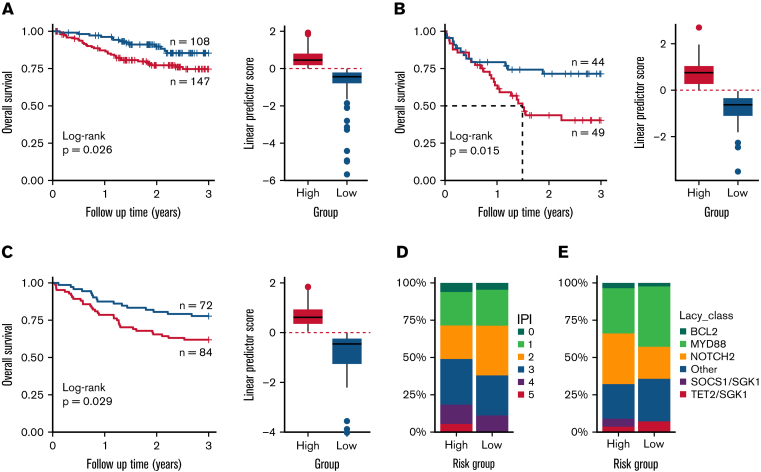
Validation of 30-gene risk model for ABC–DLBCL (activated B-cell–like diffuse large B-cell lymphoma) in population and clinical trial cohorts. The risk model was tested with survival restricted to 3 years. (A) The 30-gene signature distinguished high- and low-risk groups in the REMoDL-B clinical trial, (B) the R-CHOP arm of the Lymphoma/Leukemia Molecular Profiling Project (LLMPP) 2008 cohort, and (C) the Haematological Malignancy Research Network (HMRN) population study: red = high risk, blue = low risk. (D) Comparison of International Prognostic Index (IPI) scores and the risk groups defined using the linear predictor in the REMoDL-B cohort. (E) Comparison of genetic subcategories described by Lacy et al with risk groups defined using the linear predictor in the HMRN cohort. Of the 156 ABC cases in the HMRN data, the genomic subgroups were available for 98 cases.
Figure 3.
Figure 3.
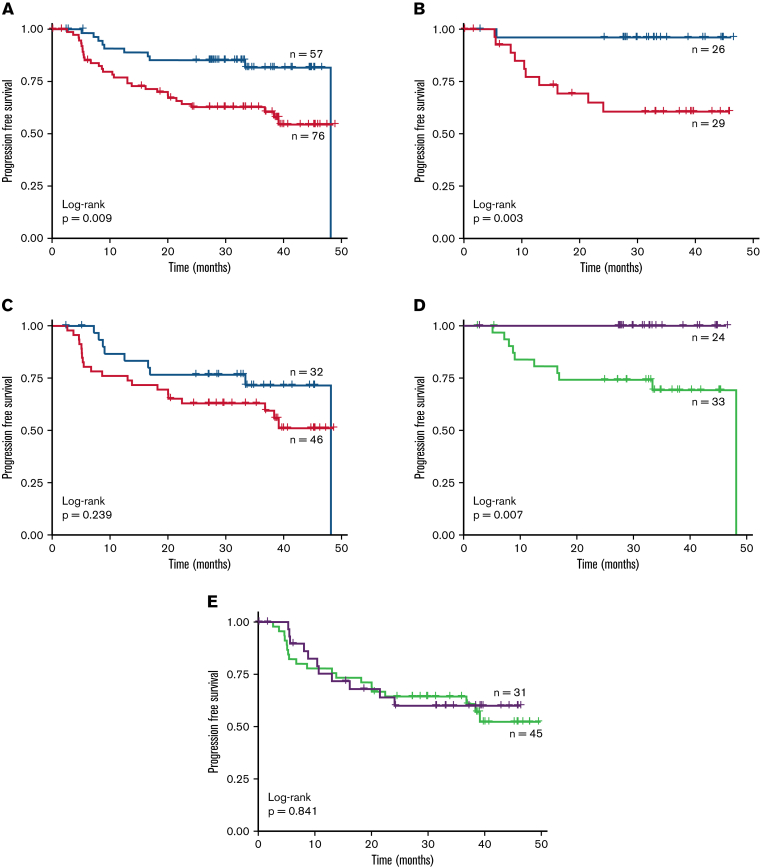
Prognostic ability of the linear predictor in the PHOENIX trial cohort. The gene expression profiling (GEP) data from the activated B-cell–like (ABC) patients < 60 years old in the PHOENIX trial were used to generate linear scores for each patient. These scores were then used to stratify the patients into high- and low-risk cohorts. Kaplan–Meier plots of the progression free survival (PFS) rate of these patient subgroups is shown. (A) Both treatment arms combined; only patients designated as ABC by GEP. The PFS rate of these subgroups was also examined in each arm separately: (B) ibrutinib and (C) placebo. Red = high risk, blue = low risk. Finally, the effect of the drugs on PFS within the subgroups was assessed: (D) low risk and (E) high risk. Green = R-CHOP + placebo; purple = R-CHOP + ibrutinib.

References

    1. Coiffier B, Lepage E, Brière J, et al. CHOP chemotherapy plus rituximab compared with CHOP alone in elderly patients with diffuse large-B-cell lymphoma. N Engl J Med. 2002;346(4):235–242. - PubMed
    1. Rovira J, Valera A, Colomo L, et al. Prognosis of patients with diffuse large B cell lymphoma not reaching complete response or relapsing after frontline chemotherapy or immunochemotherapy. Ann Hematol. 2015;94(5):803–812. - PMC - PubMed
    1. Sha C, Barrans S, Cucco F, et al. Molecular high-grade B-cell lymphoma: defining a poor-risk group that requires different approaches to therapy. J Clin Oncol. 2019;37(3):202–212. - PMC - PubMed
    1. Ma Z, Niu J, Cao Y, et al. Clinical significance of ‘double-hit’ and ‘double-expression’ lymphomas. J Clin Pathol. 2019 jclinpath-2019-206199. - PubMed
    1. Liu Y, Barta SK. Diffuse large B-cell lymphoma: 2019 update on diagnosis, risk stratification, and treatment. Am J Hematol. 2019;94(5):604–616. - PubMed

Publication types

MeSH terms