


Quantifying the benefits of remission duration in focal and segmental glomerulosclerosis
- PMID: 35948275
- PMCID: PMC10064837
- DOI: 10.1093/ndt/gfac238
Quantifying the benefits of remission duration in focal and segmental glomerulosclerosis
Abstract
Background: Although the clinical benefit of obtaining a remission in proteinuria in nephrotic patients with focal segmental glomerulosclerosis (FSGS) is recognized, the long-term value of maintaining it and the impact of relapses on outcome are not well described.
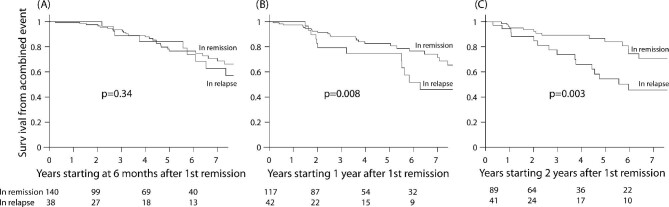
Methods: We examined the impact of remissions and relapses on either a 50% decline in kidney function or end-stage kidney disease (combined event) using time-dependent and landmark analyses in a retrospective study of all patients from the Toronto Glomerulonephritis Registry with biopsy-proven FSGS, established nephrotic-range proteinuria and at least one remission.
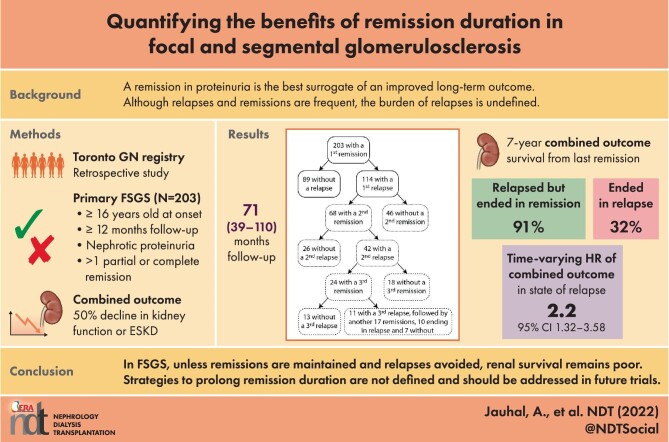
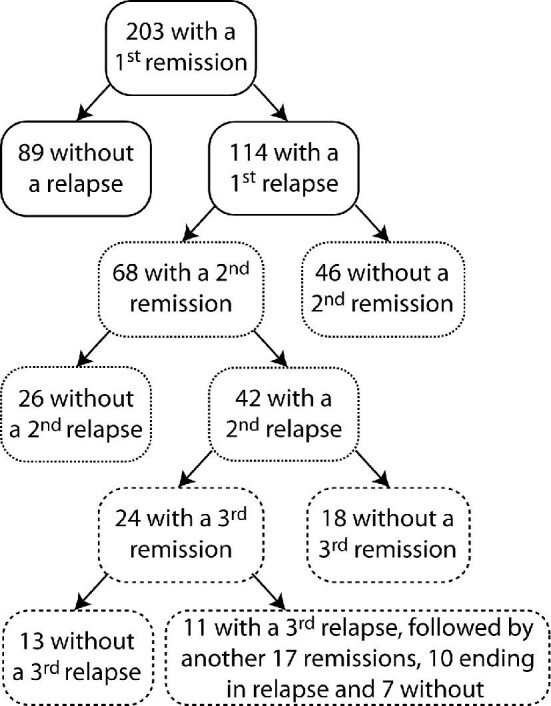
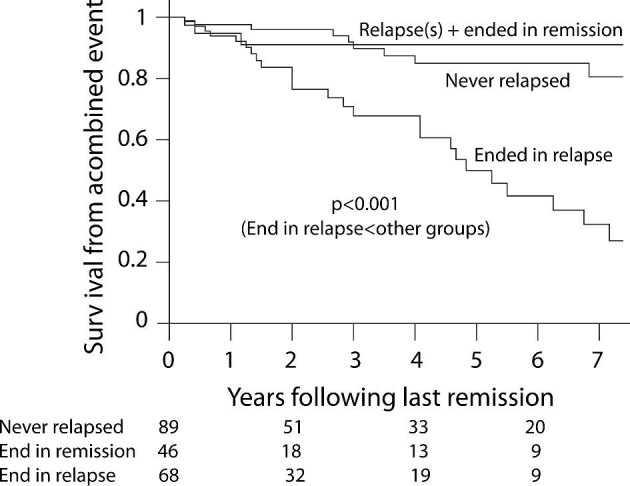
Results: In the 203 FSGS individuals with a remission, 89 never relapsed and 114 experienced at least one relapse. The first recurrence was often followed by a repeating pattern of remission and relapse. The 10-year survival from a combined event was 15% higher in those with no relapse versus those with any relapse. This smaller than anticipated difference was related to the favourable outcome in individuals whose relapses quickly remitted. Relapsers who ultimately ended in remission (n = 46) versus in relapse (n = 68) experienced a 91% and 32% 7-year event survival (P < .001), respectively. Using time-varying survival analyses that considered all periods of remission and relapse in every patient and adjusting for each period's initial estimated glomerular filtration rate, the state of relapse was associated with a 2.17 (95% confidence interval 1.32-3.58; P = .002) greater risk of experiencing a combined event even in this FSGS remission cohort.
Conclusion: In FSGS, unless remissions are maintained and relapses avoided, long-term renal survival remains poor. Treatment strategies addressing remission duration remain poorly defined and should be an essential question in future trials.
Keywords: FSGS; landmark analyses; relapse; remission; time-dependent survival analyses.
© The Author(s) 2022. Published by Oxford University Press on behalf of the ERA.
Conflict of interest statement
A.J., S.T., D.N. and B.H. have no disclosures to report. D.C. has been on scientific advisory boards or received honoraria or consulting fees from Calliditas, Chinook, Novartis, Forsee, Alnylam, Alexion, Genetech, Aurinia, Dimerix and Vera. M.B. has received honoraria from Natera for genetic testing in renal disease. H.R. has received consulting fees or honoraria for lectures from Calliditas, Novartis, Chinook, Travere and Omeros. M.H. has received grants or consulting fees from Calliditas, Pfizer, Ionis, Genentech, GlaxoSmithKline and Alnylam. Part of this material was published in abstract form for the World Congress of Nephrology in Montreal, Canada in April 2021.
Figures
References
-
- Sim JJ, Batech M, Hever Aet al. Distribution of biopsy-proven presumed primary glomerulonephropathies in 2000–2011 among a racially and ethnically diverse US population. Am J Kidney Dis 2016;68:533–44. - PubMed
-
- Kitiyakara C, Eggers P, Kopp JB.. Twenty-one-year trend in ESRD due to focal segmental glomerulosclerosis in the United States. Am J Kidney Dis 2004;44:815–25. Available from: http://www.ajkd.org/article/S0272638604010819/fulltext. - PubMed
-
- Cattran DC, Reich HN, Beanlands HJet al. The impact of sex in primary glomerulonephritis. Nephrol Dial Transplant 2008;23:2247–53. Available from: https://academic.oup.com/ndt/article/23/7/2247/1858573. - PubMed
-
- D'Agati VD, Kaskel FJ, FalkRJ.. Focal segmental glomerulosclerosis. N Engl J Med 2011;365:2398–411. - PubMed
-
- Yao T, Udwan K, John Ret al. Integration of genetic testing and pathology for the diagnosis of adults with FSGS. Clin J Am Soc Nephrol 2019;14:213–23. Available from: https://pubmed.ncbi.nlm.nih.gov/30647093/. - PMC - PubMed
