


The influence of routine and leisure family activities on the ability of young Asian Americans to maintain a healthy lifestyle: findings from a nationwide survey
- PMID: 35948698
- PMCID: PMC9365227
- DOI: 10.1007/s10865-022-00352-z
The influence of routine and leisure family activities on the ability of young Asian Americans to maintain a healthy lifestyle: findings from a nationwide survey
Abstract
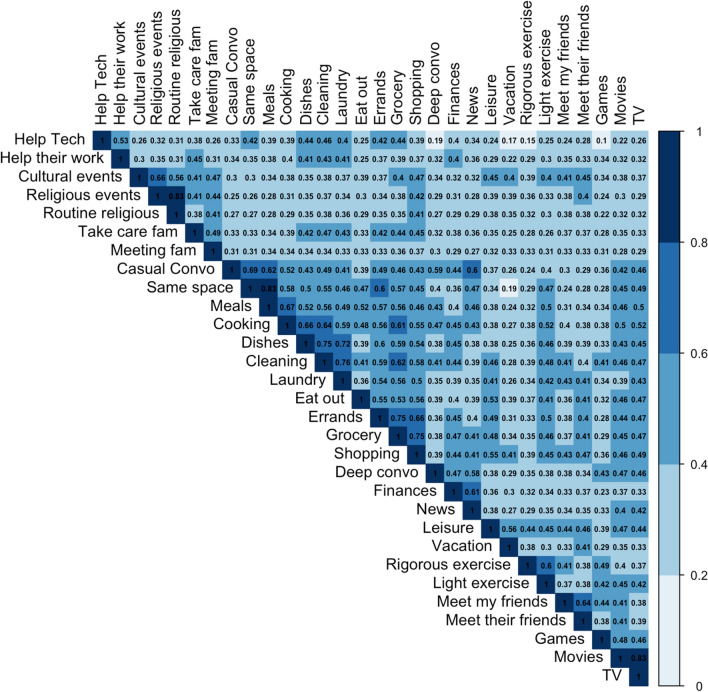
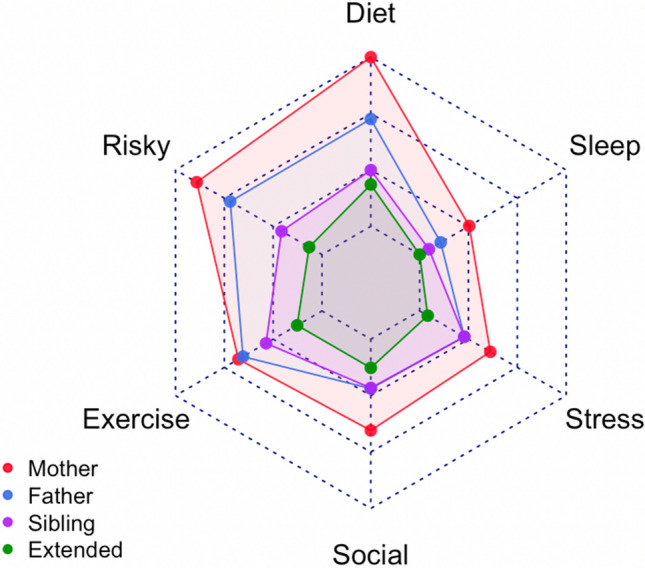
Family is uniquely influential in the health of young Asian Americans (AAs), yet little is known on the impact of specific shared family activities. This study explores different types and frequencies of AA young adult shared family activities on perceived familial influence on the ability to maintain a healthy lifestyle (diet, physical activity, sleep, social relationships, stress, and risky substances). A nationwide sample of 18-35-year-old AAs was surveyed in March 2021 on a list of 30 shared family activities with mothers, fathers, siblings, or extended family. Overall, 984 unique family relationships reported by 616 young AAs were analyzed. Confirmatory factor analysis synthesized a reliable two-factor (routine, leisure activities) 10-item Shared Activities with Family (SAF) scale. Mothers were most influential (mean 3.25, SD = 1.14), although shared activities among South Asians or with extended family were most associated with changes in perceived influence. Routine shared activities were more strongly associated with perceived influence on sleep, diet, and risky substances, while leisure shared activities were more associated with influence on developing healthy social relationships. Family-based, dyadic interventions for young AAs may incorporate shared activities (both routine and leisure) to promote healthy behaviors, although further research to explore mechanisms and directionality of influence is needed to inform action.
Keywords: Asian American; Family; Leisure; Lifestyle; Multigenerational; Parents; Routine.
© 2022. The Author(s), under exclusive licence to Springer Science+Business Media, LLC, part of Springer Nature.
Conflict of interest statement
None to declare.
Figures

References
-
- Aburto MJ, Romero D, Rezende LFM, Sanchez ZM, Bolados CC, Guzmán-Habinger J, Rios M, Suárez-Reyes M, Marques A, Drenowatz C, Cristi-Montero C, Ferrari G. Prevalence and co-occurrence of lifestyle risk factors for non-communicable diseases according to sociodemographic characteristics among adults Chilean residents. Scientific Reports. 2021;11(1):21702. doi: 10.1038/s41598-021-01167-9. - DOI - PMC - PubMed
-
- Ali SH, Foreman J, Capasso A, Jones AM, Tozan Y, DiClemente RJ. Social media as a recruitment platform for a nationwide online survey of COVID-19 knowledge, beliefs, and practices in the United States: Methodology and feasibility analysis. BMC Medical Research Methodology. 2020;20(1):116. doi: 10.1186/s12874-020-01011-0. - DOI - PMC - PubMed
-
- Ali SH, Gupta S, Tariq M, Penikalapati R, Vasquez-Lopez X, Auer S, Hanif C, Parekh N, Merdjanoff AA, DiClemente RJ. Mapping drivers of second-generation South Asian American eating behaviors using a novel integration of qualitative and social network analysis methods. Ecology of Food and Nutrition. 2022 doi: 10.1080/03670244.2022a.2056166. - DOI - PubMed
Publication types
MeSH terms
Grants and funding
LinkOut - more resources
Full Text Sources
