. 2022 Aug 11;22(1):877.
doi: 10.1186/s12885-022-09975-6.

Inflammatory biomarkers and risk of breast cancer among young women in Latin America: a case-control study

Collaborators, Affiliations

Inflammatory biomarkers and risk of breast cancer among young women in Latin America: a case-control study

Emma Fontvieille et al. BMC Cancer. .

Abstract

Background: Breast cancer incidence is increasing rapidly in Latin America, with a higher proportion of cases among young women than in developed countries. Studies have linked inflammation to breast cancer development, but data is limited in premenopausal women, especially in Latin America.

Methods: We investigated the associations between serum biomarkers of chronic inflammation (interleukin (IL)-6, IL-8, IL-10, tumor necrosis factor-α (TNF-α), interferon-γ (IFN-γ), leptin, adiponectin) and risk of premenopausal breast cancer among 453 cases and 453 matched, population-based controls from Chile, Colombia, Costa Rica, and Mexico. Odds ratios (OR) were estimated using conditional logistic regression models. Analyses were stratified by size and hormonal receptor status of the tumors.

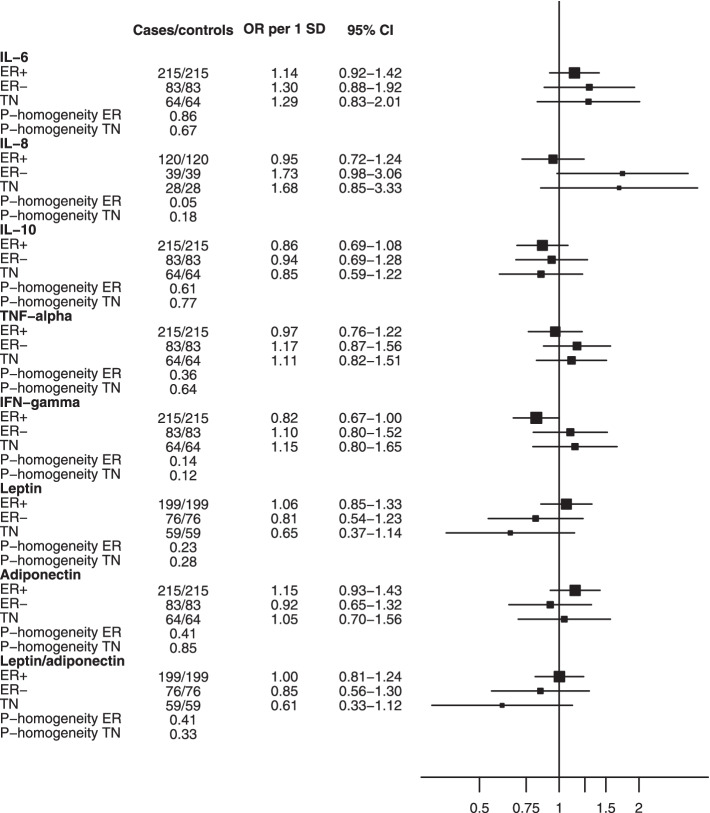
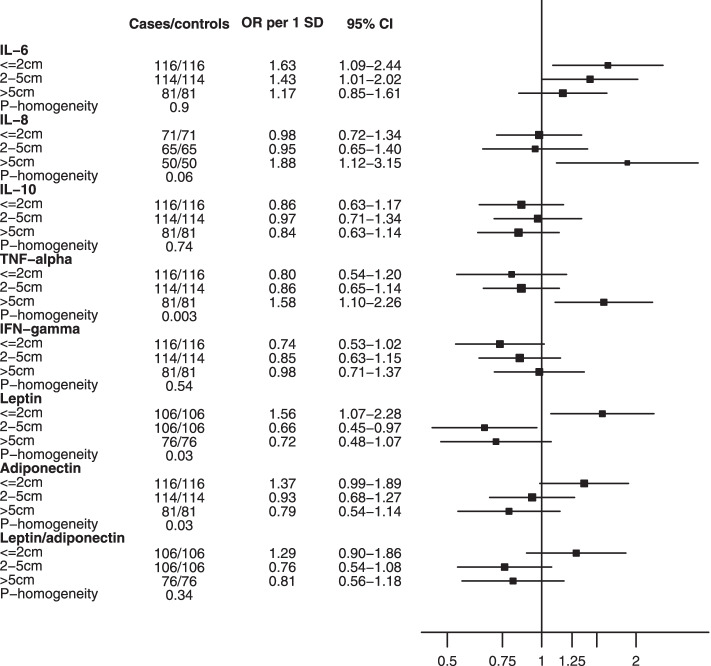
Results: IL-6 (ORper standard deviation (SD) = 1.33 (1.11-1.60)) and TNF-α (ORper SD = 1.32 (1.11-1.58)) were positively associated with breast cancer risk in fully adjusted models. Evidence of heterogeneity by estrogen receptor (ER) status was observed for IL-8 (P-homogeneity = 0.05), with a positive association in ER-negative tumors only. IL-8 (P-homogeneity = 0.06) and TNF-α (P-homogeneity = 0.003) were positively associated with risk in the largest tumors, while for leptin (P-homogeneity = 0.003) a positive association was observed for the smallest tumors only.

Conclusions: The results of this study support the implication of chronic inflammation in breast cancer risk in young women in Latin America. Largest studies of prospective design are needed to confirm these findings in premenopausal women.

Keywords: Biomarkers; Breast cancer; Inflammation; Latin America; Premenopausal.


Conflict of interest statement

The authors declare that they have no competing interests.

Figures
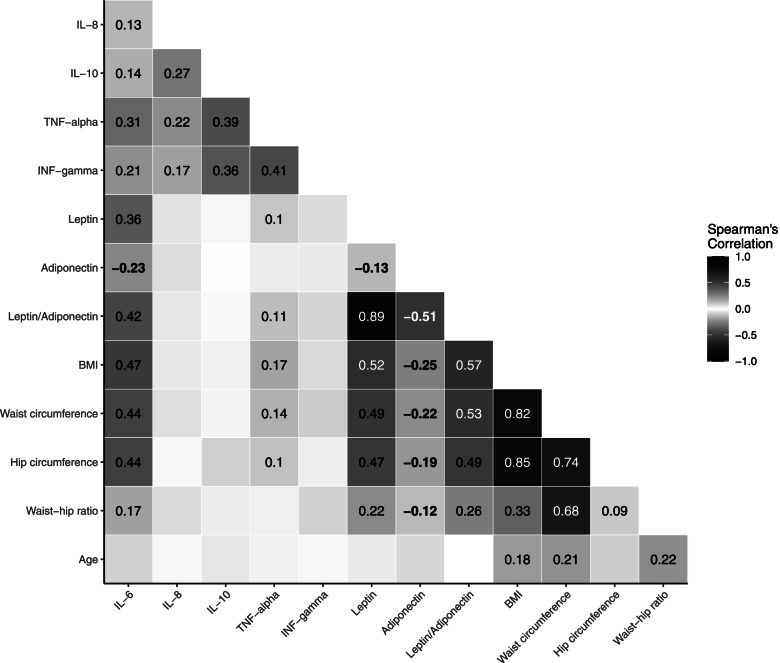
Fig. 1
Fig. 1
Age-adjusted Spearman correlation coefficients between concentrations* of inflammation markers and anthropometric measures among control participants. *Concentration of biomarkers as residual of log-transformed variables regressed on analytical batch. Only statistically significant correlations (P-value < 0.05) are shown. Bold indicate negative correlation coefficients. Abbreviations: BMI body mass index; IFN interferon, IL interleukin; OR odds ratio; SD standard deviation; TNF tumor necrosis factor
Fig. 2
Fig. 2
Associations between inflammatory biomarkers and breast cancer, by estrogen receptor status and in triple-negative tumors. Odds ratios are per standard deviation increase in residuals of log-transformed biomarker concentration regressed on analytical batch, estimated from conditional logistic regression models adjusted for BMI. P-homogeneity ER compares estrogen receptor negative and positive tumors. P-homogeneity TN compares triple-negative and non-triple-negative tumors. Abbreviations: BMI body mass index, CI confidence interval, ER + estrogen receptor positive, ER- estrogen receptor negative, IFN interferon, IL interleukin, OR odds ratio, SD standard deviation, TN triple negative, TNF tumor necrosis factor
Fig. 3
Fig. 3
Associations between inflammatory biomarkers and breast cancer risk, by tumor size. Odds ratios are per standard deviation increase in residuals of log-transformed biomarker concentration regressed on analytical batch, estimated from conditional logistic regression models adjusted for BMI. Abbreviations: BMI Body mass index, CI Confidence interval, IFN Interferon, IL Interleukin, OR Odds ratio, SD Standard deviation, TN Triple negative, TNF Tumor necrosis factor.

References

    1. Sung H, Ferlay J, Siegel RL, Laversanne M, Soerjomataram I, Jemal A, Bray F. Global Cancer Statistics 2020: GLOBOCAN Estimates of Incidence and Mortality Worldwide for 36 Cancers in 185 Countries. CA Cancer J Clin. 2021;71(3):209–249. doi: 10.3322/caac.21660. - DOI - PubMed
    1. Franco-Marina F, Lopez-Carrillo L, Keating NL, Arreola-Ornelas H, Marie Knaul F. Breast cancer age at diagnosis patterns in four Latin American Populations: A comparison with North American countries. Cancer Epidemiol. 2015;39(6):831–837. doi: 10.1016/j.canep.2015.10.004. - DOI - PubMed
    1. Amadou A, Torres-Mejia G, Hainaut P, Romieu I. Breast cancer in Latin America: global burden, patterns, and risk factors. Salud Publica Mex. 2014;56(5):547–554. doi: 10.21149/spm.v56i5.7379. - DOI - PubMed
    1. World Cancer Research Fund International / American Institute for Cancer Research: Continuous Update Project Report: Diet, Nutrition and Physical activity and Breast Cancer. In.; 2017. https://www.wcrf.org/wpcontent/uploads/2021/02/Breast-cancer-report.pdf.
    1. Amadou A, Torres Mejia G, Fagherazzi G, Ortega C, Angeles-Llerenas A, Chajes V, Biessy C, Sighoko D, Hainaut P, Romieu I. Anthropometry, silhouette trajectory, and risk of breast cancer in Mexican women. Am J Prev Med. 2014;46(3 Suppl 1):S52–64. doi: 10.1016/j.amepre.2013.10.024. - DOI - PubMed