


Platelet-derived immuno-inflammatory indices show best performance in early prediction of COVID-19 progression
- PMID: 35949002
- PMCID: PMC9459290
- DOI: 10.1002/jcla.24652
Platelet-derived immuno-inflammatory indices show best performance in early prediction of COVID-19 progression
Abstract
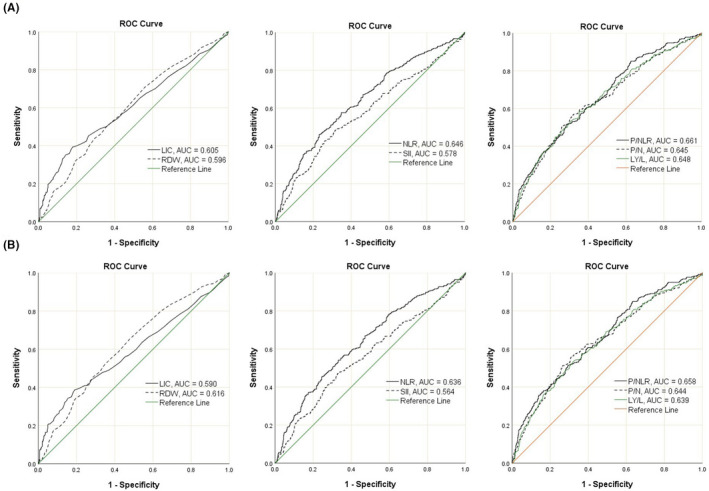
Background: Coronavirus disease 2019 (COVID-19) profoundly affects the immune and hematopoietic systems with various degrees of reactive changes in the blood cell counts. Immuno-inflammatory indices are considered a simple and effective tool in the prediction of COVID-19 outcomes. We aimed to evaluate and compare the usefulness of leukocyte and platelet counts-based immuno-inflammatory indices on admission to hospital in predicting COVID-19 progression and mortality.
Methods: A total of 945 patients were enrolled. In addition to blood cell counts, we assessed hemogram-derived immuno-inflammatory indices in relation to COVID-19 progression and death. The indices were tested by analysis of variance, receiver operating characteristic curve analysis, and binomial logistic regressions.
Results: Patients with severe COVID-19 had significantly higher counts of neutrophils, eosinophils, and large immature cells (LIC), while decreased counts of platelets and monocytes. Lymphopenia was found in all of the patients, but without significant association with the outcomes. Patients with a LIC count ≥0.265 x 09 /L had 54.7% more odds of having COVID-19 progression. In multivariable analyses, platelets/neutrophil-to-lymphocyte ratio (P/NLR) and platelets-to-neutrophil radio (P/N) were significant independent predictors of COVID-19 progression and mortality. The odds of a poor outcome were two times higher in cases with P/NLR < 43 x 109 /L and P/N < 29 x 109 /L.
Conclusion: Indices that include platelet count in combination with neutrophil and/or lymphocyte counts displayed the best discriminatory ability and prognostic value of COVID-19 outcomes. Additionally, LIC showed promising results in the early identification of severe COVID-19.
Keywords: lymphoid and myeloid progenitor cells; lymphopenia; neutrophils; severe acute respiratory syndrome coronavirus 2; thrombocytopenia.
© 2022 The Authors. Journal of Clinical Laboratory Analysis published by Wiley Periodicals LLC.
Conflict of interest statement
The authors state that there are no conflicts of interest regarding the publication of this article.
Figures
References
-
- Ozdemir A, Kocak SY, Karabela SN, Yılmaz M. Puede el índice de inflamación inmunitaria sistémica al ingreso predecir la mortalidad hospitalaria al ingreso de pacientes con enfermedad renal crónica e infección por SARS‐CoV‐2? [Can systemic immune inflammation index at admission predict in‐hospital mortality in chronic kidney disease patients with SARS‐CoV‐2 infection]. Nefrologia (Engl Ed). 2021. [Forthcoming]. doi: 10.1016/j.nefro.2021.09.001 - DOI
MeSH terms
Grants and funding
LinkOut - more resources
Full Text Sources
Medical
