


More future synergies and less trade-offs between forest ecosystem services with natural climate solutions instead of bioeconomy solutions
- PMID: 35949042
- PMCID: PMC9805065
- DOI: 10.1111/gcb.16364
More future synergies and less trade-offs between forest ecosystem services with natural climate solutions instead of bioeconomy solutions
Abstract
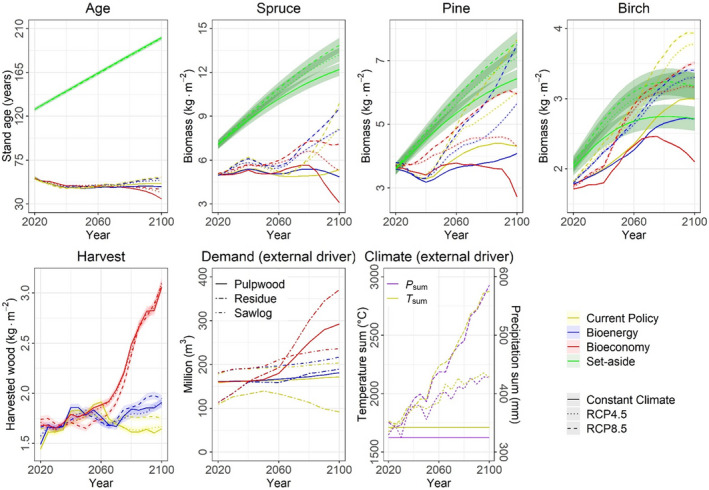
To reach the Paris Agreement, societies need to increase the global terrestrial carbon sink. There are many climate change mitigation solutions (CCMS) for forests, including increasing bioenergy, bioeconomy, and protection. Bioenergy and bioeconomy solutions use climate-smart, intensive management to generate high quantities of bioenergy and bioproducts. Protection of (semi-)natural forests is a major component of "natural climate solution" (NCS) since forests store carbon in standing biomass and soil. Furthermore, protected forests provide more habitat for biodiversity and non-wood ecosystem services (ES). We investigated the impacts of different CCMS and climate scenarios, jointly or in isolation, on future wood ES, non-wood ES, and regulating ES for a major wood provider for the international market. Specifically, we projected future ES given by three CCMS scenarios for Sweden 2020-2100. In the long term, fulfilling the increasing wood demand through bioenergy and bioeconomy solutions will decrease ES multifunctionality, but the increased stand age and wood stocks induced by rising greenhouse gas (GHG) concentrations will partially offset these negative effects. Adopting bioenergy and bioeconomy solutions will have a greater negative impact on ES supply than adopting NCS. Bioenergy or bioeconomy solutions, as well as increasing GHG emissions, will reduce synergies and increase trade-offs in ES. NCS, by contrast, increases the supply of multiple ES in synergy, even transforming current ES trade-offs into future synergies. Moreover, NCS can be considered an adaptation measure to offset negative climate change effects on the future supplies of non-wood ES. In boreal countries around the world, forestry strategies that integrate NCS more deeply are crucial to ensure a synergistic supply of multiple ES.
Keywords: EU biodiversity strategy; EU forest strategy; GLOBIOM; bioeconomy; bioenergy; boreal forest; climate change; ecosystem services; natural climate solutions.
© 2022 The Authors. Global Change Biology published by John Wiley & Sons Ltd.
Conflict of interest statement
There are no potential conflicts of interest.
Figures



References
-
- Alcamo, J. , van Vuuren, D. , Ringler, C. , Cramer, W. , Masui, T. , Alder, J. , & Schulze, K. (2005). Changes in nature's balance sheet: Model‐based estimates of future worldwide ecosystem services. Ecology and Society, 10(2), 27.
-
- Alrahahleh, L. , Ikonen, V. P. , Kilpeläinen, A. , Torssonen, P. , Strandman, H. , Asikainen, A. , Kaurola, J. , Venäläinen, A. , & Peltola, H. (2017). Effects of forest conservation and management on volume growth, harvested amount of timber, carbon stock, and amount of deadwood in Finnish boreal forests under changing climate. Canadian Journal of Forest Research, 47(2), 215–225.
-
- Anderson, R. C. , Loucks, O. L. , & Swain, A. M. (1969). Herbaceous response to canopy cover, light intensity, and throughfall precipitation in coniferous forests. Ecology, 50(2), 255–263.
-
- Augustynczik, A. L. D. , & Yousefpour, R. (2021). Assessing the synergistic value of ecosystem services in European beech forests. Ecosystem Services, 49, 101264.
MeSH terms
Substances
LinkOut - more resources
Full Text Sources
Other Literature Sources
