


Dapsone reduced cuprizone-induced demyelination via targeting Nrf2 and IKB in C57BL/6 mice
- PMID: 35949308
- PMCID: PMC9320209
- DOI: 10.22038/IJBMS.2022.64993.14310
Dapsone reduced cuprizone-induced demyelination via targeting Nrf2 and IKB in C57BL/6 mice
Abstract
Objectives: Multiple Sclerosis (MS) is an inflammatory disorder wherein the myelin of nerve cells in the central nervous system is damaged. In the current study, we assessed the effect of Dapsone (DAP) on the improvement of behavioral dysfunction and preservation of myelin in the cuprizone (CPZ) induced demyelination model via targeting Nrf2 and IKB.
Materials and methods: MS was induced in C57BL/6 mice through diet supplementation of CPZ (0.2%) for 6 weeks, and DAP (12.5 mg/kg/day; IP) was administered for the last 2 weeks of treatment. Pole test and rotarod performance test, LFB and H&E staining, and Immunohistochemistry (IHC) staining of p-Nrf2 and p-IKB were performed. Furthermore, superoxide dismutase (SOD) and nitrite were measured.
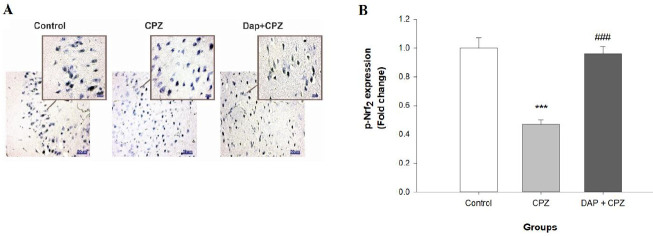
Results: DAP treatment prevented body loss induced by CPZ (P<0.001). Pole test showed that CPZ increased latency time to fall (P<0.0001) but the latency to reach the floor in the DAP-CPZ group was significantly shorter (P<0.0001). Rotarod performance test showed the effect of CPZ in reducing fall time in the CPZ group (P<0.0014); however, DAP significantly increased fall time (P=0.0012). In LFB staining, DAP reduced demyelination induced by CPZ. CPZ significantly decreased p-Nrf2 and elevated p-IKB levels compared with the control group (P<0.0001), but in DAP-treated groups markedly modified these changes (P<0.0001). CPZ increased the brain nitrite levels and reduced SOD activity, but in DAP-treated considerably reversed CPZ-induced changes.
Conclusion: These data support the suggestion that the beneficial properties of DAP on the CPZ-induced demyelination are mediated by targeting Nrf2 and NF-kB pathways.
Keywords: Cuprizone; Dapsone; Multiple sclerosis; NF-kB; Neuroinflammation; Nrf2.
Conflict of interest statement
The authors declare that they have no conflicts of interest.
Figures



References
-
- Noori T, Dehpour AR, Sureda A, Fakhri S, Sobarzo-Sanchez E, Farzaei MH, et al. The role of glycogen synthase kinase 3 beta in multiple sclerosis. Biomed Pharmacother. 2020;132:110874. - PubMed
-
- Giovannoni G, Heales SJ, Silver NC, O’Riordan J, Miller RF, Land JM, et al. Raised serum nitrate and nitrite levels in patients with multiple sclerosis. J Neurol Sci. 1997;145:77–81. - PubMed
-
- Butts BD, Houde C, Mehmet H. Maturation-dependent sensitivity of oligodendrocyte lineage cells to apoptosis: implications for normal development and disease. Cell Death Differ. 2008;15:1178–1186. - PubMed
-
- Mahurkar S, Suppiah V, O’Doherty C. Pharmacogenomics of interferon beta and glatiramer acetate response: a review of the literature. Autoimmun Rev. 2014;13:178–186. - PubMed
-
- Praet J, Guglielmetti C, Berneman Z, Van der Linden A, Ponsaerts P. Cellular and molecular neuropathology of the cuprizone mouse model: clinical relevance for multiple sclerosis. Neurosci Biobehav Rev. 2014;47:485–505. - PubMed
LinkOut - more resources
Full Text Sources