


Under-prescription of medications in older adults according to START criteria: A cross-sectional study in Lebanon
- PMID: 35949679
- PMCID: PMC9358532
- DOI: 10.1002/hsr2.759
Under-prescription of medications in older adults according to START criteria: A cross-sectional study in Lebanon
Abstract
Background and aims: Under-prescription is defined as the exclusion of medications indicated for the treatment of certain conditions without any rationale for not prescribing them. The under-prescription of medications is highly prevalent among older adults (≥65 years) receiving polypharmacy. This study aimed to assess the prevalence of the under-prescription of medications using the Screening Tool to Alert to Right Treatment (START) criteria version 2 and to identify the predictors of having potential prescribing omissions (PPOs).
Methods: This cross-sectional, face-to-face interview study was carried out between September 2021 and February 2022. The study comprised community-dwelling older adults taking at least one medication on a regular basis. The study questionnaire included the patients' demographics, clinical data, and comorbidities. PPOs were identified using the START criteria. The χ 2 test was used to assess the association between under-prescription of medication and the demographic/clinical variables. Multivariable logistic regression was performed to explore factors associated with under-prescription of medications as the dependent variable and taking all variables that showed a p < 0.05 in the bivariate analysis as independent.
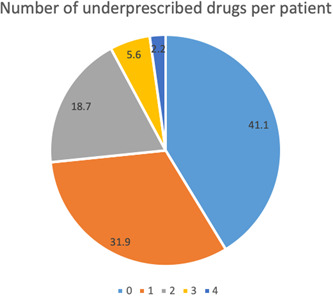
Results: A total of 444 older adults agreed to participate in this study. The mean age of participants was 71 ± 8.6; the majority of them, 305 (68.7%), were men. Polypharmacy was present in 261 patients (58.8%) and underprescribing of medications in 260 patients (58.6%). The highest percentage of under-prescribing of medications was reported with statins in 115 patients (44.2%) followed by aspirin in 93 (35.7%), and angiotensin-converting enzyme inhibitors in 61 (23.4%). The results of the multivariable analysis showed that patients with underprescribed medications had higher odds of polypharmacy (odds ratio [OR]: 2.015, confidence interval [CI] 95% 1.362-2.980, p < 0.001) and higher Charlson Comorbidity Index (OR 2.807, CI 95% 1.463-5.85, p = 0.02).
Conclusion: The present findings highlight that PPOs are highly prevalent among community-dwelling older adults in Lebanon. Multimorbidity and polypharmacy were the identified predictors for under-prescription of medications in this population.
Keywords: START screening tool; elderly; inappropriate prescribing.
© 2022 The Authors. Health Science Reports published by Wiley Periodicals LLC.
Conflict of interest statement
The author declares no conflict of interest.
Figures
References
-
- United Nations . Department of Economics and Social Affairs. Population Dynamics. 2019 Revision of World Population Prospects; 2019. Accessed May 28, 2021. https://population.un.org/wpp/
-
- Bootman JL, Harrison DL, Cox E. The health care cost of drug‐related morbidity and mortality in nursing facilities. Arch Intern Med. 1997;157(18):2089‐2096. - PubMed
-
- Merle L, Laroche ML, Dantoine T, Charmes JP. Predicting and preventing adverse drug reactions in the very old. Drugs Aging. 2005;22(5):375‐92. - PubMed
-
- Kowal P, Dowd JE. Definition of an older person. Proposed Working Definition of an Older Person In Africa for the MDS Project. World Health Organization; 2001.
LinkOut - more resources
Full Text Sources
