


Reducing bacterial adhesion to titanium surfaces using low intensity alternating electrical pulses
- PMID: 35949710
- PMCID: PMC9244958
- DOI: 10.5312/wjo.v13.i6.578
Reducing bacterial adhesion to titanium surfaces using low intensity alternating electrical pulses
Abstract
Background: Orthopedic implant-related infection remains one of the most serious complications after orthopedic surgery. In recent years, there has been an increased scientific interest to improve prevention and treatment strategies. However, many of these strategies have focused on chemical measures.
Aim: To analyze the effect of alternating current electrical fields on bacterial adherence to titanium surfaces.
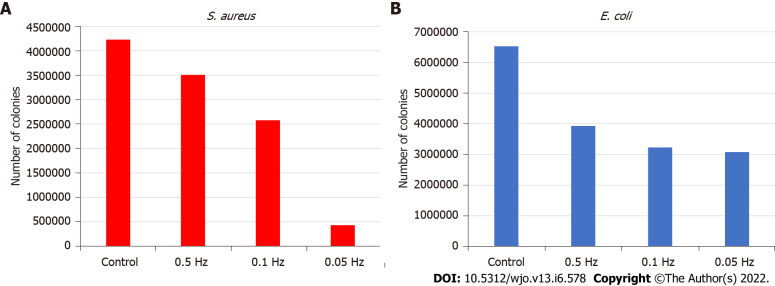
Methods: Staphylococcus aureus (S. aureus) and Escherichia coli (E. coli) were exposed to 6.5 V electrical currents at different frequencies: 0.5 Hz, 0.1 Hz, and 0.05 Hz. After exposure, a bacterial count was then performed and compared to the control model. Other variables registered included the presence of electrocoagulation of the medium, electrode oxidation and/or corrosion, and changes in pH of the medium.
Results: The most effective electrical model for reducing S. aureus adhesion was 6.5 V alternating current at 0.05 Hz achieving a 90% adhesion reduction rate. For E. coli, the 0.05 Hz frequency model also showed the most effective results with a 53% adhesion reduction rate, although these were significantly lower than S. aureus. Notable adhesion reduction rates were observed for S. aureus and E.coli in the studied conditions. However, the presence of electrode oxidation makes us presume these conditions are not optimal for in vivo use.
Conclusion: Although our findings suggest electrical currents may be useful in preventing bacterial adhesion to metal surfaces, further research using other electrical conditions must be examined to consider their use for in vivo trials.
Keywords: Bacterial adhesion; Electrical fields; Metal surfaces; Orthopedic infection; Titanium.
©The Author(s) 2022. Published by Baishideng Publishing Group Inc. All rights reserved.
Conflict of interest statement
Conflict-of-interest statement: Each author certifies that he or she has no commercial associations (e.g., consultancies, stock ownership, equity interest, patent/Licensing arrangements, etc.) that might pose a conflict of interest in connection with the submitted article.
Figures
References
-
- Papakostidis C, Kanakaris NK, Pretel J, Faour O, Morell DJ, Giannoudis PV. Prevalence of complications of open tibial shaft fractures stratified as per the Gustilo-Anderson classification. Injury. 2011;42:1408–1415. - PubMed
-
- Anderson AK, Finkelstein R. A Study of the Electro-Pure Process of Treating Milk. J Dairy Sci. 1919;2:374–406.
LinkOut - more resources
Full Text Sources
Molecular Biology Databases
