


Understanding patient preferences in anti-VEGF treatment options for age-related macular degeneration
- PMID: 35951503
- PMCID: PMC9371344
- DOI: 10.1371/journal.pone.0272301
Understanding patient preferences in anti-VEGF treatment options for age-related macular degeneration
Abstract
Purpose: (1) To investigate the relative importance of convenience (consultation frequency and injection frequency) against treatment outcomes (visual and anatomical outcomes) and out-of-pocket medical costs via a discrete choice experiment (DCE), and (2) to investigate how patient characteristics affect patient treatment preferences.
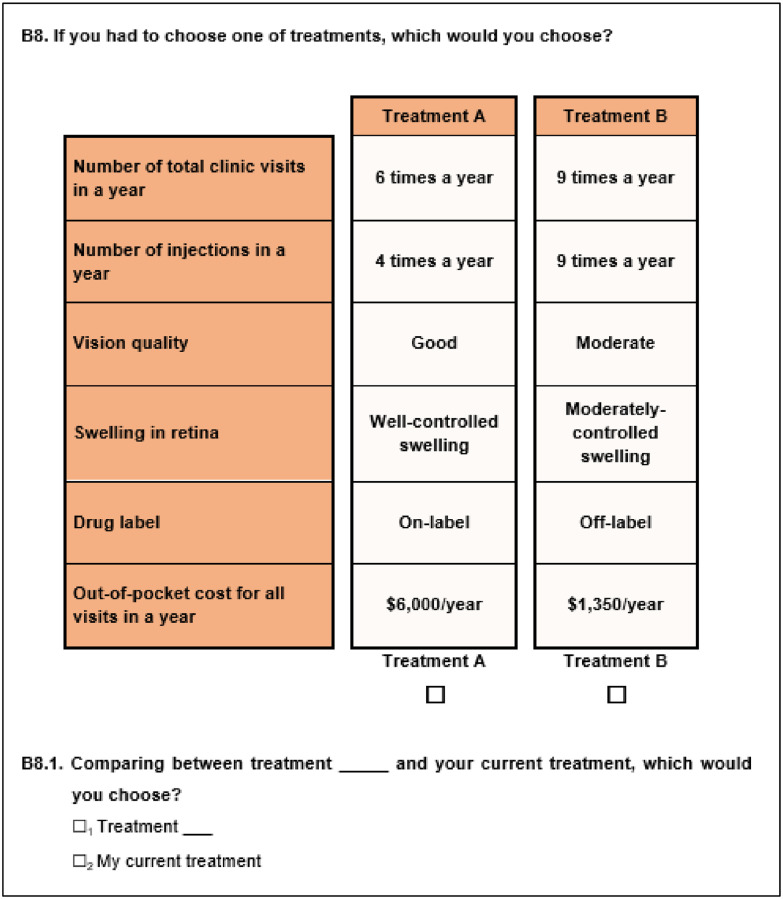
Methods: Eligibility criteria were: (1) receiving a neovascular age-related macular degeneration (nAMD) diagnosis; (2) receiving anti-VEGF treatment; (3) being ≥21 years old, and (4) being able to speak and understand English/Mandarin. Patients were presented with eight choice tasks and asked to choose between their current treatment and two hypothetical treatments that varied by six attributes: number of clinic visits in a year, number of injections in a year, vision quality, control of swelling in retina, drug labelling and out-of-pocket cost.
Results: This analysis involved 180 patients. Based on latent class logistic regressions, vision quality was the most important attribute (34%) followed by cost (24%). The frequency of total clinic visits (15%) was the third most-important attribute, closely followed by labelling (12%) and control of retina swelling (11%). Injection frequency was the least important attribute (4%).
Conclusions: Vision quality was the most important attribute followed by the out-of-pocket costs. Given the same outcomes, patients preferred treatment regimens which require fewer total clinic visits. In comparison, injection frequency alone did not influence patient preferences. With increasing treatment options for nAMD, understanding patients' preferences can help clinicians in selecting agents and treatment regimen most preferred for each patient, which may lead to improved long-term adherence and outcomes.
Conflict of interest statement
Semra Ozdemir, Anna Cheng Sim Tan, Kelvin Yi Chong Teo, Tien Yin Wong and Gemmy Chui Ming Cheung reported receiving grants from Novartis during the conduct of the study. Issac Horng Khit Too is being employed by Novartis. Eric Finkelstein and Jia Jia Lee reported no conflict of interest. This does not alter our adherence to PLOS ONE policies on sharing data and materials.
Figures


References
-
- Steinmetz JD, Bourne RR, Briant PS, Flaxman SR, Taylor HR, Jonas JB, et al. Causes of blindness and vision impairment in 2020 and trends over 30 years, and prevalence of avoidable blindness in relation to VISION 2020: the Right to Sight: an analysis for the Global Burden of Disease Study. The Lancet Global Health. 2021;9(2):e144–e60. doi: 10.1016/S2214-109X(20)30489-7 - DOI - PMC - PubMed
-
- Mitchell P, Liew G, Gopinath B, Wong TY. Age-related macular degeneration. The Lancet. 2018;392(10153):1147–59. - PubMed
Publication types
MeSH terms
Substances
LinkOut - more resources
Full Text Sources
Medical
