. 2022 Aug 12;21(1):52.
doi: 10.1186/s12937-022-00804-x.

Breakfast in the Philippines: food and diet quality as analyzed from the 2018 Expanded National Nutrition Survey

Affiliations

Breakfast in the Philippines: food and diet quality as analyzed from the 2018 Expanded National Nutrition Survey

Imelda Angeles-Agdeppa et al. Nutr J. .

Abstract

Background: The quality of foods taken during breakfast could contribute in shaping diet quality. This study determined the regularity of breakfast consumption and breakfast quality based on the food, energy and nutrient intakes of Filipinos.

Materials and methods: Data from the 2018 Expanded National Nutrition Survey (ENNS) was extracted for analysis. There were 63,655 individuals comprising about 14,013 school-aged children (6-12 years old), 9,082 adolescents (13-18 years old), 32,255 adults (19-59 years old), and 8,305 elderly (60 years old and above). Two-day non-consecutive 24-h food recalls were used to measure food and nutrient intakes. Diet quality was measured using Nutrient-Rich Food Index (NRF) 9.3. The sample was stratified by age group and NRF9.3 tertiles.

Results and findings: Results showed that 96 - 98% Filipinos across age groups were consuming breakfast. Children age 6-12 years have the highest NRF9.3 average score (417), followed by the elderly (347), adolescents (340), and adults (330). These scores were very low in comparison with the maximum possible NRF score which is 900. The essential nutrient intakes of respondents were significantly higher among those with the healthiest breakfast diet (Tertile 3) compared to those with the poorest breakfast diet (Tertile 1). However, participants in the healthiest breakfast diet did not meet 20% of the recommendations for calcium, fiber, vitamin C, and potassium.

Conclusion and recommendations: This study revealed that majority of the population are regular breakfast consumers. However, the breakfast consumed regularly by Filipinos were found to be nutritionally inadequate. And even those classified under Tertile 3 which were assumed as having a better quality of breakfast were still found to have nutrient inadequacies. Thus, the study suggests that Filipinos must consume a healthy breakfast by including nutrient-dense foods such as fruits, vegetables, whole grains, fresh meat, and milk to provide at least 20-25% of the daily energy and nutrient intakes.

Keywords: Breakfast; Diet quality; NRF 9.3; Nutrient intake; Philippines.


Conflict of interest statement

The authors declare no conflict of interest. To ensure scientific integrity of the research, a Governing Principles document outlining rights and duties in this research was signed by all researchers or their institutions.

Figures
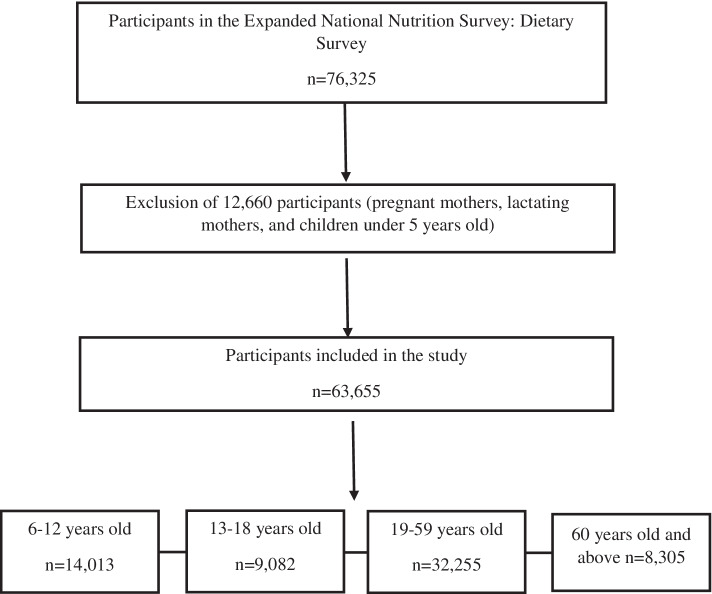
Fig. 1
Fig. 1
Flowchart for sample selection. Data from the 2018 ENNS was used with a starting sample size of 76,325. After exclusion of participants and checking of completeness of the data, final participants included in the study is 63,655
Fig. 2
Fig. 2
Energy and nutrient contribution of breakfast to the total daily intake. *PUFA stands for polyunsaturated fatty acids, MUFA stands for Monounsaturated fatty acids, SatFat stands for saturated fatty acids. The 20% cutoff is indicated by a vertical line with color green bar
Fig. 3
Fig. 3
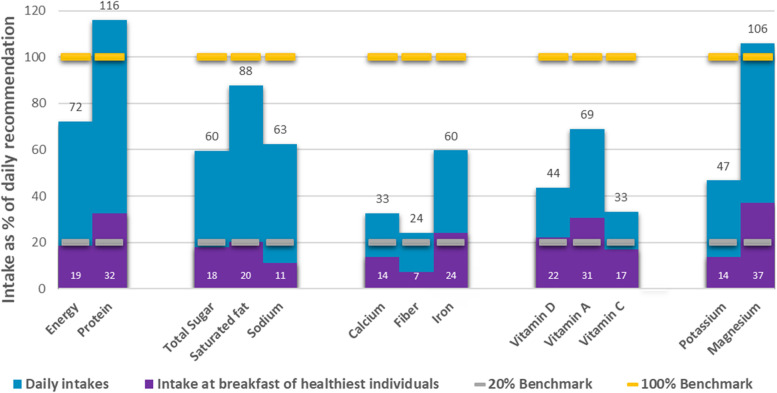
Contribution of breakfast to the daily recommendation among children NOTE: Daily Intake = All meals; Intake at breakfast of healthiest individuals = intake from breakfast only of participants that were categorized in Tertile 3 which represent the individual with healthiest diet; 20% Benchmark = 20% of the recommended intake of each nutrient (based on the PDRI), 100% Benchmark = the total recommendation per day
Fig. 4
Fig. 4
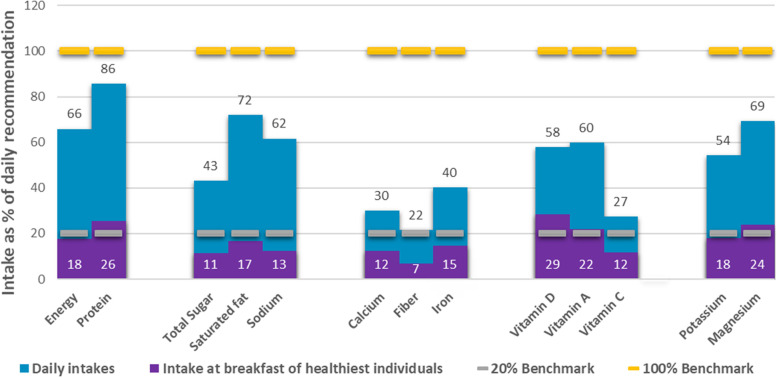
Contribution of breakfast to the daily recommendation among adolescent. NOTE: Daily Intake = 24 h food recall (All meals); Intake at breakfast of healthiest individuals = intake from breakfast only of participants that were categorized in Tertile 3 which represent the individual with healthiest diet; 20% Benchmark = 20% of the recommended intake of each nutrient (based on the PDRI), 100% Benchmark = the total recommendation per day
Fig. 5
Fig. 5
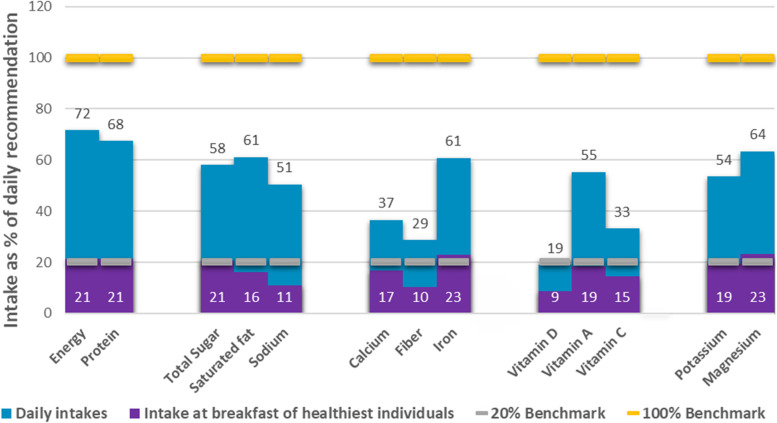
Contribution of breakfast to the daily recommendation among adults. NOTE: Daily Intake = 24 h food recall (All meals); Intake at breakfast of healthiest individuals = intake from breakfast only of participants that were categorized in Tertile 3 which represent the individual with healthiest diet; 20% Benchmark = 20% of the recommended intake of each nutrient (based on the PDRI), 100% Benchmark = the total recommendation per day
Fig. 6
Fig. 6
Contribution of breakfast to the daily recommendation among elderly. NOTE: Daily Intake = 24 h food recall (All meals); Intake at breakfast of healthiest individuals = intake from breakfast only of participants that were categorized in Tertile 3 which represent the individual with healthiest diet; 20% Benchmark = 20% of the recommended intake of each nutrient (based on the PDRI), 100% Benchmark = the total recommendation per day

References

    1. St-Onge MP, Ard J, Baskin ML, Chiuve SE, Johnson HM, Kris-Etherton P, et al. Meal timing and frequency: implications for cardiovascular disease prevention: a scientific statement from the American Heart Association. Circulation. 2017;135(9):e96–e121. - PMC - PubMed
    1. Porter S. Healthy Breakfast Food Fact Sheet | British Dietetic Association (BDA). Available from: https://www.bda.uk.com/resource/healthy-breakfast.html. Cited 2020 Sep 20.
    1. Cooper SB, Bandelow S, Nevill ME. Breakfast consumption and cognitive function in adolescent schoolchildren. Physiol Behav. 2011;103:431. doi: 10.1016/j.physbeh.2011.03.018. - DOI - PubMed
    1. Sievert K, Hussain SM, Page MJ, Wang Y, Hughes HJ, Malek M, et al. Effect of breakfast on weight and energy intake: systematic review and meta-analysis of randomised controlled trials. BMJ. 2019;364:l42. doi: 10.1136/bmj.l42. - DOI - PMC - PubMed
    1. Rabinovitz HR, Boaz M, Ganz T, Jakubowicz D, Matas Z, Madar Z, et al. Big breakfast rich in protein and fat improves glycemic control in type 2 diabetics. Obesity. 2014;22:E46. doi: 10.1002/oby.20654. - DOI - PubMed

LinkOut - more resources