


Gastrointestinal Stromal Tumors (GIST): A Population-Based Study Using the SEER Database, including Management and Recent Advances in Targeted Therapy
- PMID: 35954353
- PMCID: PMC9367571
- DOI: 10.3390/cancers14153689
Gastrointestinal Stromal Tumors (GIST): A Population-Based Study Using the SEER Database, including Management and Recent Advances in Targeted Therapy
Abstract
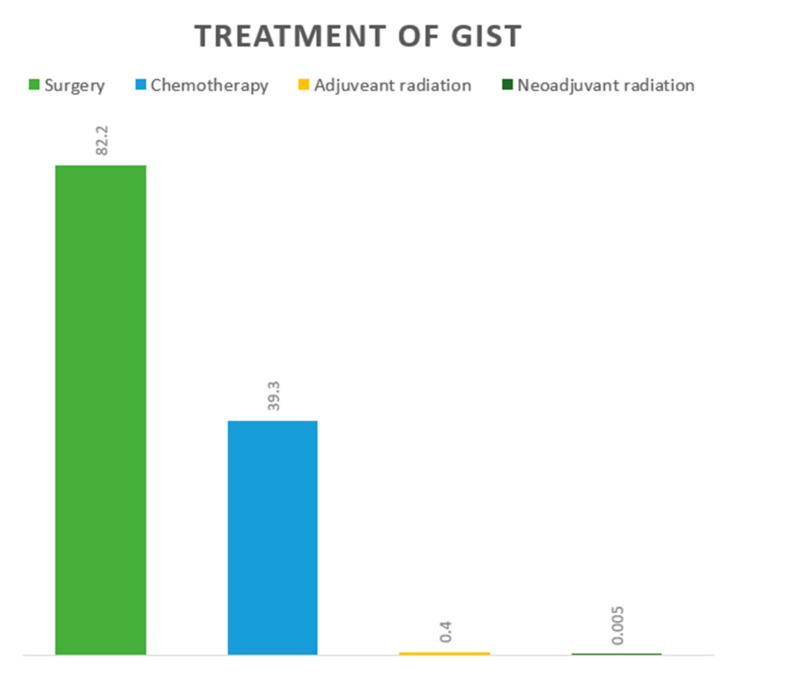
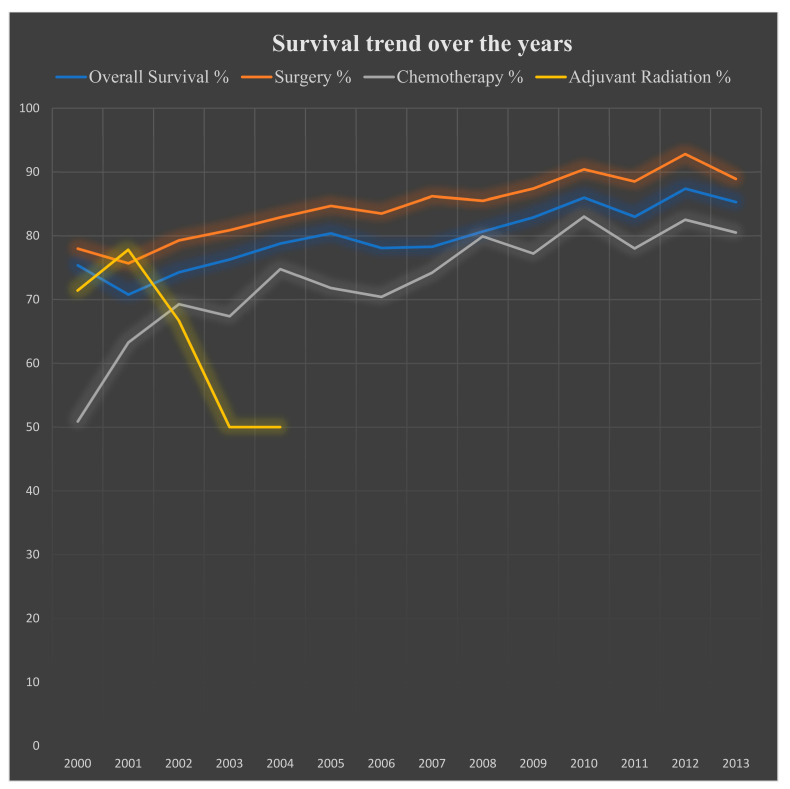
Introduction: Gastrointestinal stromal tumors (GISTs) are the most common mesenchymal neoplasm of the gastrointestinal (GI) system. Most GISTs originate from the interstitial cells of Cajal (ICC), the pacemaker cell situated between the circular and longitudinal layers of the muscularis propria along the GI tract. In this population-based study using the SEER database, we sought to identify demographic, clinical, and pathologic factors that affect the prognosis and survival of patients with this neoplasm. Molecular genetic advances, current management guidelines, and advances in targeted therapy are discussed. Methods: Demographic and clinical data from GIST patients were retrieved from the SEER research plus database for the period 2000−2018. Statistical analysis was performed with IBM SPSS® v20.2 software using the Chi-square test, paired t-test, multivariate analysis, and Kaplan−Meier functions. Results: A total of 10,833 patients with GIST were identified. Most patients were between 60−74 years of age: 40%, Caucasian: 68%, and the male to female ratio was 1.1:1. The most common primary tumor sites were stomach: 63%, small intestine: 30%, rectum: 3%, and esophagus: 0.7%. When reported, the grade of differentiation was well: 38%, moderately: 32%, undifferentiated: 19%, poorly: 12%. The size of most tumors ranged between 6−10 cm: 36% and they were treated by surgical intervention: 82% and/or chemotherapy/targeted therapy: 39%. The stage was localized: 66%, advanced: 19%, and regional: 15%. The 5-year survival was 74% (95% confidence interval (95% CI) = 72.6−74.7), and the 5-year cause-specific survival 82% (95% CI = 80.7−82.6). The 5-year cause-specific survival by treatment included surgery at 86% (95% CI = 85.4−87.3), chemotherapy/targeted therapy with or without surgery at 77% (95% CI = 75.7−78.9), and radiation at 75% (95% CI = 74.5−80). On multivariable analysis tumor size > 5 cm, poorly and undifferentiated grade, age > 60, and distant metastases at presentation were associated with worse overall survival. Conclusion: GISTs comprise 1−2% of malignancies of the GI tract, usually affect male Caucasians between the ages of 60 and 74 years, most tumors occur in the stomach and small intestine, and are usually >5 cm, but still localized, at the time of diagnosis. Most tumors receive multimodality surgical and chemotherapy/targeted therapy treatment, with a 5-year overall survival of 74% and cause-specific survival of 82%. GIST patients would benefit from enrollment in large clinical trials to establish better therapy guidelines for unresectable, treatment-refractory, and recurrent tumors.
Keywords: DOG1; GIST; SDH; SEER; metastatic GISTs; molecular; spindle cell tumors.
Conflict of interest statement
The authors declare no conflict of interest.
Figures
References
-
- Moch H. Soft Tissue and Bone Tumours, WHO Classification of Tumours. 5th ed. Volume 3. IARC; Lyon, France: 2020. [(accessed on 20 May 2022)]. (Series/Who-Classification-Of-Tumours/Soft-Tissue-And-Bone-Tumours-2020). Available online: https://publications.iarc.fr/Book-And-Report.
-
- Nilsson B., Bümming P., Meis-Kindblom J.M., Odén A., Dortok A., Gustavsson B., Sablinska K., Kindblom L.G. Gastrointestinal stromal tumors: The incidence, prevalence, clinical course, and prognostication in the preimatinib mesylate era—A population-based study in western Sweden. Cancer. 2005;103:821–829. doi: 10.1002/cncr.20862. - DOI - PubMed
LinkOut - more resources
Full Text Sources
