


Tumor Progression and Treatment-Related Changes: Radiological Diagnosis Challenges for the Evaluation of Post Treated Glioma
- PMID: 35954435
- PMCID: PMC9367286
- DOI: 10.3390/cancers14153771
Tumor Progression and Treatment-Related Changes: Radiological Diagnosis Challenges for the Evaluation of Post Treated Glioma
Abstract
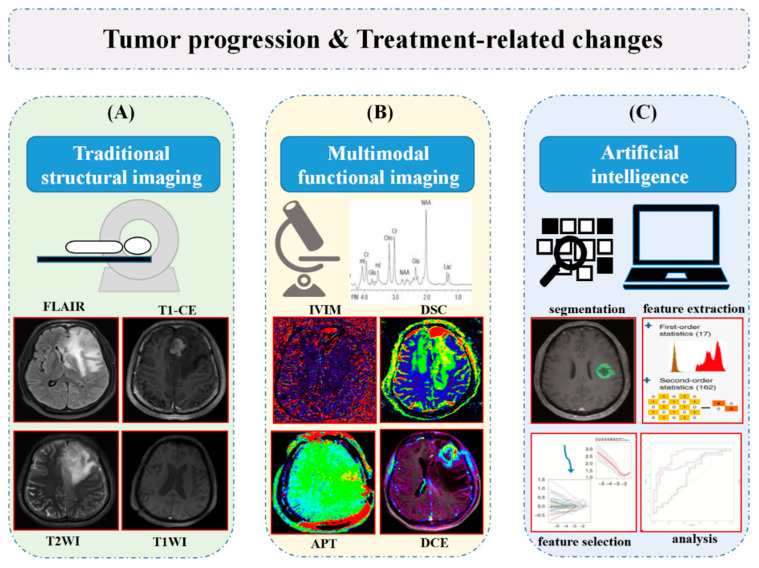
As the most common neuro-epithelial tumors of the central nervous system in adults, gliomas are highly malignant and easy to recurrence, with a dismal prognosis. Imaging studies are indispensable for tracking tumor progression (TP) or treatment-related changes (TRCs). During follow-up, distinguishing TRCs from TP in treated patients with gliomas remains challenging as both share similar clinical symptoms and morphological imaging characteristics (with new and/or increasing enhancing mass lesions) and fulfill criteria for progression. Thus, the early identification of TP and TRCs is of great significance for determining the prognosis and treatment. Histopathological biopsy is currently the gold standard for TP and TRC diagnosis. However, the invasive nature of this technique limits its clinical application. Advanced imaging methods (e.g., diffusion magnetic resonance imaging (MRI), perfusion MRI, magnetic resonance spectroscopy (MRS), positron emission tomography (PET), amide proton transfer (APT) and artificial intelligence (AI)) provide a non-invasive and feasible technical means for identifying of TP and TRCs at an early stage, which have recently become research hotspots. This paper reviews the current research on using the abovementioned advanced imaging methods to identify TP and TRCs of gliomas. First, the review focuses on the pathological changes of the two entities to establish a theoretical basis for imaging identification. Then, it elaborates on the application of different imaging techniques and AI in identifying the two entities. Finally, the current challenges and future prospects of these techniques and methods are discussed.
Keywords: artificial intelligence; glioma; magnetic resonance imaging; positron emission tomography; treatment-related changes; tumor progression.
Conflict of interest statement
The authors declare no conflict of interest.
Figures
References
-
- Delgado-López P.D., Riñones-Mena E., Corrales-García E.M. Treatment-related changes in glioblastoma: A review on the controversies in response assessment criteria and the concepts of true progression, pseudoprogression, pseudoresponse and radionecrosis. Clin. Transl. Oncol. 2017;20:939–953. doi: 10.1007/s12094-017-1816-x. - DOI - PubMed
-
- Zikou A., Sioka C., Alexiou G.A., Fotopoulos A., Voulgaris S., Argyropoulou M.I. Radiation Necrosis, Pseudoprogression, Pseudoresponse, and Tumor Recurrence: Imaging Challenges for the Evaluation of Treated Gliomas. Contrast Media Mol. Imaging. 2018;2018:6828396. doi: 10.1155/2018/6828396. - DOI - PMC - PubMed
Publication types
LinkOut - more resources
Full Text Sources
Research Materials
