


The Role of Immunohistochemistry Markers in Endometrial Cancer with Mismatch Repair Deficiency: A Systematic Review
- PMID: 35954447
- PMCID: PMC9367287
- DOI: 10.3390/cancers14153783
The Role of Immunohistochemistry Markers in Endometrial Cancer with Mismatch Repair Deficiency: A Systematic Review
Abstract
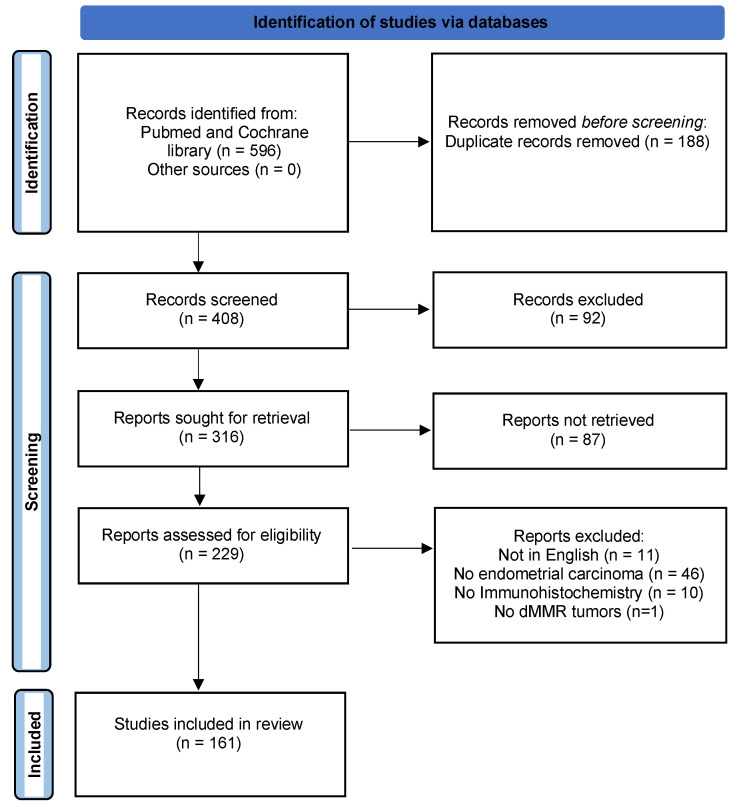
The objective of this systematic review was to summarize our current knowledge of the role of immunohistochemistry (IHC) markers for identifying mismatch repair-deficient (MMRd) tumors in endometrial cancer (EC). Identification of MMRd tumors, which occur in 13% to 30% of all ECs, has become critical for patients with colorectal and endometrial cancer for therapeutic management, clinical decision making, and prognosis. This review was conducted by two authors applying the Preferred Reporting Items for Systematic Reviews and Meta-Analyses (PRISMA) guidelines using the following terms: "immunohistochemistry and microsatellite instability endometrial cancer" or "immunohistochemistry and mismatch repair endometrial cancer" or "immunohistochemistry and mismatch repair deficient endometrial cancer". Among 596 retrieved studies, 161 fulfilled the inclusion criteria. Articles were classified and presented according to their interest for the diagnosis, prognosis, and theragnostics for patients with MMRd EC. We identified 10, 18, and 96 articles using IHC expression of two, three, or four proteins of the MMR system (MLH1, MSH2, MHS6, and PMS2), respectively. MLH1 promoter methylation was analyzed in 57 articles. Thirty-four articles classified MMRd tumors with IHC markers according to their prognosis in terms of recurrence-free survival (RFS), overall survival (OS), stage, grade, and lymph node invasion. Theragnostics were studied in eight articles underlying the important concentration of PD-L1 in MMRd EC. Even though the role of IHC has been challenged, it represents the most common, robust, and cheapest method for diagnosing MMRd tumors in EC and is a valuable tool for exploring novel biotherapies and treatment modalities.
Keywords: diagnosis; endometrial cancer; immunohistochemistry markers; microsatellite instability; mismatch repair-deficient; prognosis.
Conflict of interest statement
The authors declare no conflict of interest.
References
-
- Statistics Adapted from the American Cancer Society’s (ACS) Publication, Cancer Facts & Figures 2022, the ACS Website, and the International Agency for Research on Cancer Website. [(accessed on 1 January 2022)]. Available online: https://www.cancer.org/research/cancer-facts-statistics/all-cancer-facts....
-
- Talhouk A., McConechy M.K., Leung S., Yang W., Lum A., Senz J., Boyd N., Pike J., Anglesio M., Kwon J.S., et al. Confirmation of ProMisE: A simple, genomics-based clinical classifier for endometrial cancer: Molecular Classification of EC. Cancer. 2017;123:802–813. doi: 10.1002/cncr.30496. - DOI - PubMed
Publication types
LinkOut - more resources
Full Text Sources
Research Materials
