


Artificial Intelligence in Colorectal Cancer Surgery: Present and Future Perspectives
- PMID: 35954466
- PMCID: PMC9367568
- DOI: 10.3390/cancers14153803
Artificial Intelligence in Colorectal Cancer Surgery: Present and Future Perspectives
Abstract
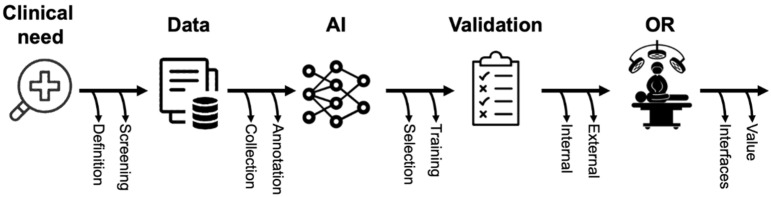
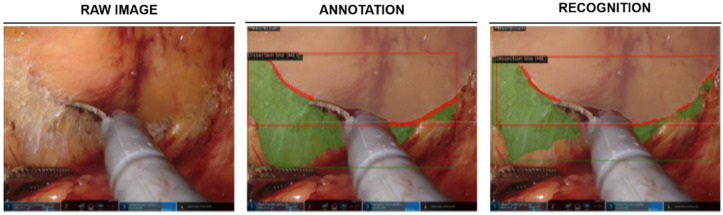
Artificial intelligence (AI) and computer vision (CV) are beginning to impact medicine. While evidence on the clinical value of AI-based solutions for the screening and staging of colorectal cancer (CRC) is mounting, CV and AI applications to enhance the surgical treatment of CRC are still in their early stage. This manuscript introduces key AI concepts to a surgical audience, illustrates fundamental steps to develop CV for surgical applications, and provides a comprehensive overview on the state-of-the-art of AI applications for the treatment of CRC. Notably, studies show that AI can be trained to automatically recognize surgical phases and actions with high accuracy even in complex colorectal procedures such as transanal total mesorectal excision (TaTME). In addition, AI models were trained to interpret fluorescent signals and recognize correct dissection planes during total mesorectal excision (TME), suggesting CV as a potentially valuable tool for intraoperative decision-making and guidance. Finally, AI could have a role in surgical training, providing automatic surgical skills assessment in the operating room. While promising, these proofs of concept require further development, validation in multi-institutional data, and clinical studies to confirm AI as a valuable tool to enhance CRC treatment.
Keywords: artificial intelligence; colorectal cancer; colorectal surgery.
Conflict of interest statement
The authors declare no conflict of interest.
Figures
References
-
- Fitzmaurice C., Abate D., Abbasi N., Abbastabar H., Abd-Allah F., Abdel-Rahman O., Abdelalim A., Abdoli A., Abdollahpour I., Abdulle A.S.M., et al. Global, Regional, and National Cancer Incidence, Mortality, Years of Life Lost, Years Lived with Disability, and Disability-Adjusted Life-Years for 29 Cancer Groups, 1990 to 2017: A Systematic Analysis for the Global Burden of Disease Study. JAMA Oncol. 2019;5:1749–1768. doi: 10.1001/jamaoncol.2019.2996. - DOI - PMC - PubMed
Publication types
LinkOut - more resources
Full Text Sources
