


A-REST (Activity to Reduce Excessive Sitting Time): A Feasibility Trial to Reduce Prolonged Sitting in Police Staff
- PMID: 35954543
- PMCID: PMC9368451
- DOI: 10.3390/ijerph19159186
A-REST (Activity to Reduce Excessive Sitting Time): A Feasibility Trial to Reduce Prolonged Sitting in Police Staff
Abstract
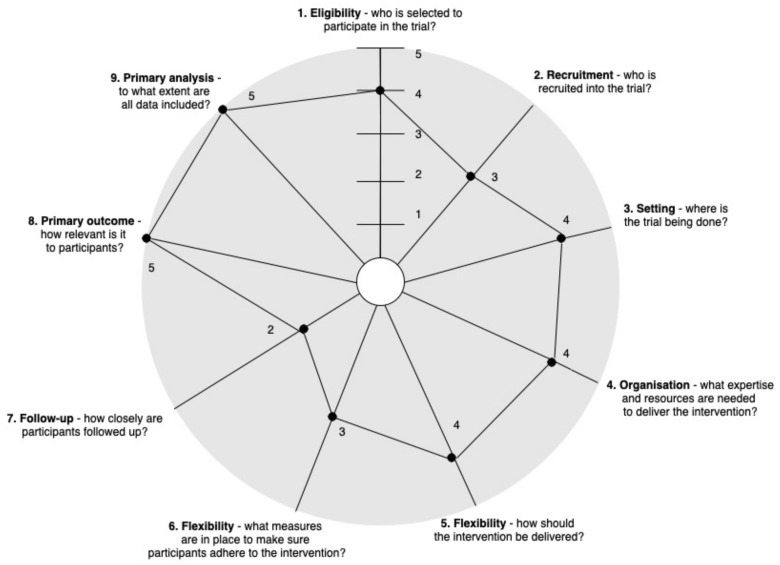
The aim of this study was to evaluate the acceptability and feasibility of a theory-derived sedentary workplace intervention for police office staff. Twenty-four staff participated in an 8-week intervention (single arm, pre-post design) incorporating an education session, team competition with quick response (QR) codes, team trophy, weekly leaderboard newsletters, a self-monitoring phone app, and electronic prompt tools. The intervention supported participants to reduce and break up their sitting time with three minutes of incidental movement every 30 min at work. Feasibility and acceptability were assessed using mixed methods via the RE-AIM QuEST and PRECIS-2 frameworks. The intervention was highly pragmatic in terms of eligibility, organisation, adherence, outcome, and analysis. It was slightly less pragmatic on recruitment and setting. Delivery and follow-up were more explanatory. Reach and adoption indicators demonstrated feasibility among police staff, across a range of departments, who were demographically similar to participants in previous office-based multi-component interventions. The intervention was delivered mostly as planned with minor deviations from protocol (implementation fidelity). Participants perceived the intervention components as highly acceptable. Results showed improvements in workplace sitting and standing, as well as small improvements in weight and positive affect. Evaluation of the intervention in a fully powered randomised controlled trial to assess behaviour and health outcomes is recommended.
Keywords: QR codes; activity breaks; behaviour change wheel; feasibility; intervention; office workers; police; sitting.
Conflict of interest statement
The authors declare no conflict of interest.
Figures
References
-
- Thorp A.A., Healy G.N., Winkler E., Clark B.K., Gardiner P.A., Owen N., Dunstan D.W. Prolonged Sedentary Time and Physical Activity in Workplace and Non-Work Contexts: A Cross-Sectional Study of Office, Customer Service and Call Centre Employees. Int. J. Behav. Nutr. Phys. Act. 2012;9:128. doi: 10.1186/1479-5868-9-128. - DOI - PMC - PubMed
-
- Wilmot E.G., Edwardson C.L., Achana F.A., Davies M.J., Gorely T., Gray L.J., Khunti K., Yates T., Biddle S.J.H. Sedentary Time in Adults and the Association with Diabetes, Cardiovascular Disease and Death: Systematic Review and Meta-Analysis. Diabetologia. 2012;55:2895–2905. doi: 10.1007/s00125-012-2677-z. - DOI - PubMed
Publication types
MeSH terms
LinkOut - more resources
Full Text Sources
