


The Relationship between Physical Activity and College Students' Mobile Phone Addiction: The Chain-Based Mediating Role of Psychological Capital and Social Adaptation
- PMID: 35954644
- PMCID: PMC9367822
- DOI: 10.3390/ijerph19159286
The Relationship between Physical Activity and College Students' Mobile Phone Addiction: The Chain-Based Mediating Role of Psychological Capital and Social Adaptation
Abstract
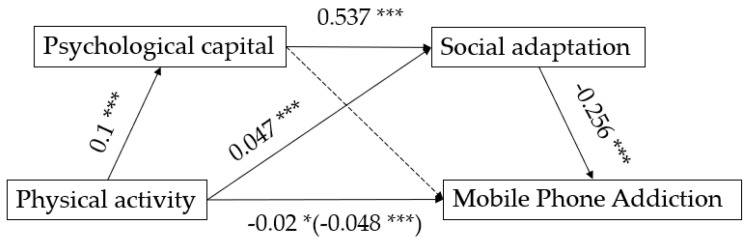
The purpose of this study was to investigate the effects and mechanisms of physical activity on mobile phone addiction among college students. A total of 9406 students, ranging from freshmen to seniors, from 35 colleges in four regions of Jiangsu Province were selected using the whole group sampling method. Questionnaires, particularly the International Physical Activity Questionnaire-Long Form (IPAQ), the positive psychological capital scale (PPQ), the social adjustment diagnostic questionnaire (SAFS), and the mobile phone addiction index scale (MPAI), were administered. We found that physical activity negatively predicted mobile phone addiction among university students. Social adaptation partially mediates between physical activity and mobile phone addiction among university students, with separate mediation of psychological capital playing no indirect role. Psychological capital and social adjustment mediate the chain between physical activity and mobile phone dependence among college students. Our findings suggest that physical activity is an important external factor influencing college students' mobile phone dependence, and it indirectly affects university students' mobile phone addiction through psychological capital and social adaptation. Improving the physical activity level of college students, enhancing their psychological capital, and promoting improved social adaptation are important ways to prevent mobile phone addiction among college students.
Keywords: mobile phone addiction; physical activity; psychological capital; social adaptation; the intermediary effect.
Conflict of interest statement
The authors declare no conflict of interest.
Figures
References
-
- CNNIC CNNIC Released the 49th Statistical Report on China’s Internet Development. [(accessed on 25 February 2022)]; Available online: http://www.cnnic.net.cn/hlwfzyj/hlwxzbg/hlwtjbg/202202/t20220225_71727.htm.
-
- Duke É., Montag C. Smartphone Addiction and Beyond: Initial Insights on an Emerging Research Topic and Its Relationship to Internet Addiction. In: Montag C., Reuter M., editors. Internet Addiction. Studies in Neuroscience, Psychology and Behavioral Economics. Springer; Cham, Switzerland: 2017. pp. 359–372.
-
- Fu X., Liu J., Liu R.-D., Ding Y., Hong W., Jiang S. The impact of parental active mediation on adolescent mobile phone dependency: A moderated mediation model. Comput. Hum. Behav. 2020;107:106280. doi: 10.1016/j.chb.2020.106280. - DOI
-
- Tang J., Hao J., Han H., Wan Y., Li H., Gu X. Relationship between mobile phone dependence and injury among Bengbu middle school students. Chin. J. Sch. Health. 2016;37:208–211. doi: 10.16835/j.cnki.1000-9817.2016.02.015. - DOI
-
- Sohn S.Y., Rees P., Wildridge B., Kalk N.J., Carter B. Prevalence of problematic smartphone usage and associated mental health outcomes amongst children and young people: A systematic review, meta-analysis and GRADE of the evidence. BMC Psychiatry. 2019;19:397. doi: 10.1186/s12888-019-2393-z. - DOI - PMC - PubMed
MeSH terms
LinkOut - more resources
Full Text Sources
