


Mental Health Consequences of COVID-19 Pandemic Period in the European Population: An Institutional Challenge
- PMID: 35954706
- PMCID: PMC9367746
- DOI: 10.3390/ijerph19159347
Mental Health Consequences of COVID-19 Pandemic Period in the European Population: An Institutional Challenge
Abstract
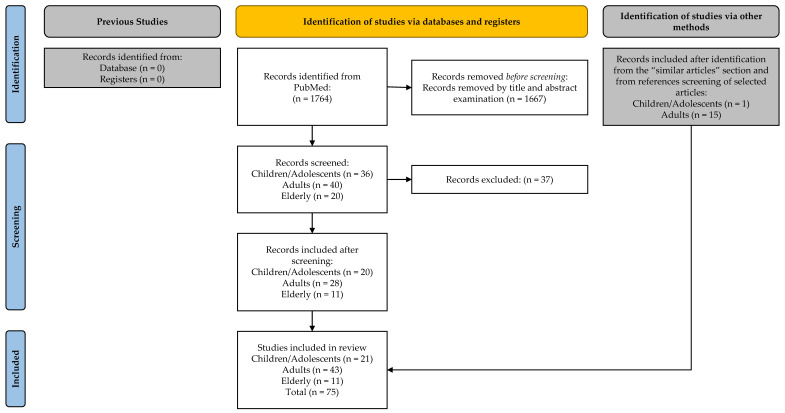
The worldwide spread of SARS-CoV-2 has been responsible for an infectious pandemic, with repercussions on socio-economic aspects and on the physical and mental health of the general population. The present systematic review aimed to evaluate the data belonging to the European framework, analyzing the population by age group. Original articles and reviews on the state of mental health of the general European population have been researched starting from 2021. Initially, a total of 1764 studies were found, among which a total of 75 were selected. Youth were the age group most affected by pandemic consequences on mental health, with emotional and behavioral alterations observed from a third to more than a half of children and adolescents examined. Among both adolescents and adults, the female gender had a higher prevalence of psychopathological symptoms. The main risk factors were poor social support, economic difficulties, and, in particular, unemployment or job changes. Additional individual risk factors were the perception of loneliness, the presence of pre-pandemic mental illness/distress, and some personality traits, such as neuroticism, impulsiveness, and the use of maladaptive coping strategies. Unexpectedly, the elderly maintained good resilience towards change, even if a stress factor was represented by the feeling of loneliness and poor social contact. As regards suicidal behaviors, among adolescents, there was an increase in attempts of 25%, with a greater risk for the female gender. This risk increased also among adults, in association with symptoms of anxiety and depression, and poor socio-environmental conditions. In conclusion, some population groups were found to be at greater risk of psychological burden during pandemic waves, thus representing priority targets for socio-health interventions.
Keywords: COVID-19; Europe; general population; health policies; lockdown; mental health; pandemic; psychiatric diseases; psychological burden.
Conflict of interest statement
The authors declare no conflict of interest.
Figures
References
-
- Giannakou K., Kyprianidou M., Christofi M., Kalatzis A., Fakonti G. Mandatory COVID-19 Vaccination for Healthcare Professionals and Its Association with General Vaccination Knowledge: A Nationwide Cross-Sectional Survey in Cyprus. Front. Public Health. 2022;10:897526. doi: 10.3389/fpubh.2022.897526. - DOI - PMC - PubMed
-
- Burhamah W., AlKhayyat A., Oroszlányová M., AlKenane A., Almansouri A., Behbehani M., Karimi N., Jafar H., AlSuwaidan M. The psychological burden of the COVID-19 pandemic and associated lockdown measures: Experience from 4000 participants. J. Affect. Disord. 2020;277:977–985. doi: 10.1016/j.jad.2020.09.014. - DOI - PMC - PubMed
-
- Fountoulakis K.N., Karakatsoulis G., Abraham S., Adorjan K., Ahmed H.U., Alarcón R.D., Arai K., Auwal S.S., Berk M., Bjedov S., et al. Results of the COVID-19 mental health international for the general population (COMET-G) study. Eur. Neuropsychopharmacol. 2022;54:21–40. doi: 10.1016/j.euroneuro.2021.10.004. - DOI - PMC - PubMed
Publication types
MeSH terms
LinkOut - more resources
Full Text Sources
Medical
Research Materials
Miscellaneous
