. 2022 Jul 30;19(15):9357.
doi: 10.3390/ijerph19159357.

In Utero Exposure to Caffeine and Acetaminophen, the Gut Microbiome, and Neurodevelopmental Outcomes: A Prospective Birth Cohort Study

Affiliations

In Utero Exposure to Caffeine and Acetaminophen, the Gut Microbiome, and Neurodevelopmental Outcomes: A Prospective Birth Cohort Study

Hannah E Laue et al. Int J Environ Res Public Health. .

Abstract

Pregnant individuals are exposed to acetaminophen and caffeine, but it is unknown how these exposures interact with the developing gut microbiome. We aimed to determine whether acetaminophen and/or caffeine relate to the childhood gut microbiome and whether features of the gut microbiome alter the relationship between acetaminophen/caffeine and neurodevelopment. Forty-nine and 85 participants provided meconium and stool samples at 6-7, respectively, for exposure and microbiome assessment. Fecal acetaminophen and caffeine concentrations were quantified, and fecal DNA underwent metagenomic sequencing. Caregivers and study staff assessed the participants' motor and cognitive development using standardized scales. Prenatal exposures had stronger associations with the childhood microbiome than concurrent exposures. Prenatal acetaminophen exposure was associated with a trend of lower gut bacterial diversity in childhood [β = -0.17 Shannon Index, 95% CI: (-0.31, -0.04)] and was marginally associated with differences in the relative abundances of features of the gut microbiome at the phylum (Firmicutes, Actinobacteria) and gene pathway levels. Among the participants with a higher relative abundance of Proteobacteria, prenatal exposure to acetaminophen and caffeine was associated with lower scores on WISC-IV subscales. Acetaminophen during bacterial colonization of the naïve gut is associated with lasting alterations in childhood microbiome composition. Future studies may inform our understanding of downstream health effects.

Keywords: acetaminophen; caffeine; children’s health; microbiome; neurodevelopment.


Conflict of interest statement

The authors declare no conflict of interest. The sponsors had no role in the design, execution, interpretation, or writing of the study.

Figures
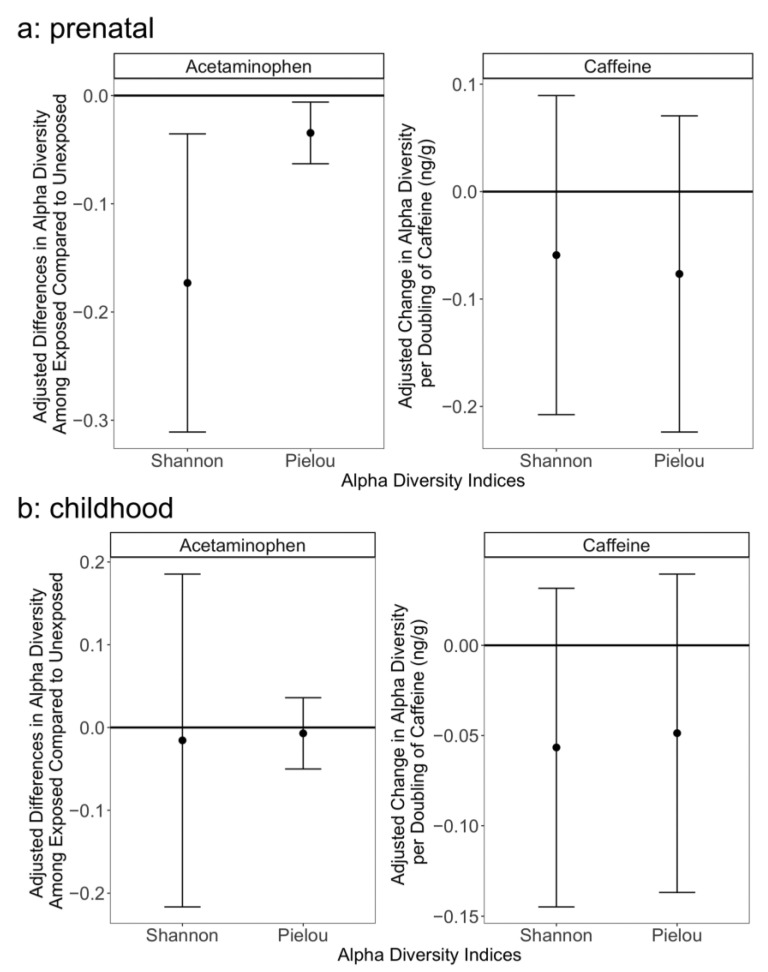
Figure 1
Figure 1
Association between acetaminophen/caffeine concentrations in (a) meconium (n = 49) and (b) 6–7-year-old stool (n = 85) and alpha diversity. Diversity was measured with Shannon Diversity Index and Pielou Evenness Index. Whiskers represent 95% confidence intervals. Models are adjusted for whether the child was ever breastfed, sex, mode of birth, and family income.
Figure 2
Figure 2
Association between prenatal exposure to acetaminophen and phyla (n = 49). Whiskers represent 95% confidence intervals. Models adjust for whether the child was ever breastfed, sex, mode of birth, and family income.
Figure 3
Figure 3
Association between (a) prenatal (n = 49) and (b) childhood exposure (n = 85) to caffeine or acetaminophen and relative abundance of functional pathways. Effect estimates for caffeine are expressed per doubling of exposure. Effect estimates for acetaminophen are comparing exposed to unexposed. Models are adjusted for whether the child was ever breastfed, sex, mode of birth, and socioeconomic status. Point size is proportional to average relative abundance of the represented pathway. Pathways with an FDR q-value < 0.1 are labeled. Full names: L-methionine biosynthesis = Superpathway of L-methionine biosynthesis (by sulfhydrylation); Sulfate assimilation and cysteine biosynthesis = Superpathway of Sulfate assimilation and cysteine biosynthesis.
Figure 4
Figure 4
Interaction between meconium concentrations of caffeine and acetaminophen with Proteobacteria (n = 49). Models are adjusted for whether the child was ever breastfed, sex, mode of birth, and socioeconomic status. In (ac), solid lines show the association when acetaminophen is detected, and dashed lines show the association when acetaminophen is not detected. In (de), solid lines show the association when caffeine is at the 75th percentile, dashed lines show when caffeine is at the 50th percentile, and dash-dot lines show when caffeine is at the 25th percentile. Subfigures (a,d) show the association between Proteobacteria and WISC-IV Digit Span scores; subfigure (b) shows the association between Proteobacteria and WISC-IV Information scores; subfigures (c,e) show the association between Proteobacteria and WISC-IV summary scores.

References

    1. McKenna L., McIntyre M. What over-the-counter preparations are pregnant women taking? A literature review. J. Adv. Nurs. 2006;56:636–645. doi: 10.1111/j.1365-2648.2006.04037.x. - DOI - PubMed
    1. Werler M.M., Mitchell A.A., Hernandez-Diaz S., Honein M.A. Use of over-the-counter medications during pregnancy. Am. J. Obstet. Gynecol. 2005;193:771–777. doi: 10.1016/j.ajog.2005.02.100. - DOI - PubMed
    1. Vernacchio L., Kelly J.P., Kaufman D.W., Mitchell A.A. Medication Use Among Children <12 Years of Age in the United States: Results From the Slone Survey. Pediatrics. 2009;124:446–454. doi: 10.1542/peds.2008-2869. - DOI - PubMed
    1. Baker B.H., Lugo-Candelas C., Wu H., Laue H.E., Boivin A., Gillet V., Aw N., Rahman T., Lepage J.-F., Whittingstall K. Association of prenatal acetaminophen exposure measured in meconium with risk of attention-deficit/hyperactivity disorder mediated by frontoparietal network brain connectivity. JAMA Pediatrics. 2020;174:1073–1081. doi: 10.1001/jamapediatrics.2020.3080. - DOI - PMC - PubMed
    1. Bauer A.Z., Kriebel D., Herbert M.R., Bornehag C.-G., Swan S.H. Prenatal paracetamol exposure and child neurodevelopment: A review. Horm. Behav. 2018;101:125–147. doi: 10.1016/j.yhbeh.2018.01.003. - DOI - PubMed

Publication types

LinkOut - more resources
