


The Leaf Trichome, Venation, and Mesophyll Structural Traits Play Important Roles in the Physiological Responses of Oak Seedlings to Water-Deficit Stress
- PMID: 35955770
- PMCID: PMC9369340
- DOI: 10.3390/ijms23158640
The Leaf Trichome, Venation, and Mesophyll Structural Traits Play Important Roles in the Physiological Responses of Oak Seedlings to Water-Deficit Stress
Abstract
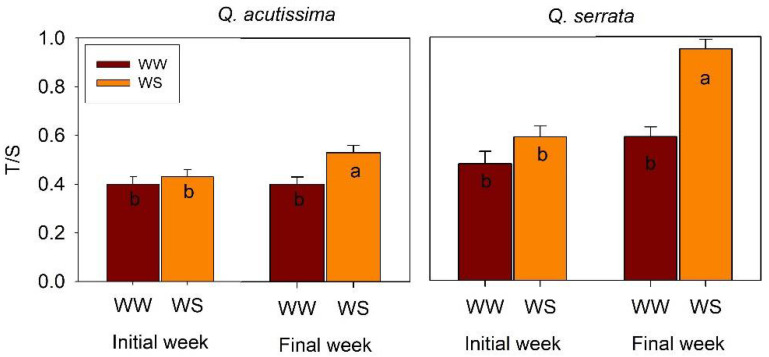
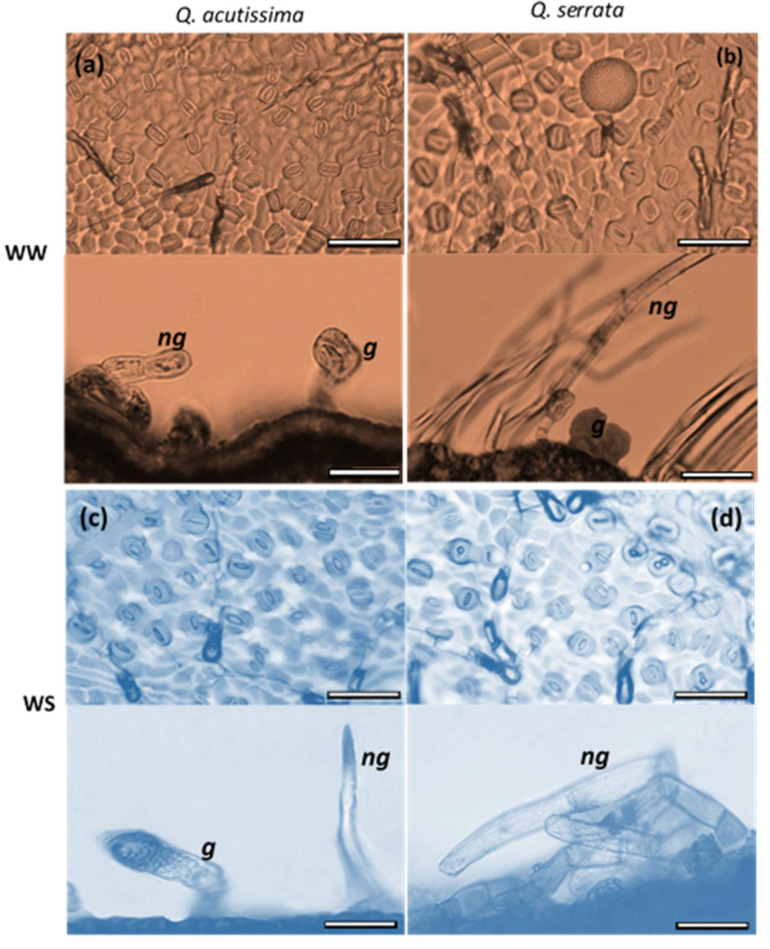
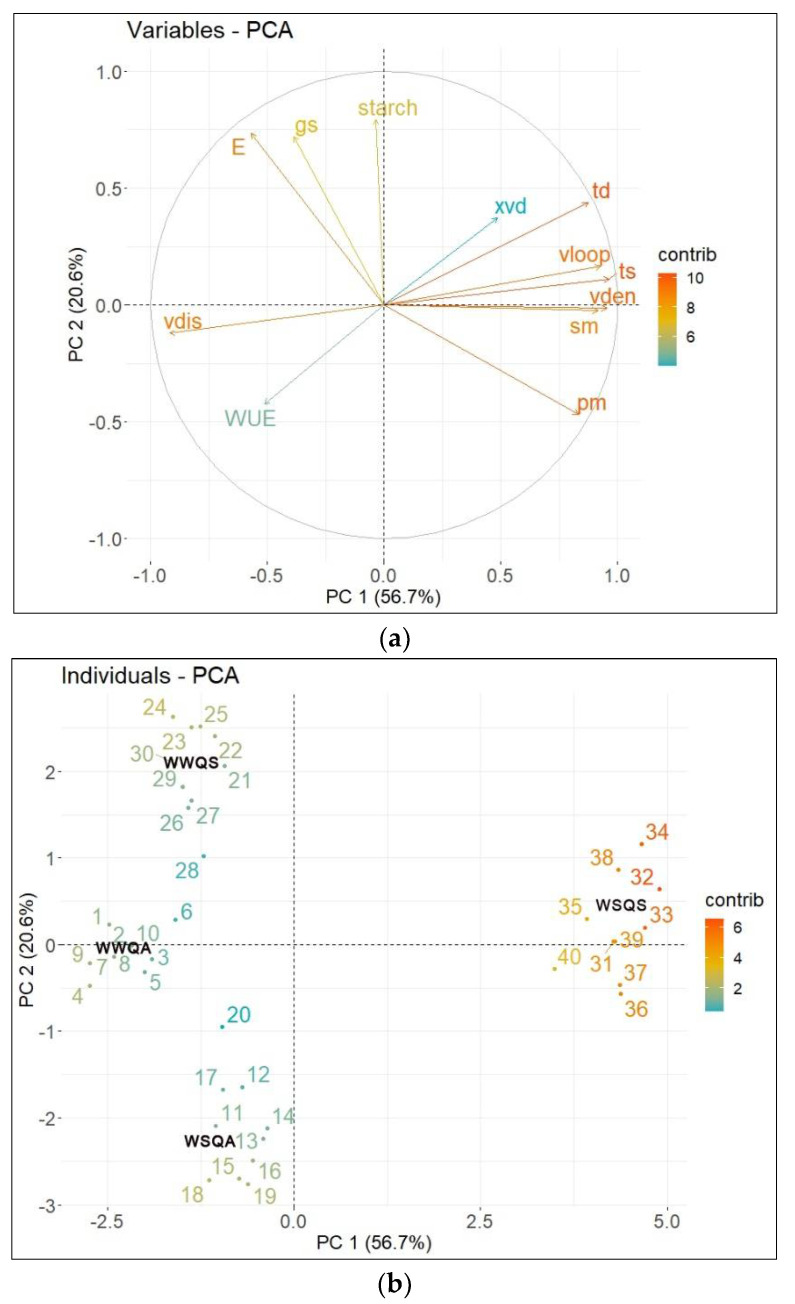
In this study, we investigated the effects of water-deficit stress on the leaf anatomical traits, physiological traits, and stem starch content in Quercus acutissima Carruth and Quercus serrata Murray by subjecting their seedlings to well-watered (WW) and water-deficit stress (WS) treatments. The water stress-induced changes in trichome density, trichome-to-stomata ratio, mesophyll thickness, vein density, vein distance, vein loopiness, vessel diameter, transpiration (E), stomatal conductance (gs), water use efficiency (WUE), and starch content were analyzed between two time points. While trichome density did not vary between treatments in Q. acutissima, it dramatically increased in Q. serrata (62.63-98.96 trichomes mm-2) at the final week. The WS-treated seedlings had a thicker palisade mesophyll (162.85-169.56 µm) than the WW-treated samples (118.56-132.25 µm) in both species. The vein density and loopiness increased significantly in the WS-treated Q. serrata seedlings. Small-sized vessels (10-50 µm) were more frequent in the WS than the WW in Q. serrata. The E, gs, WUE, and starch content declined significantly in the WS-treated seedlings compared with WW-treated samples in both species. Further, principal component analysis revealed significant relationships between anatomical and physiological traits, particularly in the WS-treated seedlings of Q. serrata. The coordinated changes in leaf anatomical traits, physiological traits, and stem starch content indicate an important role in the survival of Q. acutissima and Q. serrata seedlings in water-deficit stress environments, although Q. serrata may show higher survivability under prolonged water stress than Q. acutissima.
Keywords: drought stress; drought tolerance; oak species; starch reserves; stomatal conductance; water use efficiency.
Conflict of interest statement
The authors declare no conflict of interest.
Figures





References
-
- United Nations Convention to Combat Desertification [UNCCD] [(accessed on 2 May 2022)]. Available online: https://www.unccd.int/news-stories/stories/latest-climate-report-undersc....
-
- Méndez-Toribio M., Ibarra-Manríquez G., Paz H., Lebrija-Trejos E. Atmospheric and soil drought risks combined shape community assembly of trees in a tropical dry forest. J. Ecol. 2020;108:1347–1357. doi: 10.1111/1365-2745.13355. - DOI
-
- Resende A.F., Piedade M.T.F., Feitosa Y.O., Andrade V.H.F., Trumbore S.E., Durgante F.M., Macedo M.O., Schöngart J. Flood-pulse disturbances as a threat for long-living Amazonian trees. New Phytol. 2020;227:1790–1803. - PubMed
-
- Han J., Singh V.P. Forecasting of droughts and tree mortality under global warming: A review of causative mechanisms and modeling methods. J. Water Clim. Chang. 2020;11:600–632.
-
- Dai A. Drought under global warming: A Review. WIREs Clim. Chang. 2020;2:45–65. doi: 10.1002/wcc.81. - DOI
MeSH terms
Substances
Grants and funding
LinkOut - more resources
Full Text Sources
