


The Feasibility of Liver Biopsy for Undefined Nodules in Patients under Surveillance for Hepatocellular Carcinoma: Is Biopsy Really a Useful Tool?
- PMID: 35956016
- PMCID: PMC9369413
- DOI: 10.3390/jcm11154399
The Feasibility of Liver Biopsy for Undefined Nodules in Patients under Surveillance for Hepatocellular Carcinoma: Is Biopsy Really a Useful Tool?
Abstract
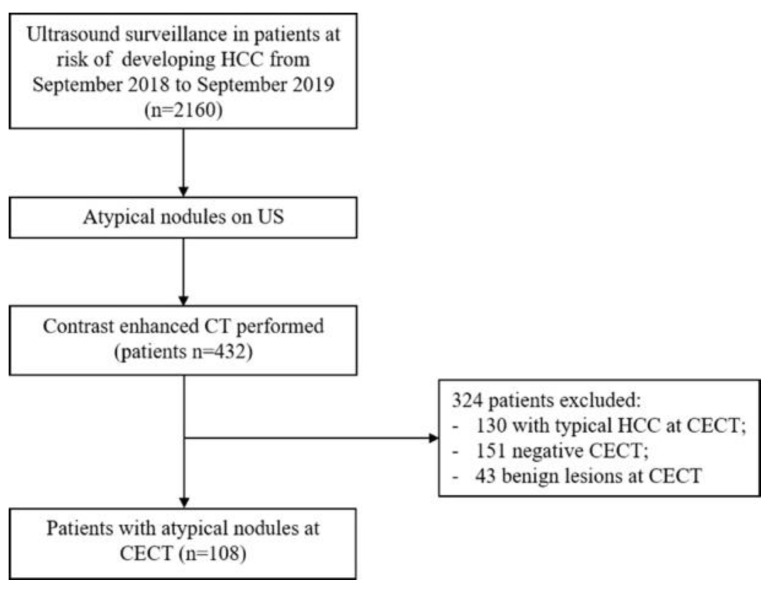
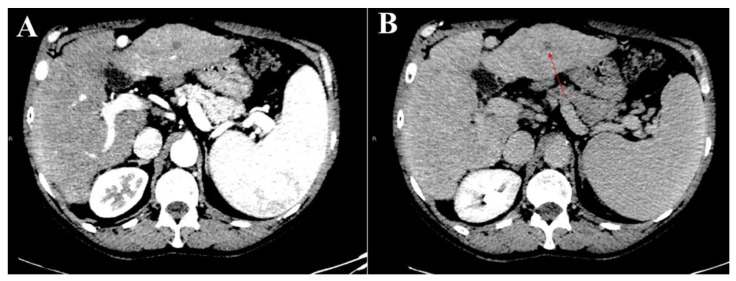
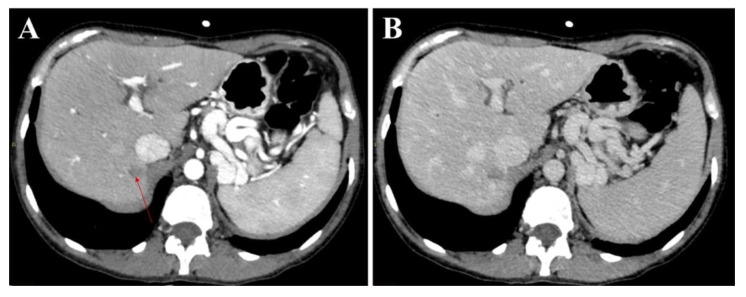
Background: The aim of the present study is to determine the feasibility of biopsy for atypical liver nodules in patients under surveillance for hepatocellular carcinoma (HCC), assessing which factors influence the decision to perform it. Methods: A total of 128 atypical liver nodules in 108 patients under surveillance for HCC, who underwent CT between September 2018 and September 2019, were included. All the images were saved digitally (on CD-ROM) and the two most representative images in the arterial and delayed phases were selected for each lesion and inserted into a digital atlas (on PDF). Two experienced radiologists (Readers 1 and 2) reviewed both the CD-ROM and the PDF to define the feasibility of biopsy in both scenarios, specifying the reasons for the unfeasibility of biopsy. The intra-observer variability and inter-observer variability were assessed. Results: When reviewing the PDF, 76 (59.4%) and 68 (53.1%) nodules were deemed unfeasible for biopsy by the less experienced radiologist (Reader 1) and the more experienced radiologist (Reader 2), respectively (p = 0.604). When reviewing the entire CT study, both percentages decreased slightly (Reader 1 = 70/128 (54.7%); Reader 2 = 61/128 (47.6%); p = 0.591). The intra-reader agreement on the PDF was substantial (k = 0.648 (95% CI = 0.513-0.783)). The inter-reader agreement on the PDF was slight (k = 0.185 (95% CI = 0.021-0.348)) and moderate on the entire CT study (k = 0.424 (95% CI = 0.269-0.579)). When assessing the PDF, the nodule size (10-20 mm) and location in segments six and eight were negatively and positively associated with the feasibility of liver biopsy, respectively. When assessing the CD-ROM, only the nodule dimension was associated with the unfeasibility of liver biopsy. Conclusions: The unfeasibility of liver biopsy is mainly due to the small size of the lesions and their location.
Keywords: feasibility; hepatocellular carcinoma; liver biopsy; liver imaging; multidisciplinary meeting.
Conflict of interest statement
The authors declare no conflict of interest.
Figures
References
LinkOut - more resources
Full Text Sources
