


The Genus Cetraria s. str.-A Review of Its Botany, Phytochemistry, Traditional Uses and Pharmacology
- PMID: 35956939
- PMCID: PMC9370490
- DOI: 10.3390/molecules27154990
The Genus Cetraria s. str.-A Review of Its Botany, Phytochemistry, Traditional Uses and Pharmacology
Abstract
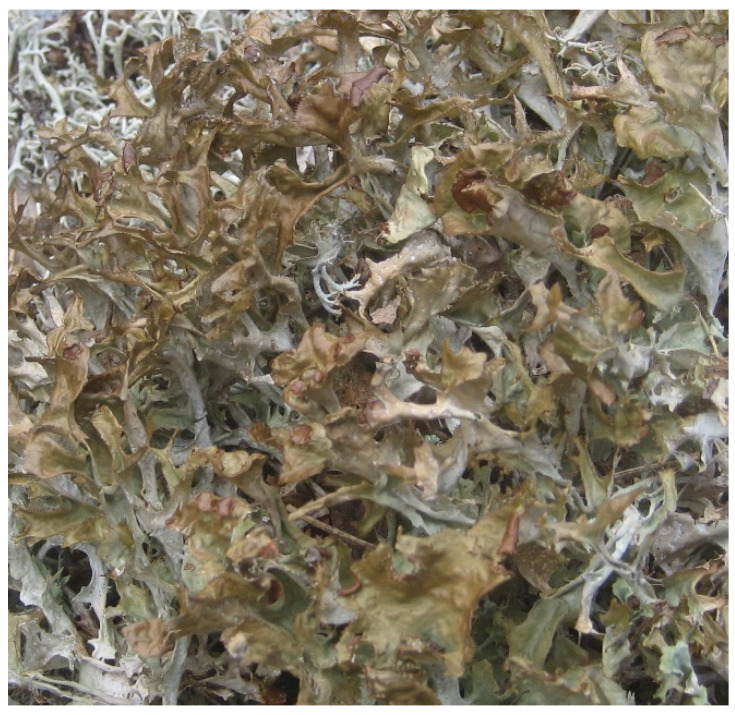
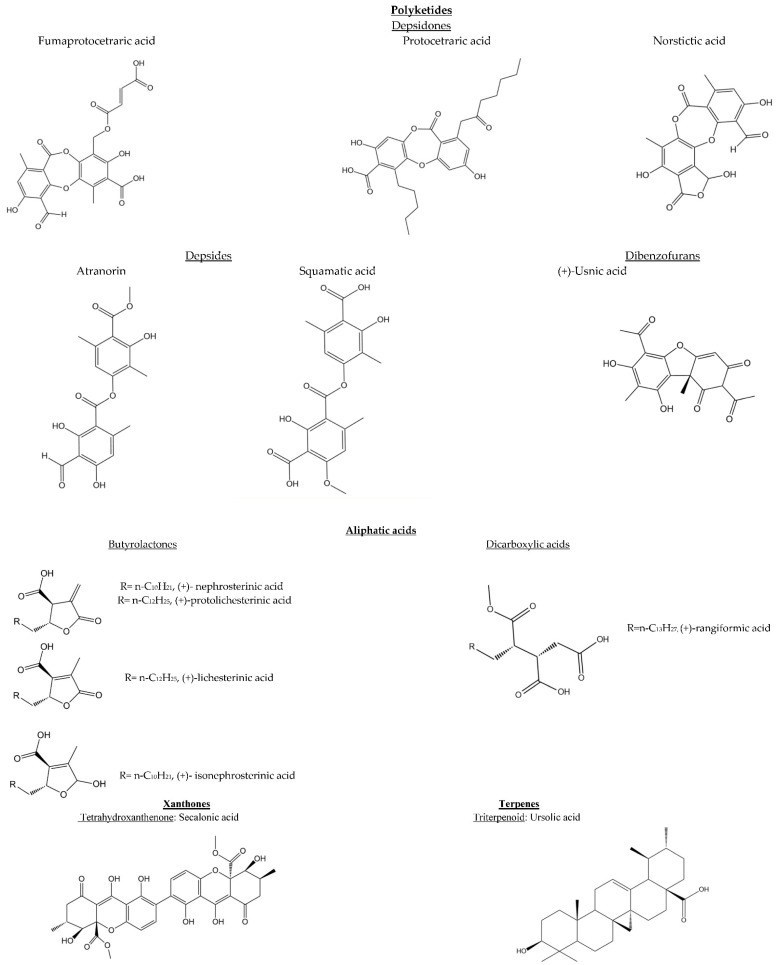
The genus Cetraria s. str. (Parmeliaceae family, Cetrarioid clade) consists of 15 species of mostly erect brown or greenish yellow fruticose or subfoliose thallus. These Cetraria species have a cosmopolitan distribution, being primarily located in the Northern Hemisphere, in North America and in the Eurasia area. Phytochemical analysis has demonstrated the presence of dibenzofuran derivatives (usnic acid), depsidones (fumarprotocetraric and protocetraric acids) and fatty acids (lichesterinic and protolichesterinic acids). The species of Cetraria, and more particularly Cetraria islandica, has been widely employed in folk medicine for the treatment of digestive and respiratory diseases as decoctions, tinctures, aqueous extract, and infusions. Moreover, Cetraria islandica has had an important nutritional and cosmetic value. These traditional uses have been validated in in vitro and in vivo pharmacological studies. Additionally, new therapeutic activities are being investigated, such as antioxidant, immunomodulatory, cytotoxic, genotoxic and antigenotoxic. Among all Cetraria species, the most investigated by far has been Cetraria islandica, followed by Cetraria pinastri and Cetraria aculeata. The aim of the current review is to update all the knowledge about the genus Cetraria covering aspects that include taxonomy and phylogeny, morphology and distribution, ecological and environmental interest, phytochemistry, traditional uses and pharmacological properties.
Keywords: Cetraria; botany; lichens; pharmacology; phytochemistry; traditional uses.
Conflict of interest statement
The authors declare no conflict of interest.
Figures
References
-
- Gómez-Serranillos M., Fernández-Moriano C., González-Burgos E., Divakar P., Crespo A. Parmeliaceae family: Phytochemistry, pharmacological potential and phylogenetic features. RSC Adv. 2014;4:59017–59047. doi: 10.1039/C4RA09104C. - DOI
-
- Wang Y.Y., Liu B., Zhang X.Y., Zhou Q.M., Zhang T., Li H., Yu Y.F., Zhang X.L., Hao X.Y., Wang M., et al. Genome characteristics reveal the impact of lichenization on lichen-forming fungus Endocarpon pusillum Hedwig (Verrucariales, Ascomycota) BMC Genom. 2014;15:34. doi: 10.1186/1471-2164-15-34. - DOI - PMC - PubMed
-
- Klarenberg I.J., Keuschnig C., Warshan D., Jónsdóttir I.S., Vilhelmsson O. The Total and Active Bacterial Community of the Chlorolichen Cetraria islandica and Its Response to Long-Term Warming in Sub-Arctic Tundra. Front. Microbiol. 2020;11:540404. doi: 10.3389/fmicb.2020.540404. - DOI - PMC - PubMed
-
- Sipman H.J.M., Aptroot A. Where are the missing lichens? Mycol. Res. 2001;105:1433–1439. doi: 10.1017/S0953756201004932. - DOI
Publication types
MeSH terms
Substances
LinkOut - more resources
Full Text Sources
