


Water as a Link between Membrane and Colloidal Theories for Cells
- PMID: 35956945
- PMCID: PMC9370763
- DOI: 10.3390/molecules27154994
Water as a Link between Membrane and Colloidal Theories for Cells
Abstract
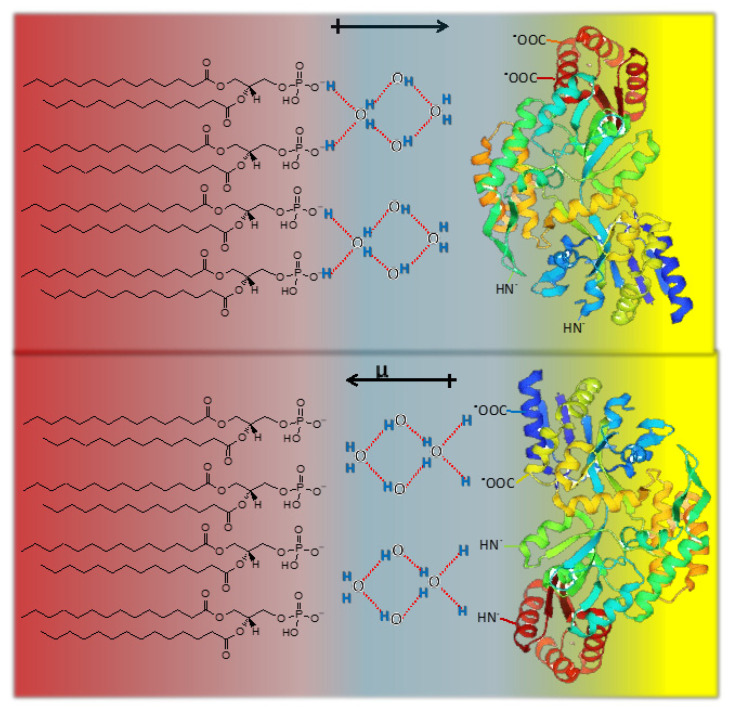
This review is an attempt to incorporate water as a structural and thermodynamic component of biomembranes. With this purpose, the consideration of the membrane interphase as a bidimensional hydrated polar head group solution, coupled to the hydrocarbon region allows for the reconciliation of two theories on cells in dispute today: one considering the membrane as an essential part in terms of compartmentalization, and another in which lipid membranes are not necessary and cells can be treated as a colloidal system. The criterium followed is to describe the membrane state as an open, non-autonomous and responsive system using the approach of Thermodynamic of Irreversible Processes. The concept of an open/non-autonomous membrane system allows for the visualization of the interrelationship between metabolic events and membrane polymorphic changes. Therefore, the Association Induction Hypothesis (AIH) and lipid properties interplay should consider hydration in terms of free energy modulated by water activity and surface (lateral) pressure. Water in restricted regions at the lipid interphase has thermodynamic properties that explain the role of H-bonding networks in the propagation of events between membrane and cytoplasm that appears to be relevant in the context of crowded systems.
Keywords: H bonding propagation; crowded systems; lipid hydration; restricted environments; water interphases.
Conflict of interest statement
The authors declare that they have no known competing financial interest or personal relationship that could have appeared to influence the work reported in this paper.
Figures
References
-
- Luckey M. Membrane Structural Biology: With Biochemical and Biophysical Foundations. Cambridge University Press; Cambridge, UK: 2014.
-
- Luisi P.L. The Emergence of Life: From Chemical Origins to Synthetic Biology. Cambridge University Press; Cambridge, UK: 2016.
Publication types
MeSH terms
Substances
Grants and funding
LinkOut - more resources
Full Text Sources
