


Mechanism and kinetics of chlorpyrifos co-metabolism by using environment restoring microbes isolated from rhizosphere of horticultural crops under subtropics
- PMID: 35958149
- PMCID: PMC9360973
- DOI: 10.3389/fmicb.2022.891870
Mechanism and kinetics of chlorpyrifos co-metabolism by using environment restoring microbes isolated from rhizosphere of horticultural crops under subtropics
Abstract
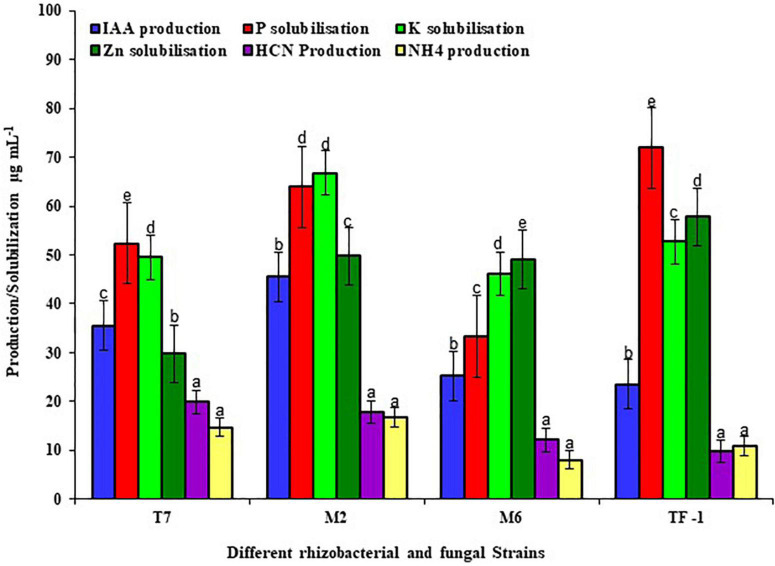
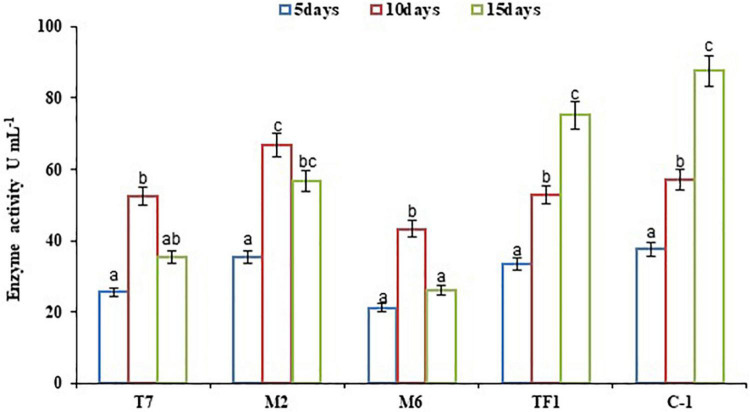
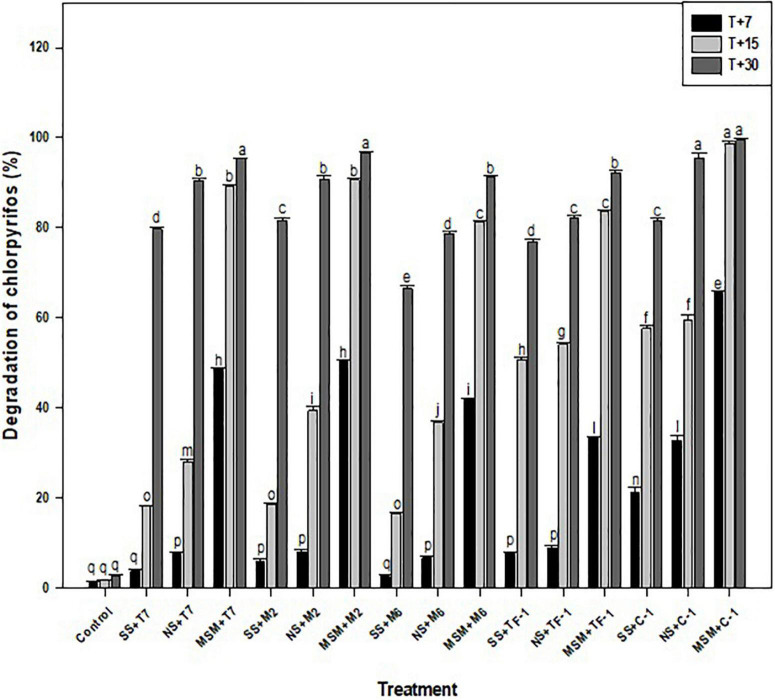
The indiscriminate use of organophosphate insecticide chlorpyrifos in agricultural crops causes significant soil and water pollution and poses a serious threat to the global community. In this study, a microbial consortium ERM C-1 containing bacterial strains Pseudomonas putida T7, Pseudomonas aeruginosa M2, Klebsiella pneumoniae M6, and a fungal strain Aspergillus terreus TF1 was developed for the effective degradation of chlorpyrifos. Results revealed that microbial strains were not only utilizing chlorpyrifos (500 mg L-1) but also coupled with plant growth-promoting characteristics and laccase production. PGP traits, that is, IAA (35.53, 45.53, 25.19, and 25.53 μg mL-1), HCN (19.85, 17.85, 12.18, and 9.85 μg mL-1), and ammonium (14.73, 16.73, 8.05, and 10.87 μg mL-1) production, and potassium (49.53, 66.72, 46.14, and 52.72 μg mL-1), phosphate (52.37, 63.89, 33.33, and 71.89 μg mL-1), and zinc (29.75, 49.75, 49.12, and 57.75 μg mL-1) solubilization tests were positive for microbial strains T7, M2, M6, and TF1, respectively. The laccase activity by ERM C-1 was estimated as 37.53, 57.16, and 87.57 enzyme U mL-1 after 5, 10, and 15 days of incubation, respectively. Chlorpyrifos degradation was associated with ERM C-1 and laccase activity, and the degree of enzyme activity was higher in the consortium than in individual strains. The biodegradation study with developed consortium ERM C-1 showed a decreased chlorpyrifos concentration from the 7th day of incubation (65.77% degradation) followed by complete disappearance (100% degradation) after the 30th day of incubation in the MS medium. First-order degradation kinetics with a linear model revealed a high k -day value and low t 1/2 value in ERM C-1. The results of HPLC and GC-MS analysis proved that consortium ERM C-1 was capable of completely removing chlorpyrifos by co-metabolism mechanism.
Keywords: ERM C-1; biodegradation; chlorpyrifos; consortium; plant growth promotion.
Copyright © 2022 Kumar, Lal, Soni, Maurya, Shukla, Chaudhary, Bhattacherjee and Garg.
Conflict of interest statement
The authors declare that the research was conducted in the absence of any commercial or financial relationships that could be construed as a potential conflict of interest.
Figures
References
-
- Adam G., Duncan H. (2001). Development of a sensitive and rapid method for the measurement of total microbial activity using fluorescein diacetate (FDA) in a range of soils. Soil Biol. Biochem. 33, 943–951. 10.1016/S0038-0717(00)00244-3 - DOI
-
- Abd El Monssef R. A., Hassan E. A., Ramadan E. M. (2016). Production of laccase enzyme for their potential application to decolorize fungal pigments on aging paper and parchment. Ann. Agric. Sci. 61 145–154.
-
- Abdul Manan M., Webb C. (2018). Estimating fungal growth in submerged fermentation in the presence of solid particles based on colour development. Biotechnol. Biotechnol. Equip. 32 618–627.
-
- Abouseoud M., Maachi R., Amrane A., Boudergua S., Nabi A. (2008). Evaluation of different carbon and nitrogen sources in production of biosurfactant by Pseudomonas fluorescens. Desalination 223 143–151.
-
- Ambreen S., Yasmin A. (2021). Novel degradation pathways for Chlorpyrifos and 3, 5, 6-Trichloro-2-pyridinol degradation by bacterial strain Bacillus thuringiensis MB497 isolated from agricultural fields of Mianwali, Pakistan. Pestic. Biochem. Physiol. 172:104750. 10.1016/j.pestbp.2020.104750 - DOI - PubMed
LinkOut - more resources
Full Text Sources
Miscellaneous
