


Case report: Variant-specific pre-exposure prophylaxis of SARS-CoV-2 infection in multiple sclerosis patients lacking vaccination responses
- PMID: 35958567
- PMCID: PMC9360990
- DOI: 10.3389/fimmu.2022.897748
Case report: Variant-specific pre-exposure prophylaxis of SARS-CoV-2 infection in multiple sclerosis patients lacking vaccination responses
Abstract
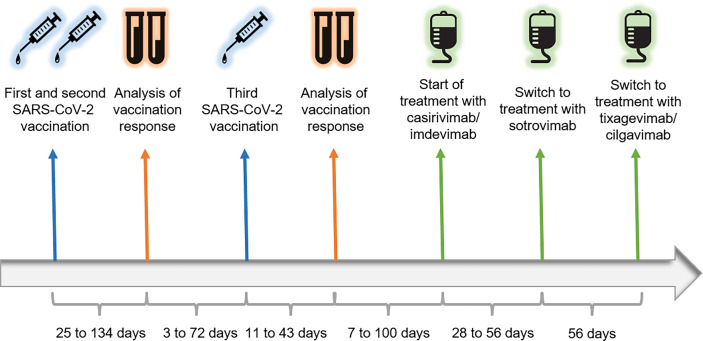
Sphingosine-1-phosphate receptor modulators and anti-CD20 treatment are widely used disease-modifying treatments for multiple sclerosis. Unfortunately, they may impair the patient's ability to mount sufficient humoral and T-cellular responses to vaccination, which is of special relevance in the context of the SARS-CoV-2 pandemic. We present here a case series of six multiple sclerosis patients on treatment with sphingosine-1-phosphate receptor modulators who failed to develop SARS-CoV-2-specific antibodies and T-cells after three doses of vaccination. Due to their ongoing immunotherapy, lacking vaccination response, and additional risk factors, we offered them pre-exposure prophylactic treatment with monoclonal SARS-CoV-2-neutralizing antibodies. Initially, treatment was conducted with the antibody cocktail casirivimab/imdevimab. When the SARS-CoV-2 Omicron variant became predominant, we switched treatment to monoclonal antibody sotrovimab due to its sustained neutralizing ability also against the Omicron strain. Since sotrovimab was approved only for the treatment of COVID-19 infection and not for pre-exposure prophylaxis, we switched treatment to tixagevimab/cilgavimab as soon as it was granted marketing authorization in the European Union. This antibody cocktail has retained, albeit reduced, neutralizing activity against the Omicron variant and is approved for pre-exposure prophylaxis. No severe adverse events were recorded for our patients. One patient had a positive RT-PCR for SARS-CoV-2 under treatment with sotrovimab, but was asymptomatic. The other five patients did not develop symptoms of an upper respiratory tract infection or evidence of a SARS-CoV-2 infection during the time of treatment up until the finalization of this report. SARS-CoV-2-neutralizing antibody treatment should be considered individually for multiple sclerosis patients lacking adequate vaccination responses on account of their immunomodulatory treatment, especially in times of high incidences of SARS-CoV-2 infection.
Keywords: case report; coronavirus disease (COVID-19); multiple sclerosis; neutralizing antibody; prophylaxis; severe acute respiratory syndrome coronavirus 2 (SARS-CoV-2); sphingosine-1-receptor modulators (S1PR); vaccination.
Copyright © 2022 Woopen, Konofalska, Akgün and Ziemssen.
Conflict of interest statement
CW received travel support from Novartis. KA received personal compensation from Roche, Sanofi, Teva, Merck, Alexion, BMS, and Celgene for oral presentations and consulting services. TZ received personal compensation from Biogen, BMS, Bayer, Merck, Novartis, Roche, Sanofi, Teva, and Viatris for consulting and speaking services. TZ received additional financial support for research activities from Biogen, Novartis, Roche, Teva, and Sanofi. TZ is principal investigator of the AMA-VAC and KYRIOS study. The remaining author declares that the research was conducted in the absence of any commercial or financial relationships that could be construed as a potential conflict of interest.
Figures
References
-
- Tortorella C, Aiello A, Gasperini C, Agrati C, Castilletti C, Ruggieri S, et al. Humoral- and T-Cell–specific immune responses to SARS-CoV-2 mRNA vaccination in patients with MS using different disease-modifying therapies. Neurology (2022) 98(5):e541–54. doi: 10.1212/wnl.0000000000013108 - DOI - PMC - PubMed
-
- Malin J, Spinner C, Fätkenheuer G, Salzberger B, Kluge S, Karagiannidis, et al. SARS-CoV-2 prä-expositionsprophylaxe (PrEP) mit neutralisierenden monoklonalen antikörpern: Neue möglichkeiten für risikogruppen durch passive immunisierung (2021). Available at: https://dgpi.de/sarscov2-prae-expositionsprophylaxe-mit-neutralisierende... (Accessed January 21, 2022).
-
- European Commission . Union register of medicinal products for human use (2021). Available at: https://ec.europa.eu/health/documents/community-register/html/h1601.htm (Accessed January 20, 2022).
Publication types
MeSH terms
Substances
Supplementary concepts
LinkOut - more resources
Full Text Sources
Medical
Miscellaneous
