


Associations Between Complex Trauma Exposure in Childhood/Adolescence and Psychopathology in Older Age: The Role of Stress Coping and Coping Self-Perception
- PMID: 35958721
- PMCID: PMC9360395
- DOI: 10.1007/s40653-021-00419-0
Associations Between Complex Trauma Exposure in Childhood/Adolescence and Psychopathology in Older Age: The Role of Stress Coping and Coping Self-Perception
Abstract
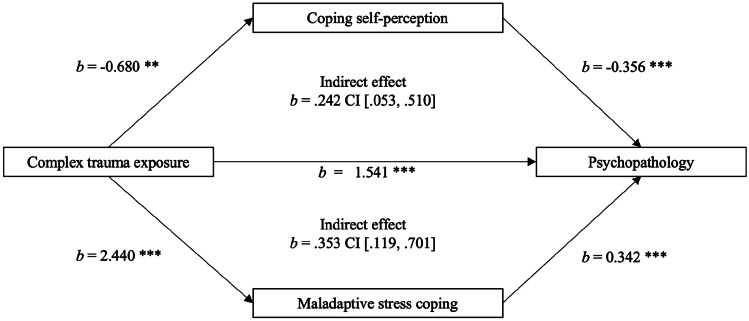
Complex trauma exposure in childhood and/or adolescence is common and has repeatedly been linked to mental ill-health across the lifespan. While the correlates of complex trauma and mental health are well-studied in individuals up to middle adulthood, correlates in older adulthood, as well as potential mediators of this relationship, such as stress coping, are insufficiently studied. Therefore, this study aimed to (a) examine the mental health of Swiss older adults affected by complex trauma exposure in childhood and/or adolescence, in comparison to non-affected individuals; and (b) to examine the potential mediating role of coping strategies and coping self-perception. Data from N = 257 participants (complex trauma [CT] group: n = 161; M age = 69.66 years, 48.4% female; non-complex trauma [nCT] group: n = 96; M age = 72.49 years, 42.7% female) were assessed using self-report questionnaires and a clinical interview. The CT group presented with significantly more current and lifetime mental health disorders, more disadvantageous coping strategies, and significantly lower coping self-perception, compared to the nCT group. Mediation analyses revealed that maladaptive coping and coping self-perception were relevant mediators of the relationship between complex trauma exposure and psychopathology. Results suggest that complex trauma exposure in childhood and/or adolescence can have a lasting impact on mental health in later life and can be negatively associated with stress coping. Findings emphasize the relevance of a lifespan perspective in research and clinical practice for addressing consequences of complex trauma exposure.
Keywords: Adolescence; Childhood; Complex trauma exposure; Coping self-perception; Mental health; Older adults; Stress coping.
© The Author(s) 2021.
Conflict of interest statement
Conflicts of InterestThe authors have no known conflict of interest to disclose.
Figures
References
-
- Allen SF, Pfefferbaum B, Nitiema P, Pfefferbaum RL, Houston JB, McCarter GS, III, Gray SR. Resilience and coping intervention with children and adolescents in at-risk neighborhoods. Journal of Loss and Trauma. 2016;21:85–98. doi: 10.1080/15325024.2015.1072014. - DOI
-
- Bellis MA, Hughes K, Ford K, Ramos Rodriguez G, Sethi D, Passmore J. Life course health consequences and associated annual costs of adverse childhood experiences across Europe and North America: A systematic review and meta-analysis. Lancet Public Health. 2019;4:517–528. doi: 10.1016/S2468-2667(19)30145-8. - DOI - PMC - PubMed
-
- Bernstein, D. P., & Fink, L. (1998). Childhood trauma Questionnaire: A retrospective self-report: Manual. Harcourt Brace & Company.
-
- Bodenmann G. Stress und Coping bei Paaren. Hogrefe; 2000.
LinkOut - more resources
Full Text Sources