


The relationship between Comprehensive Geriatric Assessment parameters and depression in elderly patients
- PMID: 35959294
- PMCID: PMC9360413
- DOI: 10.3389/fnagi.2022.936024
The relationship between Comprehensive Geriatric Assessment parameters and depression in elderly patients
Abstract
Background: Depression is common and serious among elderly patients. The treatment of elderly depression is often delayed owing to insufficient diagnosis, which eventually leads to adverse consequences.
Aims: To explore the association between the parameters of the Comprehensive Geriatric Assessment and depression in elderly patients.
Methods: A cross-sectional study of 211 outpatients and inpatients aged ≥ 65 years from the Comprehensive Geriatric Assessment database was conducted. A Comprehensive Geriatric Assessment inventory was prepared by compiling and screening general characteristics, chronic diseases (cardiovascular disease, diabetes, and peptic ulcer disease), nutritional status, daily living ability, anthropometric measurements (body mass index (BMI), upper arm circumference, and calf circumference), and blood biochemical indicators (hemoglobin, albumin, prealbumin, triglycerides, and low-density lipoprotein cholesterol). The Geriatric Depression Scale was also conducted for each elderly patient to screen for depression. A multivariable logistic regression analysis was used to determine the association between the parameters of the Comprehensive Geriatric Assessment and geriatric depression.
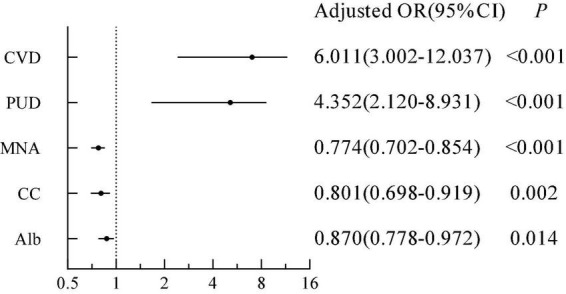
Results: There were 63 patients in the depression group with a median age of 84.00 years, and 148 patients in the non-depression group with a median age of 78.50 years. After controlling for confounders, the risk of depression in elderly patients with cardiovascular diseases was 6.011 times higher than that in those without cardiovascular diseases (p < 0.001); and the risk of depression in elderly patients with peptic ulcer diseases was 4.352 times higher than that in those without peptic ulcer diseases (p < 0.001); the risk of depression in elderly patients decreased by 22.6% for each 1-point increase in the Mini Nutritional Assessment (p < 0.001). The risk of depression in elderly patients decreased by 19.9% for each 1-point increase in calf circumference (p = 0.002), and by 13.0% for each 1-point increase in albumin (p = 0.014).
Conclusion: Our findings suggest that Comprehensive Geriatric Assessment parameters, such as cardiovascular disease, peptic ulcer disease, Mini Nutritional Assessment score, calf circumference, and albumin, were associated with depression. The Comprehensive Geriatric Assessment can assist in the early identification of depression in the elderly population.
Keywords: Comprehensive Geriatric Assessment; Geriatric Depression Scale; depression; elderly patients; multivariable logistic regression analysis.
Copyright © 2022 Ju, Liu, Zhang, Lin, Zheng and Leng.
Conflict of interest statement
The authors declare that the research was conducted in the absence of any commercial or financial relationships that could be construed as a potential conflict of interest.
Figures
References
-
- Chou H. H., Lai T. J., Yen C. H., Chang P. S., Pan J. C., Lin P. T., et al. (2022). Sarcopenic obesity tendency and nutritional status is related to the risk of sarcopenia, frailty, depression and quality of life in patients with dementia. Int. J. Environ. Res. Public Health 19:2492. 10.3390/ijerph19052492 - DOI - PMC - PubMed
-
- Driga M. P., Catalin B., Olaru D. G., Slowik A., Plesnila N., Hermann D. M., et al. (2021). The need for new biomarkers to assist with stroke prevention and prediction of post-stroke therapy based on plasma-derived extracellular vesicles. Biomedicines 9:1226. 10.3390/biomedicines9091226 - DOI - PMC - PubMed
-
- Fagard K., Casaer J., Wolthuis A., Flamaing J., Milisen K., Lobelle J. P., et al. (2017). Value of geriatric screening and assessment in predicting postoperative complications in patients older than 70 years undergoing surgery for colorectal cancer. J. Geriatr. Oncol. 8 320–327. 10.1016/j.jgo.2017.07.008 - DOI - PubMed
LinkOut - more resources
Full Text Sources
Research Materials
