


Association of Autonomic Activation with traumatic reminder challenges in posttraumatic stress disorder: A co-twin control study
- PMID: 35959570
- PMCID: PMC10157622
- DOI: 10.1111/psyp.14167
Association of Autonomic Activation with traumatic reminder challenges in posttraumatic stress disorder: A co-twin control study
Abstract
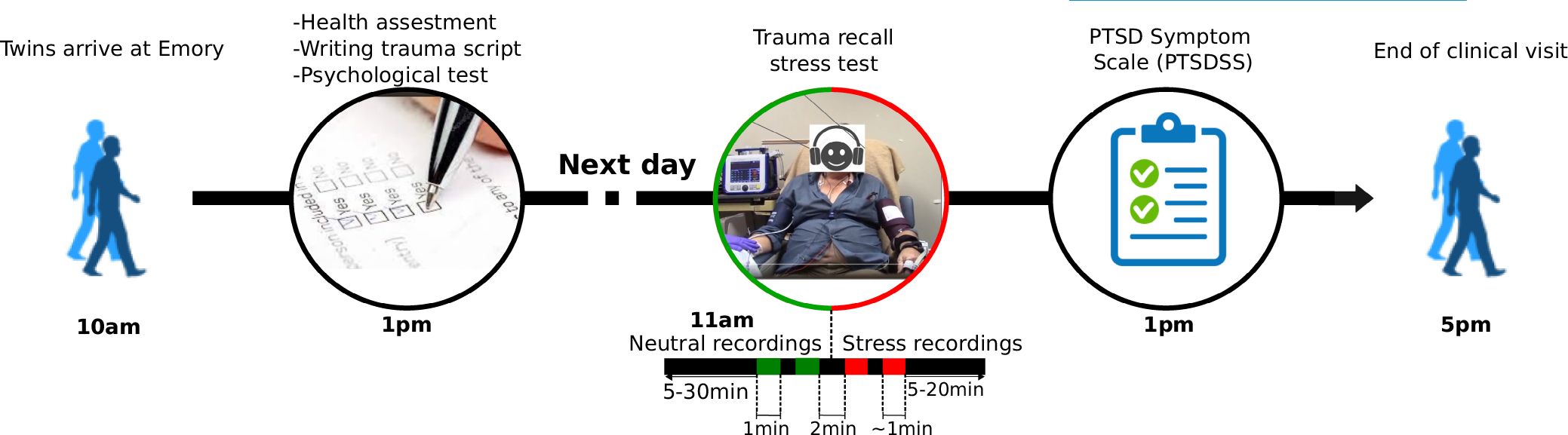
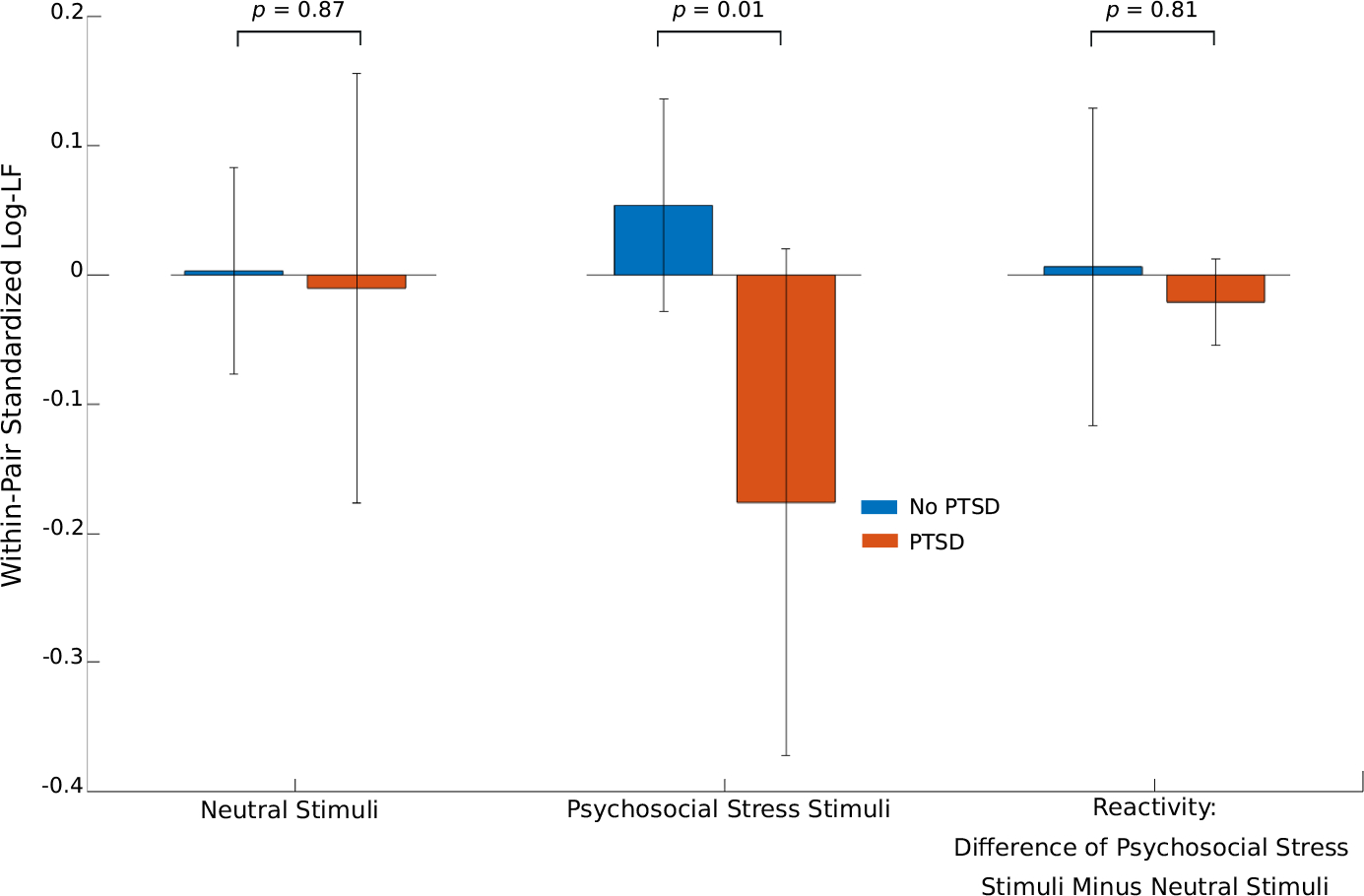
Post-traumatic stress disorder (PTSD) has been associated with cardiovascular disease (CVD), but the mechanisms remain unclear. Autonomic dysfunction, associated with higher CVD risk, may be triggered by acute PTSD symptoms. We hypothesized that a laboratory-based trauma reminder challenge, which induces acute PTSD symptoms, provokes autonomic dysfunction in a cohort of veteran twins. We investigated PTSD-associated real-time physiologic changes with a simulation of traumatic experiences in which the twins listened to audio recordings of a one-minute neutral script followed by a one-minute trauma script. We examined two heart rate variability metrics: deceleration capacity (DC) and logarithmic low frequency (log-LF) power from beat-to-beat intervals extracted from ambulatory electrocardiograms. We assessed longitudinal PTSD status with a structured clinical interview and the severity with the PTSD Symptoms Scale. We used linear mixed-effects models to examine twin dyads and account for cardiovascular and behavioral risk factors. We examined 238 male Veteran twins (age 68 ± 3 years old, 4% black). PTSD status and acute PTSD symptom severity were not associated with DC or log-LF measured during the neutral session, but were significantly associated with lower DC and log-LF during the traumatic script listening session. Long-standing PTSD was associated with a 0.38 (95% confidence interval, -0.83,-0.08) and 0.79 (-1.30,-0.29) standardized unit lower DC and log-LF, respectively, compared to no history of PTSD. Traumatic reminders in patients with PTSD lead to real-time autonomic dysregulation and suggest a potential causal mechanism for increased CVD risk, based on the well-known relationships between autonomic dysfunction and CVD mortality.
Keywords: DC-HRV; HRV; LF-HRV; PTSD; trauma stress test.
© 2022 Society for Psychophysiological Research.
Conflict of interest statement
CONFLICT OF INTEREST
All authors report no biomedical financial interests or potential conflicts of interest.
Figures
References
-
- Bauer A, Kantelhardt JW, Barthel P, Schneider R, Mäkikallio T, Ulm K, Hnatkova K, Schömig A, Huikuri H, Bunde A, Malik M, & Schmidt G (2006). Deceleration capacity of heart rate as a predictor of mortality after myocardial infarction: Cohort study. Lancet, 367, 1674–1681. 10.1016/S0140-6736(06)68735-7 - DOI - PubMed
-
- Bauer A, Kantelhardt JW, Bunde A, Barthel P, Schneider R, Malik M, & Schmidt G (2006). Phase-rectified signal averaging detects quasi-periodicities in non-stationary data. Physica A: Statistical Mechanics and its Applications, 364, 423–434. 10.1016/j.physa.2005.08.080 - DOI
-
- Bootsma M, Swenne CA, Janssen MJA, Cats VM, & Schalij MJ (2003). Heart rate variability and sympathovagal balance: Pharmacological validation. Netherlands Heart Journal, 11, 250–259 https://www.ncbi.nlm.nih.gov/pmc/articles/PMC2499895/ - PMC - PubMed
Publication types
MeSH terms
Grants and funding
- I01 RX003418/RX/RRD VA/United States
- I01 CX002331/CX/CSRD VA/United States
- R01 MH056120/MH/NIMH NIH HHS/United States
- K24 HL077506/HL/NHLBI NIH HHS/United States
- R01 HL125246/HL/NHLBI NIH HHS/United States
- R01 MH120262/MH/NIMH NIH HHS/United States
- K23 HL127251/HL/NHLBI NIH HHS/United States
- R01 HL155711/HL/NHLBI NIH HHS/United States
- R01 HL068630/HL/NHLBI NIH HHS/United States
- UH3 DA048502/DA/NIDA NIH HHS/United States
- P01 HL101398/HL/NHLBI NIH HHS/United States
- UG3 DA048502/DA/NIDA NIH HHS/United States
- R01 AG026255/AG/NIA NIH HHS/United States
- R01 HL136205/HL/NHLBI NIH HHS/United States
- K24 MH076955/MH/NIMH NIH HHS/United States
- R01 HL088726/HL/NHLBI NIH HHS/United States
LinkOut - more resources
Full Text Sources
Medical
