


Global Consumption Trend of Antifungal Agents in Humans From 2008 to 2018: Data From 65 Middle- and High-Income Countries
- PMID: 35960433
- PMCID: PMC9402496
- DOI: 10.1007/s40265-022-01751-x
Global Consumption Trend of Antifungal Agents in Humans From 2008 to 2018: Data From 65 Middle- and High-Income Countries
Abstract
Background: Understanding the trend of global antifungal agent consumption could assist with identification of global healthcare policy inadequacies and promote accessibility and availability of antifungal agents.
Methods: Using pharmaceutical sales data from the IQVIA-multinational integrated data analysis system database, we assessed use of systemic antifungal agents in humans in 27 middle- and 38 high-income countries from 2008 through 2018.
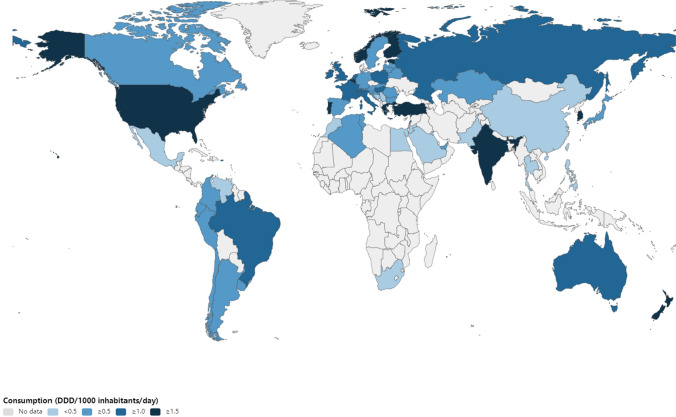
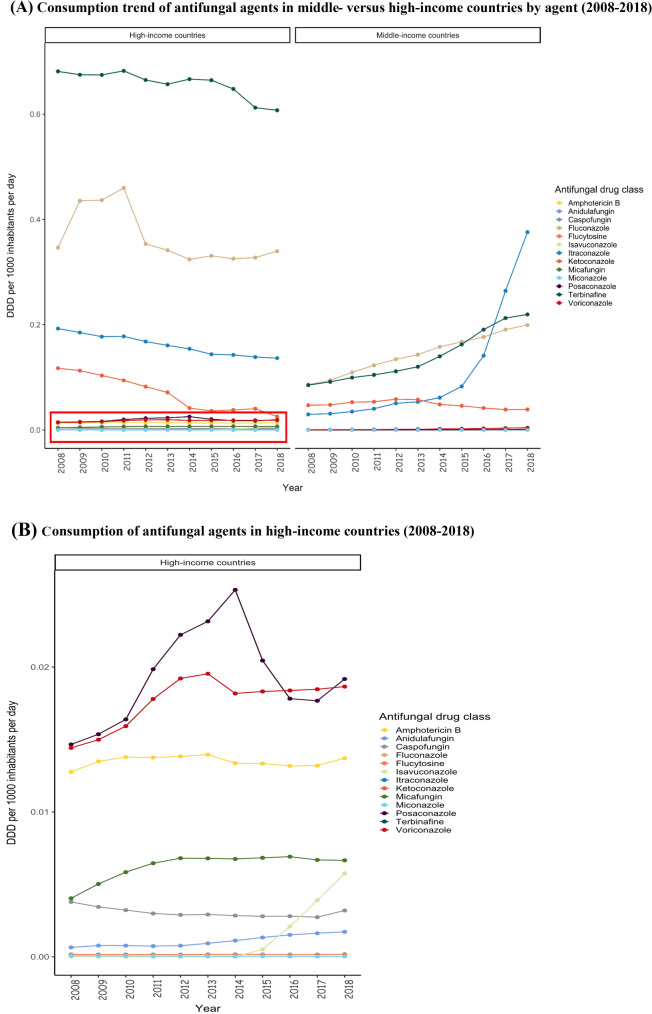
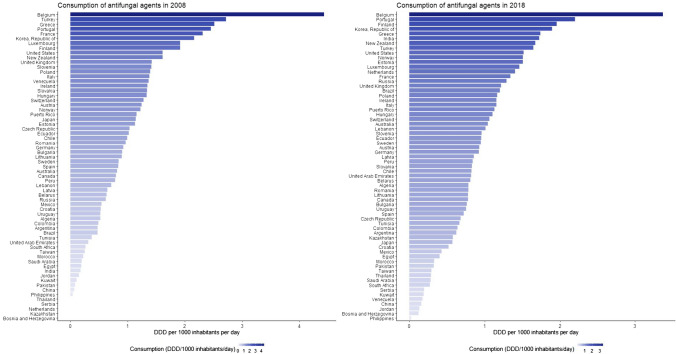
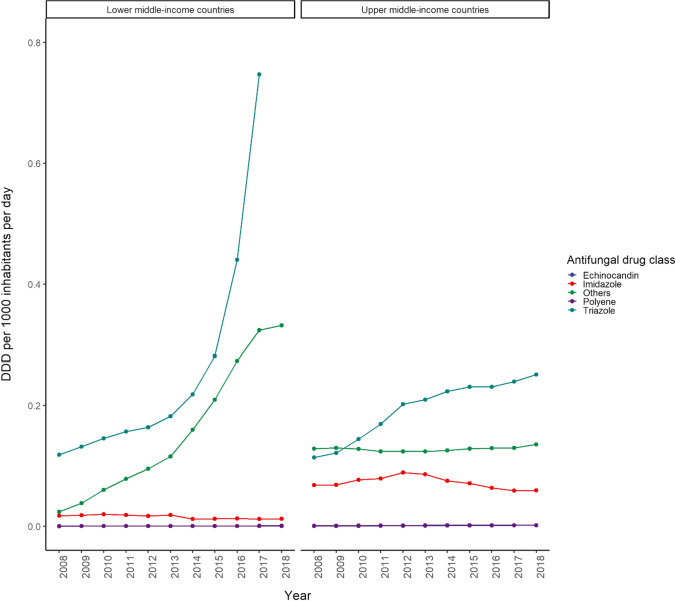
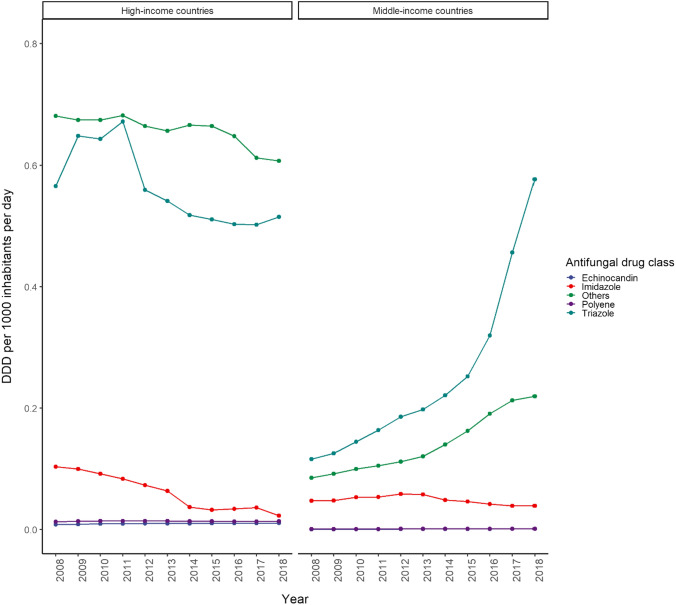
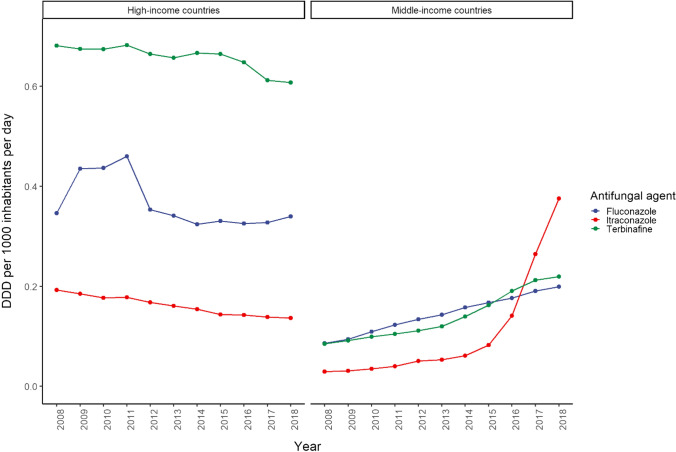
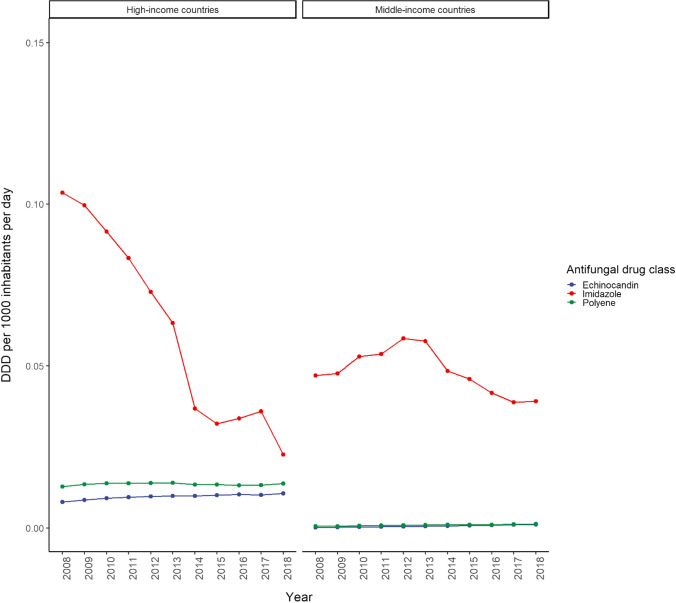
Results: Consumption of systemic antifungal agents increased from 0.50 (in 2008) to 0.92 defined daily dose (DDD)/1000 inhabitants/day (in 2018), with a compound annual growth rate of 6.2%. High-income countries remain major consumers of antifungal agents with large variance in quantities consumed, with a gradual decline in consumption in recent years. Consumption in middle-income countries increased. Itraconazole (0.32 DDD/1000 inhabitants/day), terbinafine (0.30 DDD/1000 inhabitants/day), and fluconazole (0.23 DDD/1000 inhabitants/day) were the most commonly used antifungal agents in middle- and high-income countries in 2018. Following incorporation into the World Health Organization Essential Medicines List, itraconazole consumption in middle-income countries surged. Consumption of ketoconazole slowly declined, with 5.04% annual decrease, probably due to labelling changes in 2013 to reflect hepatotoxicity concerns. The use of polyenes (0.004 DDD/1000 inhabitants/day) and echinocandins (0.003 DDD/1000 inhabitants/day) were lowest among all the antifungal drug classes.
Conclusion: Global consumption of triazoles and terbinafine has gradually increased in middle- and high-income countries. Life-saving antifungal agents, including echinocandins and polyenes, are available only parenterally and may be underutilized, mainly in middle-income countries. Future research on country-specific epidemiology is warranted to guide health policy coordination to ensure equitable access to appropriate use of antifungal agents.
© 2022. The Author(s).
Conflict of interest statement
EWC has received research grants from the Research Grants Council (RGC, Hong Kong), Narcotics Division of the Security Bureau of the Government of the Hong Kong SAR, Research Fund Secretariat of the Food and Health Bureau, National Natural Science Fund of China, Wellcome Trust, Bayer, Bristol-Myers Squibb, Pfizer, Janssen, Amgen, and Takeda, outside the submitted work. ICKW has received research grants from Research Grants Council (RGC, Hong Kong), Innovative Medicines Initiative (IMI), Shire, Janssen-Cilag, Eli-Lily, Pfizer, Bayer, and grants from European Union FP7 program, outside the submitted work. DCMK has sat on advisory boards for Becton Dickinson Pty Ltd and Merck Sharp & Dohme (MSD), and received financial support from MSD and F2G, outside the submitted work. MS has received grants from Gilead Sciences, Merck, F2G, and Pfizer unrelated to the submitted work. BJC has received funding from Sanofi Pasteur and Roche, outside the submitted work. The other author(s) declare no conflict of interest.
Figures
References
-
- Global Action Fund for Fungal Infections. 95–95 by 2025. Improving outcomes for patients with fungal infections across the world: a roadmap for the next decade. 2020. https://www.gaffi.org/. Accessed 19 Feb 2020.
-
- World Health Organization. WHO model list of essential medicine, 21st list. 2019. https://www.who.int/medicines/publications/essentialmedicines/en/. Accessed 17 Aug 2020.
-
- Hsia Y, Sharland M, Jackson C, Wong ICK, Magrini N, Bielicki JA. Consumption of oral antibiotic formulations for young children according to the WHO Access, Watch, Reserve (AWaRe) antibiotic groups: an analysis of sales data from 70 middle-income and high-income countries. Lancet Infect Dis. 2019;19(1):67–75. doi: 10.1016/S1473-3099(18)30547-4. - DOI - PubMed
MeSH terms
Substances
LinkOut - more resources
Full Text Sources
Research Materials
