


Efficacy of triple dose albendazole treatment for soil-transmitted helminth infections
- PMID: 35960935
- PMCID: PMC9374461
- DOI: 10.1371/journal.pone.0272821
Efficacy of triple dose albendazole treatment for soil-transmitted helminth infections
Abstract
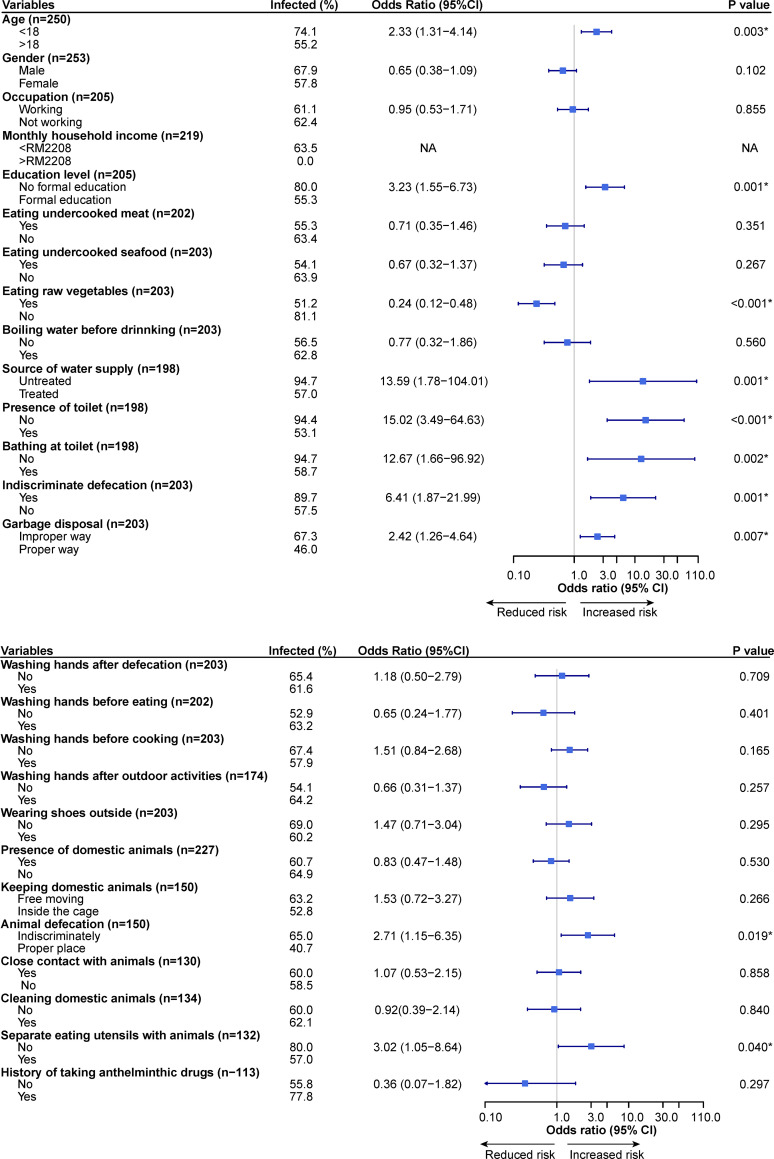
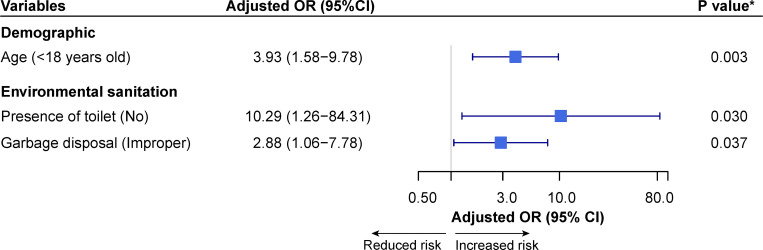
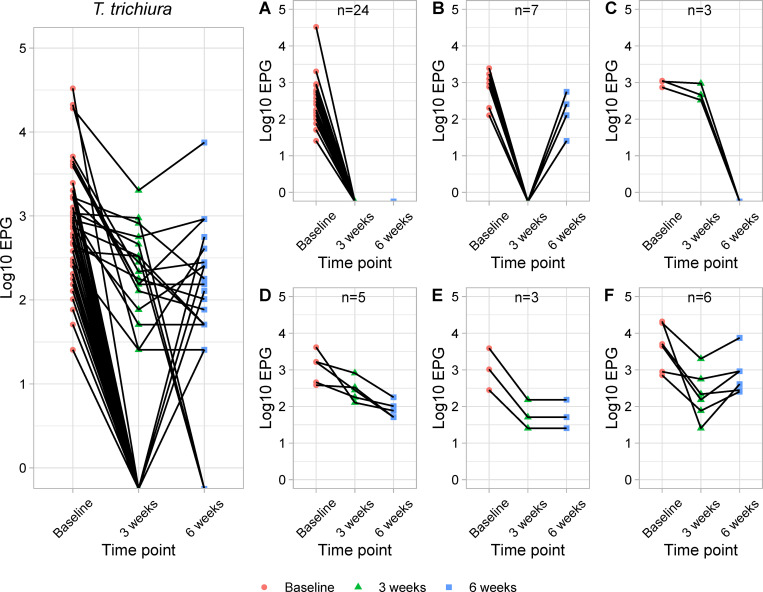
In Malaysia, soil-transmitted helminth (STH) infections still persist among indigenous communities. In the past, local studies have focused mostly on epidemiologic aspects of STH infections with a scarcity of information on the efficacy of deworming treatment. The present study consisted of 2 phases: a cross-sectional phase on current epidemiological status and risk factors of STH infections and a longitudinal study over 6 weeks on triple dose albendazole efficacy against STH infections. A total of 253 participants were recruited at baseline and a pre-tested questionnaire was administered to obtain information on socio-demographics, environmental and behavioural risk factors. Stool samples were evaluated using a modified Kato-Katz technique. Cure rate (CR) and egg reduction rate (ERR) were assessed at 3 weeks following a 3-day course of 400mg albendazole treatment and infection status were observed again at 6 weeks. Baseline positivity of trichuriasis, ascariasis and hookworm infections were 56.1%, 11.9% and 20.2%, respectively. Multivariate analysis showed age below 18 years old (P = 0.004), without latrine in house (P = 0.042) and indiscriminate defecation (P = 0.032) were associated with STH infections. In the longitudinal study (N = 89), CR for trichuriasis was 64.6%, while CR of 100% was observed for both ascariasis and hookworm. ERR was above 90% for all three STH species. A rapid increased of Trichuris trichiura egg output was observed at 6 weeks. In conclusion, STH infections are highly prevalent among indigenous communities. Children and teenagers, poor sanitation and hygiene behaviour were determinants for STH infections. Triple dose albendazole is found to be efficacious against Ascaris lumbricoides and hookworm infections but has moderate curative effect with high ERR against T. trichiura. Although triple dose albendazole regimen has logistic challenges and may not be a routine option, consideration of this treatment regime may still be necessary in selective communities to reduce high intensity of T. trichiura infection.
Conflict of interest statement
In accordance to PLOS ONE policies, we are reporting that one of our co-authors, Ken Cadwell has received research support from Pfizer, Takeda, Pacific Biosciences, Genentech, and Abbvie. Ken Cadwell has consulted for or received honoraria from Puretech Health, Genentech, and Abbvie. Ken Cadwell holds U.S. patent 10,722,600 and provisional patent 62/935,035 and 63/157,225. Ken Cadwell has consulted for or received an honoraria from Puretech Health, Genentech, Abbvie, GentiBio, and Synedgen. Ken Cadwell is an inventor on U.S. patent 10,722,600 and provisional patents 62/935,035 and 63/157,225. Other authors have declared that no competing interests exist. This does not alter our adherence to PLOS ONE policies on sharing data and materials.
Figures
References
-
- World Health Organization. Fact Sheet. Soil-transmitted helminth infections. 2021. [cited 2021 July 23]. Available from: https://www.who.int/en/news-room/fact-sheets/detail/soil-transmitted-hel....
-
- Silver ZA, Kaliappan SP, Samuel P, Venugopal S, Kang G, Sarkar R, et al. Geographical distribution of soil transmitted helminths and the effects of community type in South Asia and South East Asia—A systematic review. PLoS Negl Trop Dis. 2018;12(1):e0006153. doi: 10.1371/journal.pntd.0006153 - DOI - PMC - PubMed
-
- Jamaiah I, Rohela M. Prevalence of intestinal parasites among members of the public in Kuala Lumpur, Malaysia. Southeast Asian J Trop Med Public Health. 2005;36:68–71. - PubMed
Publication types
MeSH terms
Substances
Grants and funding
LinkOut - more resources
Full Text Sources
Miscellaneous
