


Fertility intentions among young people in the era of China's three-child policy: a national survey of university students
- PMID: 35962340
- PMCID: PMC9372952
- DOI: 10.1186/s12884-022-04873-y
Fertility intentions among young people in the era of China's three-child policy: a national survey of university students
Abstract
Background: This study aimed to assess the fertility intentions of young people after the announcement of the three-child policy in China and to determine whether knowledge about reproductive, maternal, newborn, and child health (RMNCH) services or support, childbearing- and childbirth-related anxiety, and parenthood-related anxiety influence fertility intentions.
Methods: A cross-sectional Internet-based survey was conducted on a nationwide sample of young people aged 18 to 28 years old in education institutions. Factors associated with fertility intentions were analysed using partial least squares structural equation modelling (PLS-SEM).
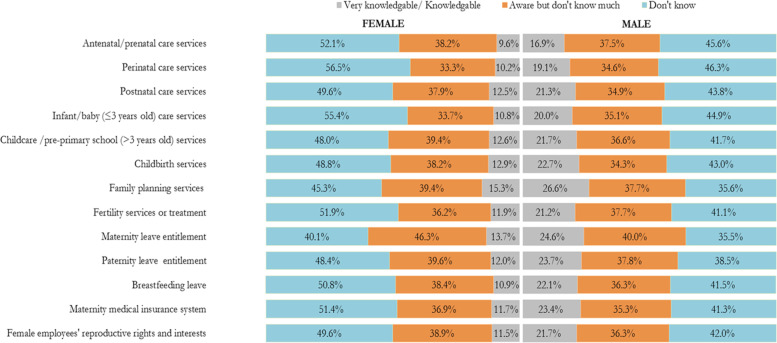
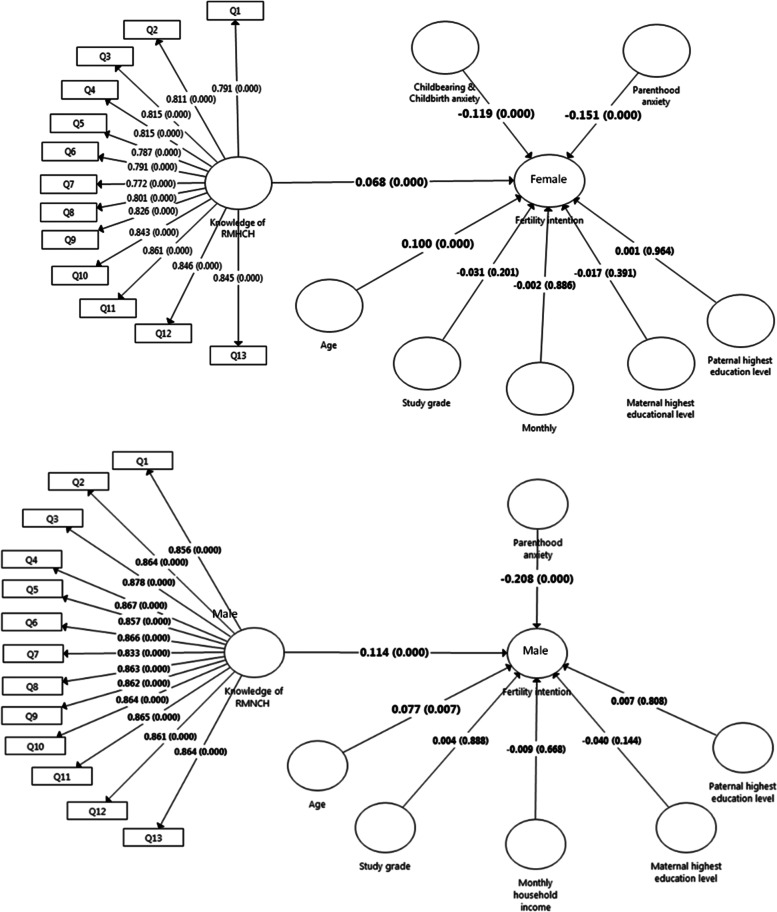
Results: Only 4.2% of males and 1.7% of females intended to have three children or more. On the whole, the majority (40.3%) reported the intention to have two children. The mean and standard deviation (SD) for the total knowledge RMNCH support and/or services knowledge score was 9.5 (SD ± 8.9), out of a possible score of 39. The median and interquartile range (IQR) of childbearing- and childbirth-related anxiety score was 8.0 (IQR = 6.0-9.0), out of a possible score of 10. The median and IQR of parenthood-related anxiety score among the males was 6.0 (IQR = 4.0-9.0) and for females was 7.0 (IQR = 5.0-9.0). Results from PLS-SEM revealed that a higher level of knowledge of RMNCH support and/or services is significantly associated with higher fertility intentions. Both childbearing- and childbirth-related anxiety and parenthood-related anxiety were inversely associated with fertility intentions.
Conclusion: Raising awareness about RMNCH supportive measures and easing birth- and parenting anxiety are imperative to enhance birth rates. Future policies should pay more attention to these determinants to achieve their intended goal of boosting population growth.
Keywords: Childbearing; Fertility intentions; Parenthood; Three–child policy; Young adult.
© 2022. The Author(s).
Conflict of interest statement
The authors declare that they have no competing interests.
Figures



References
-
- National Bureau of Statistics China . Main Data of the Seventh National Population Census. 2021.
-
- World Population Review . Total Fertility Rate 2021. 2021.
-
- Global Times . China’s fertility rate may become ‘world’s lowest’ without strong intervention policy, India may overtake China by 2023: demographers. 2021.
-
- China Briefing . Why China Has Amended its Population Policy and What it Means for the Economy. 2021.
MeSH terms
LinkOut - more resources
Full Text Sources
