


Advances in nuclear medicine-based molecular imaging in head and neck squamous cell carcinoma
- PMID: 35962347
- PMCID: PMC9373390
- DOI: 10.1186/s12967-022-03559-5
Advances in nuclear medicine-based molecular imaging in head and neck squamous cell carcinoma
Abstract
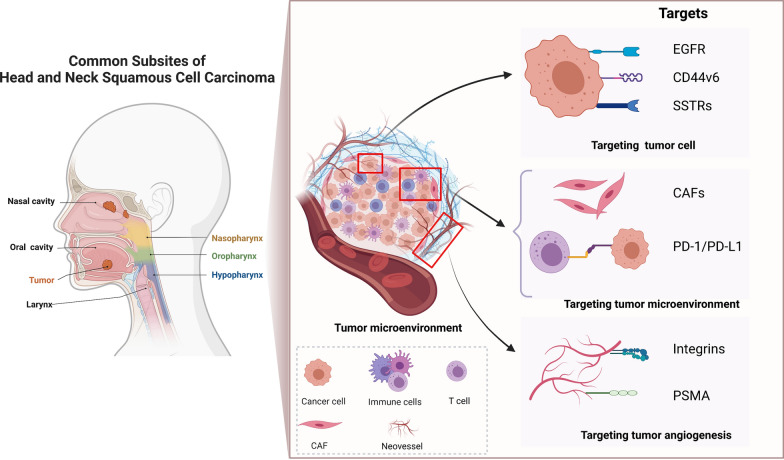
Head and neck squamous cell carcinomas (HNSCCs) are often aggressive, making advanced disease very difficult to treat using contemporary modalities, such as surgery, radiation therapy, and chemotherapy. However, targeted therapy, e.g., cetuximab, an epidermal growth factor receptor inhibitor, has demonstrated survival benefit in HNSCC patients with locoregional failure or distant metastasis. Molecular imaging aims at various biomarkers used in targeted therapy, and nuclear medicine-based molecular imaging is a real-time and non-invasive modality with the potential to identify tumor in an earlier and more treatable stage, before anatomic-based imaging reveals diseases. The objective of this comprehensive review is to summarize recent advances in nuclear medicine-based molecular imaging for HNSCC focusing on several commonly radiolabeled biomarkers. The preclinical and clinical applications of these candidate imaging strategies are divided into three categories: those targeting tumor cells, tumor microenvironment, and tumor angiogenesis. This review endeavors to expand the knowledge of molecular biology of HNSCC and help realizing diagnostic potential of molecular imaging in clinical nuclear medicine.
Keywords: Cancer-associated fibroblasts; Epidermal growth factor receptor; Head and neck squamous cell carcinoma; Molecular imaging; Nuclear medicine; Programmed cell death ligand 1; Prostate-specific membrane antigen; Somatostatin receptor.
© 2022. The Author(s).
Conflict of interest statement
The authors declare that there is no conflict of interest regarding the publication of this paper.
Figures
References
-
- Adkins D, Ley J, Neupane P, Worden F, Sacco AG, Palka K, et al. Palbociclib and cetuximab in platinum-resistant and in cetuximab-resistant human papillomavirus-unrelated head and neck cancer: a multicentre, multigroup, phase 2 trial. Lancet Oncol. 2019;20:1295–1305. doi: 10.1016/S1470-2045(19)30405-X. - DOI - PubMed
Publication types
MeSH terms
Substances
LinkOut - more resources
Full Text Sources
Medical
Research Materials
