. 2022 Oct;90(5):375-388.
doi: 10.1007/s00239-022-10068-y. Epub 2022 Aug 13.

uORF-Mediated Translational Regulation of ATF4 Serves as an Evolutionarily Conserved Mechanism Contributing to Non-Small-Cell Lung Cancer (NSCLC) and Stress Response

Affiliations

uORF-Mediated Translational Regulation of ATF4 Serves as an Evolutionarily Conserved Mechanism Contributing to Non-Small-Cell Lung Cancer (NSCLC) and Stress Response

Wenjing Xiao et al. J Mol Evol. 2022 Oct.

Abstract

Diseases and environmental stresses are two distinct challenges for virtually all living organisms. In light of evolution, cellular responses to diseases and stresses might share similar molecular mechanisms, but the detailed regulation pathway is not reported yet.We obtained the transcriptomes and translatomes from several NSCLC (non-small-cell lung cancer) patients as well as from different species under normal or stress conditions. We found that the translation level of gene ATF4 is remarkably enhanced in NSCLC due to the reduced number of ribosomes binding to its upstream open reading frames (uORFs). We also showed the evolutionary conservation of this uORF-ATF4 regulation in the stress response of other species. Molecular experiments showed that knockdown of ATF4 reduced the cell growth rate while overexpression of ATF4 enhanced cell growth, especially for the ATF4 allele with mutated uORFs. Population genetics analyses in multiple species verified that the mutations that abolish uATGs (start codon of uORFs) are highly deleterious, suggesting the functional importance of uORFs.Our study proposes an evolutionarily conserved pattern that enhances the ATF4 translation by uORFs upon stress or disease. We generalized the concept of cellular response to diseases and stresses. These two biological processes may share similar molecular mechanisms.

Keywords: ATF4; Evolutionarily conserved; Non-small-cell lung cancer (NSCLC); Stress response; Translation regulation; Upstream open reading frame (uORF).


Conflict of interest statement

The authors declare they have no conflict of interest.

Figures

Fig. 1
Fig. 1
uORF and ATF4 gene. A Normally, ribosomes will translate the CDS from start codon ATG. If there is uORF in the 5′UTR, then the ATG of uORF will sequestrate the ribosomes and lead to the translation on uORF, preventing the CDS from being translated. B Mammalian gene ATF4 (activating transcription factor 4) has four uORFs. The conservation level (given by phyloP value) is obviously higher in the uORF regions compared to the rest of the 5′UTR regions. The sequence alignment also shows high similarity among vertebrates. The black regions mean identical nucleotides with human sequence. Gray regions mean non-identical nucleotides with human sequence. Gaps are shown as thin lines. The gene model is just an example because in reality the uORF could extend into the CDS
Fig. 2
Fig. 2
Expression and translation of ATF4 in NSCLC patients. A The mRNA and TE foldchange of expressed genes. The genes are ranked by mean foldchange among the 7 NSCLC patients. There are three genes with mRNA and TE foldchange > 0 in all 7 patients. They are ATF4 (activating transcription factor 4), S100P (S100 calcium binding protein P), and NeK2 (NIMA-related kinase 2). B The foldchange of mRNA expression and TE in seven NSCLC patients compared to normal white blood cells. ATF4 gene is labeled with red star. C Pearson correlation between the mRNA foldchange and TE foldchange of ATF4 gene in seven NSCLC patients. D Correlation between ATF4 foldchange and the age of NSCLC patients. E Relationship between ATF4 foldchange and the gender of NSCLC patients
Fig. 3
Fig. 3
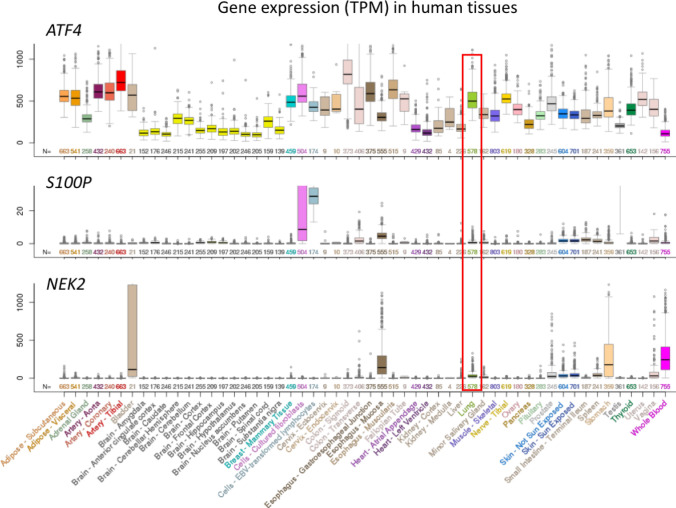
Expression (measured by TPM) of genes in human tissues from GTEx data. The rectangle highlights the white blood. These three genes have mRNA and TE foldchange > 0 in all 7 patients. ATF4 (activating transcription factor 4), S100P (S100 calcium binding protein P), and NeK2 (NIMA-related kinase 2)
Fig. 4
Fig. 4
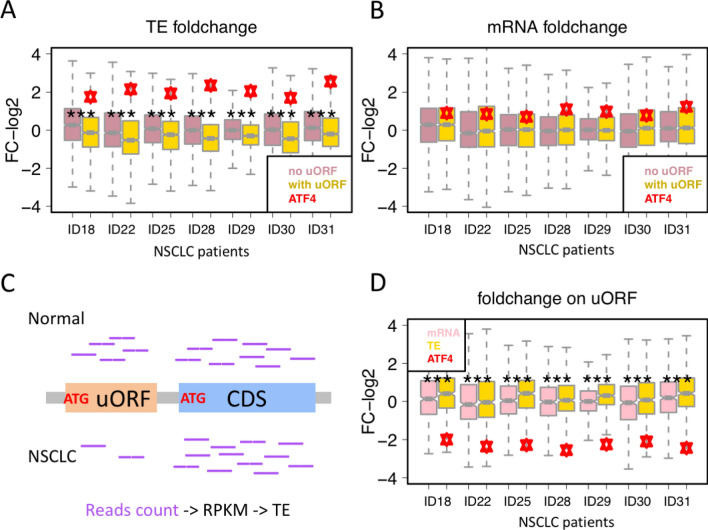
Genes with uORFs are translationally suppressed except ATF4. A TE foldchange of genes with or without uORFs. ATF4 gene is labeled with red star. The statistical significance is calculated with KS tests. ***represents p-value < 0.001. B mRNA foldchange of genes with or without uORFs. ATF4 gene is labeled with red star. C The reads count on uORF and CDS to calculate RPKM, TE, and foldchange values. D mRNA and TE foldchange of uORFs. ATF4 gene is labeled with red star. The statistical significance is calculated with KS tests. ***represents p-value < 0.001
Fig. 5
Fig. 5
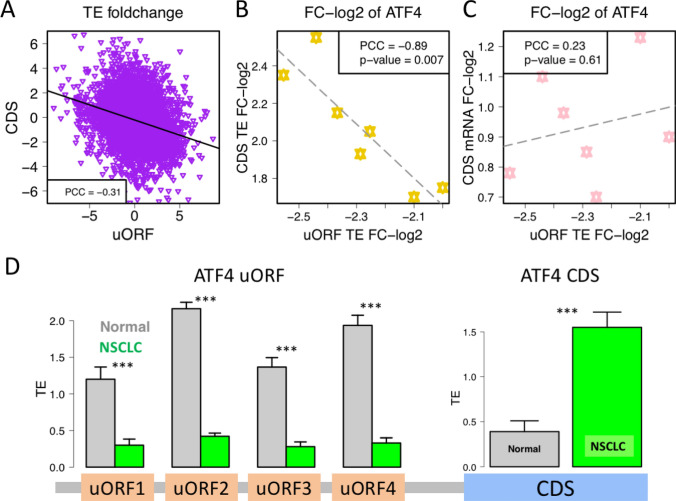
The reduced uORF translation lead to the increased translation in CDS of gene ATF4. A Pearson correlation between the TE foldchange in each gene and the matched uORF. Multiple uORFs within one gene are combined. Patient ID18 was used to plot this graph. B For ATF4 gene across the seven NSCLC patients, the TE foldchange in CDS is negatively correlated with the TE foldchange in uORF. C The mRNA foldchange in CDS is not correlated with the TE foldchange in uORF. D TE of CDS and 4 uORFs in ATF4 gene. The mean and standard deviation across seven patients were displayed. The gene model is just an example because in reality the uORF could extend into the CDS. The overlapped region between uORF and CDS is not used for reads count and TE calculation. All the comparisons between normal and NSCLC are significant under KS tests (p-value < 0.001)
Fig. 6
Fig. 6
The experimental verification of the uORF-ATF4-phenotype axis. A Design of five ATF4 variant sequences. The ATG of the four uORFs is mutated separately (variant-1 to variant-4) or together (variant-5). B Cell growth of human cell line with si-NC (negative control) and the knockdown of ATF4. C Cell growth under transfection of different ATF4 variants and NC
Fig. 7
Fig. 7
The translational changes on uORF and CDS of ATF4 upon nutrient deprivation. A In MEF (mouse embryonic fibroblast) cells, the uORF translation of ATF4 is reduced while the CDS translation is enhanced upon nutrient deprivation. B In Drosophila S2 cells, the uORF translation of ATF4 is reduced while the CDS translation is enhanced upon nutrient deprivation. The TE is displayed as mean and standard deviation of all the samples and replicates. The gene model is just an example because in reality the uORF could extend into the CDS. The overlapped region between uORF and CDS is not used for reads count and TE calculation
Fig. 8
Fig. 8
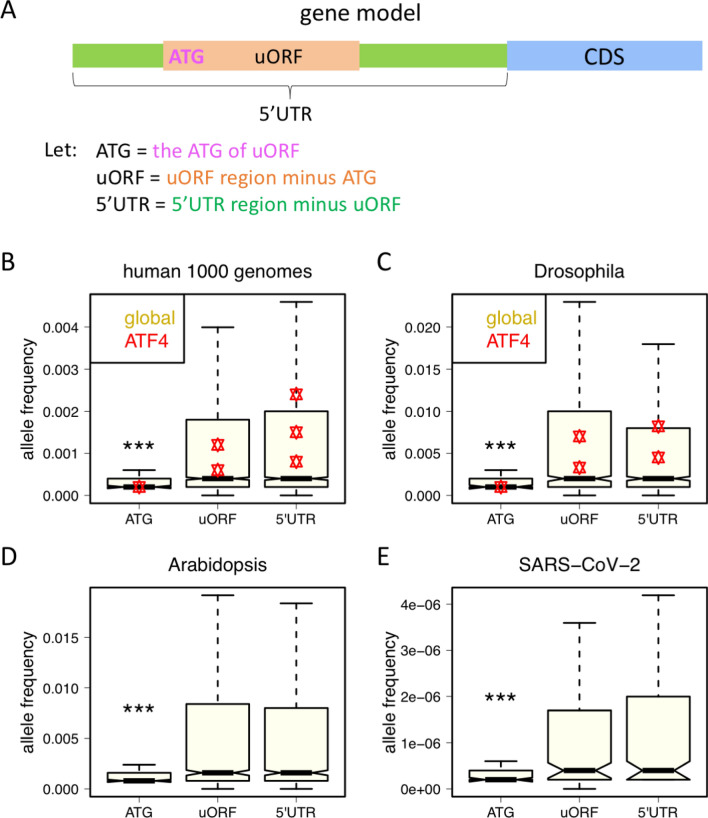
The population genetics analysis on uORFs. A Classification of mutations in 5′UTR. B Allele frequency of different sets of mutations in the human 1000 genomes. The mutations in ATF4 gene are highlighted as red stars. The statistical significance is judged by KS test between ATG and the other two sets of mutations. ***means p-value < 0.001. C Allele frequency of different sets of mutations in the Drosophila genetic reference panel. The mutations in ATF4 gene are highlighted as red stars. The statistical significance is judged by KS test between ATG and the other two sets of mutations. ***means p-value < 0.001. D Allele frequency of mutations obtained from the 1000 genome project of Arabidopsis thaliana. ***means p-value < 0.001. E Allele frequency of mutations obtained from the world-wide SARS-CoV-2 sequences. ***means p-value < 0.001. These results prove that mutations in uATG are sufficient to abolish uORFs and that these mutations are deleterious

References

    1. Akulich KA, Sinitcyn PG, Makeeva DS, Andreev DE, Terenin IM, Anisimova AS, Shatsky IN, Dmitriev SE. A novel uORF-based regulatory mechanism controls translation of the human MDM2 and eIF2D mRNAs during stress. Biochimie. 2019;157:92–101. doi: 10.1016/j.biochi.2018.11.005. - DOI - PubMed
    1. Alonso-Blanco C, Andrade J, Becker C, Bemm F, Bergelson J, Borgwardt KM, Cao J, Chae E, Dezwaan TM, Ding W, et al. 1,135 genomes reveal the global pattern of polymorphism in arabidopsis thaliana. Cell. 2016;166:481–491. doi: 10.1016/j.cell.2016.05.063. - DOI - PMC - PubMed
    1. Arella D, Dilucca M, Giansanti A. Codon usage bias and environmental adaptation in microbial organisms. Mol Genet Genomics. 2021;296:751–762. doi: 10.1007/s00438-021-01771-4. - DOI - PMC - PubMed
    1. Cai H, Liu X, Zheng X. RNA editing detection in SARS-CoV-2 transcriptome should be different from traditional SNV identification. J Appl Genet. 2022 doi: 10.1007/s13353-022-00706-y. - DOI - PMC - PubMed
    1. Chan CP, Kok KH, Tang HM, Wong CM, Jin DY. Internal ribosome entry site-mediated translational regulation of ATF4 splice variant in mammalian unfolded protein response. Biochim Biophys Acta. 2013;1833:2165–2175. doi: 10.1016/j.bbamcr.2013.05.002. - DOI - PubMed

Substances