Review
. 2022 Oct:69:102189.
doi: 10.1016/j.mib.2022.102189. Epub 2022 Aug 11.

How did we get here? Insights into mechanisms of immunity-related GTPase targeting to intracellular pathogens

Affiliations
Review

How did we get here? Insights into mechanisms of immunity-related GTPase targeting to intracellular pathogens

Jacob Dockterman et al. Curr Opin Microbiol. 2022 Oct.

Abstract

The cytokine gamma-interferon activates cell-autonomous immunity against intracellular bacterial and protozoan pathogens by inducing a slew of antimicrobial proteins, some of which hinge upon immunity-related GTPases (IRGs) for their function. Three regulatory IRG clade M (Irgm) proteins chaperone about approximately 20 effector IRGs (GKS IRGs) to localize to pathogen-containing vacuoles (PVs) within mouse cells, initiating a cascade that results in PV elimination and killing of PV-resident pathogens. However, the mechanisms that allow IRGs to identify and traffic specifically to 'non-self' PVs have remained elusive. Integrating recent findings demonstrating direct interactions between GKS IRGs and lipids with previous work, we propose that three attributes mark PVs as GKS IRG targets: the absence of membrane-bound Irgm proteins, Atg8 lipidation, and the presence of specific lipid species. Combinatorial recognition of these three distinct signals may have evolved as a mechanism to ensure safe delivery of potent host antimicrobial effectors exclusively to PVs.


Conflict of interest statement

Conflict of interest statement

The authors declare that they have no known competing financial interests or personal relationships that could have appeared to influence the work reported in this paper.

Figures
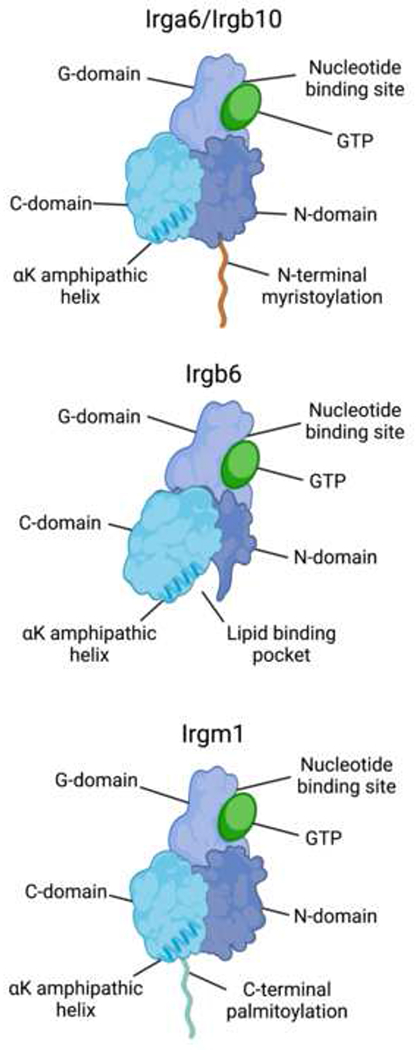
Figure 1.
Figure 1.. Structural features of IRGs.
All IRGs contain a C-domain, G-domain, and N-domain. The G-domain contains the nucleotide binding pocket, with GKS IRGs such as Irga6, Irgb6, and Irgb10 containing a canonical GxxxxGKS amino acid sequence in the nucleotide-binding pocket and Irgm proteins containing a non-canonical GxxxxGMS sequence. Homo- and hetero-oligomerization among IRGs occurs via G-domain interactions. Membrane binding requires a conserved αK amphipathic helix in the C-domain. Additionally, Irga6 and Irgb6 possess an N-terminal myristoylation motif, and Irgm1 contains a C-terminal palmitoylation motif allowing for covalent lipid attachments that assist in membrane binding. In contrast, Irgb6 harbors a binding pocket for specific phospholipids such as PI5P. Figure created with BioRender.com
Figure 2.
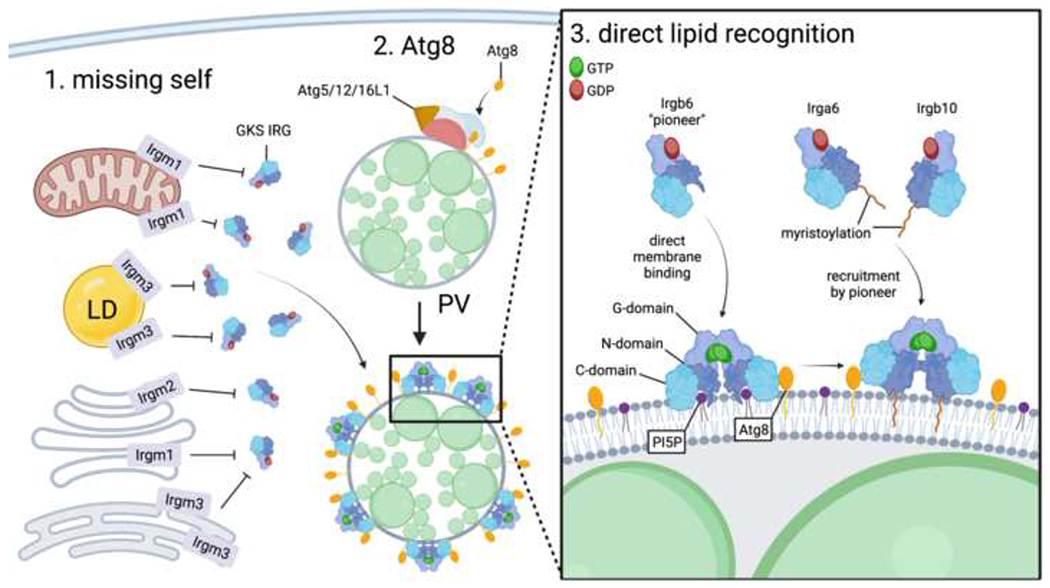
Figure 2.. Three-signal model for IRG recruitment.
Irgm proteins reside on the membranes of host organelles such as mitochondria, lipid droplet (LD), endoplasmic reticulum, and Golgi apparatus. As Irgm proteins inhibit GTPase activity of GKS IRGs, their absence (i.e. “missing self”) on the membranes of vacuoles containing intracellular pathogens such as C. trachomatis (green circles) renders those membranes permissive to GKS IRG recruitment. Conjugation of Atg8 proteins to phosphotidylethanolamine by Atg5/12/16L1 at the PVM comprises a second signal for GKS IRG recruitment. Finally, some IRGs such as Irgb6 specifically bind PV-enriched lipid species such as PI5P and may go on to recruit other IRGs such as Irga6 and Irgb10. Figure created with BioRender.com.

References

    1. Borden EC, Sen GC, Uze G, Silverman RH, Ransohoff RM, Foster GR, Stark GR: Interferons at age 50: past, current and future impact on biomedicine. Nat Rev Drug Discov 2007, 6:975–990. - PMC - PubMed
    1. Pilla-Moffett D, Barber MF, Taylor GA, Coers J: Interferon-Inducible GTPases in Host Resistance, Inflammation and Disease. J Mol Biol 2016, 428:3495–3513. - PMC - PubMed
    1. Huang S, Meng Q, Maminska A, MacMicking JD: Cell-autonomous immunity by IFN-induced GBPs in animals and plants. Curr Opin Immunol 2019, 60:71–80. - PMC - PubMed
    1. Bekpen C, Hunn JP, Rohde C, Parvanova I, Guethlein L, Dunn DM, Glowalla E, Leptin M, Howard JC: The interferon-inducible p47 (IRG) GTPases in vertebrates: loss of the cell autonomous resistance mechanism in the human lineage. Genome Biol 2005, 6:R92. - PMC - PubMed
    1. Martens S, Parvanova I, Zerrahn J, Griffiths G, Schell G, Reichmann G, Howard JC: Disruption of Toxoplasma gondii parasitophorous vacuoles by the mouse p47-resistance GTPases. Plos Pathogens 2005, 1:187–201. - PMC - PubMed
    2. Martens et al, Ling et al., and Zhao et al. identify the membranolytic activity of GKS proteins resulting in PV lysis and host cell death. Ling et al. further demonstrate that some GKS IRGs can directly target the plasma membrane of the parasite resulting in parasite killing.

Publication types