. 2022 Sep 26;32(18):3925-3938.e6.
doi: 10.1016/j.cub.2022.07.036. Epub 2022 Aug 12.

Rational engineering of a synthetic insect-bacterial mutualism

Affiliations

Rational engineering of a synthetic insect-bacterial mutualism

Yinghua Su et al. Curr Biol. .

Abstract

Many insects maintain mutualistic associations with bacterial endosymbionts, but little is known about how they originate in nature. In this study, we describe the establishment and manipulation of a synthetic insect-bacterial symbiosis in a weevil host. Following egg injection, the nascent symbiont colonized many tissues, including prototypical somatic and germinal bacteriomes, yielding maternal transmission over many generations. We then engineered the nascent symbiont to overproduce the aromatic amino acids tyrosine and phenylalanine, which facilitate weevil cuticle strengthening and accelerated larval development, replicating the function of mutualistic symbionts that are widely distributed among weevils and other beetles in nature. Our work provides empirical support for the notion that mutualistic symbioses can be initiated in insects by the acquisition of environmental bacteria. It also shows that certain bacterial genera, including the Sodalis spp. used in our study, are predisposed to develop these associations due to their ability to maintain benign infections and undergo vertical transmission in diverse insect hosts, facilitating the partner-fidelity feedback that is critical for the evolution of obligate mutualism. These experimental advances provide a new platform for laboratory studies focusing on the molecular mechanisms and evolutionary processes underlying insect-bacterial symbiosis.

Keywords: bacteria; genome engineering; insect; mutualism; symbiosis; synthetic biology.


Conflict of interest statement

Declaration of interests The authors declare no competing interests.

Figures

Figure 1:
Figure 1:. Establishment of S. praecaptivus MC1 in aposymbiotic weevils following egg injection.
(A) Schematic and micrograph showing microinjection into the egg posterior pole (PP). Subsequent images (B-I) are shown under normal light and under mCherry fluorescence. (B) Egg one day post injection (PI) showing infection at PP. (C) Egg four days post injection, with infection progressing. (D) Egg four days post injection with a ΔypeI mutant, showing extensive pathogenesis. (E) First instar larva, immediately following emergence from microinjected egg. (F) Adult weevil, injected at egg stage following emergence from grain. (G) Egg derived from microinjected parents that acquired S. praecaptivus via maternal transmission at five days post deposition (PD). (H) First instar larva derived from egg-microinjected parents. (I) Ovaries from mated aposymbiotic female derived from microinjected egg, showing extensive colonization. See also Figure S1 and Video S1.
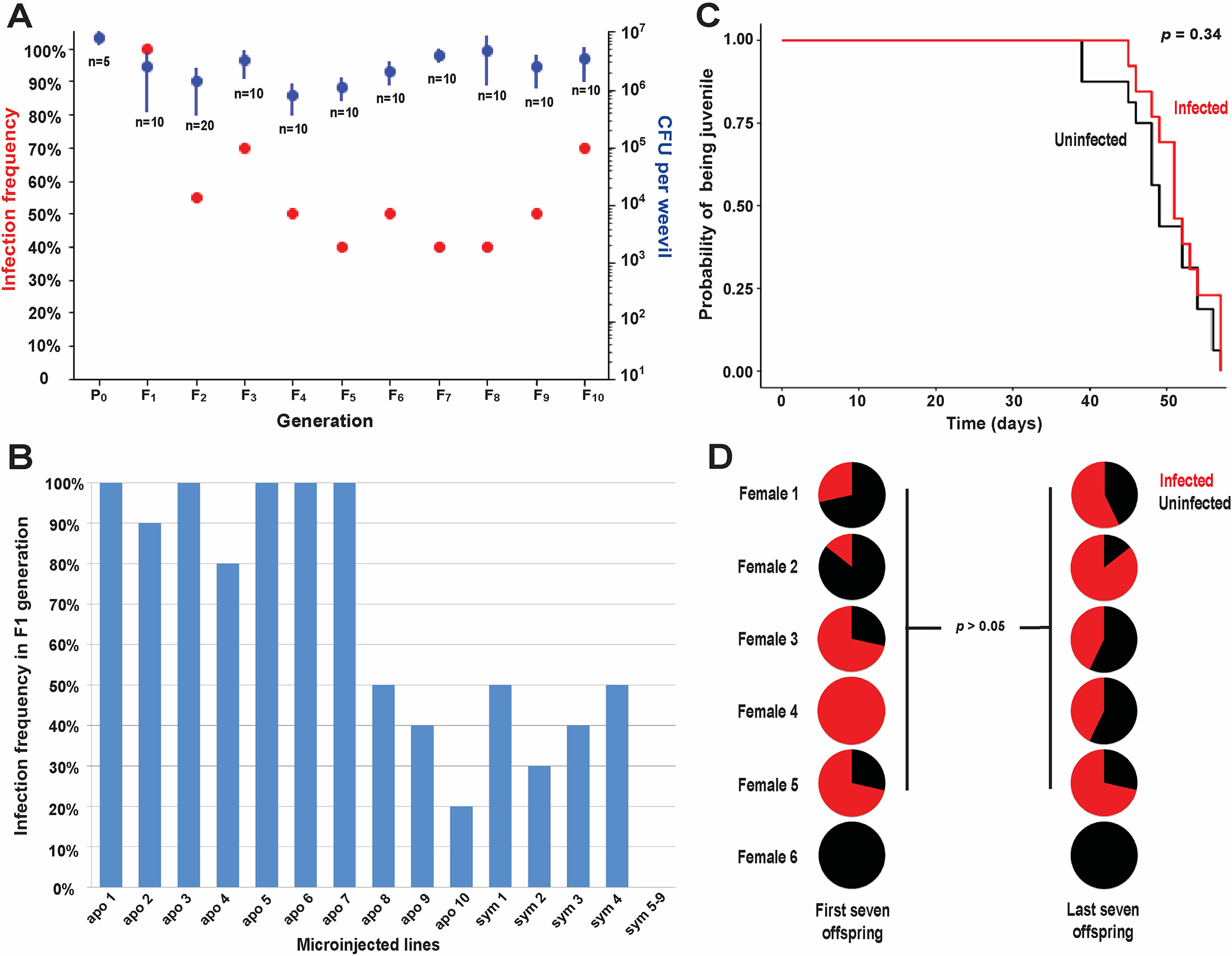
Figure 2:
Figure 2:. Dynamics of S. praecaptivus MC1 infection following egg injection.
(A) Infection frequency and average bacterial density (with error bars showing standard deviation) in adult weevils over ten generations. (B) Dynamics of F1 infection in multiple replicated egg injection experiments involving aposymbiotic (apo) and symbiotic (sym) grain weevils (n=10 for each line). (C) Kaplan-Meier analysis of association between infection and developmental status. (D) Infection status of the first seven and last seven offspring obtained from six individual aposymbiotic F6 females infected with S. praecaptivus MC1, demonstrating no significant difference.
Figure 3:
Figure 3:. Localization of Sodalis praecaptivus MC1 expressing mCherry (red) in offspring of aposymbiotic (apo) and symbiotic (sym) weevils infected by egg microinjection.
(A) Larval gut with white circle highlighting the bacteriome that develop only in sym weevils, shown under normal (left) and fluorescent (right) light. (B) Scanning electron micrograph (SEM) of the weevil symbiont, S. pierantonius, isolated from uninjected sym S. zeamais bacteriome, showing distinctive spiral morphology. (C) Confocal image of larval gut bacteriome from sym weevil, stained with Hoechst 33342 (blue; targeting nucleic acid), showing co-habitation of S. praecaptivus MC1 (red) and S. pierantonius (blue spirals). (D) Adult gut from newly emerged weevils with white circles highlighting cecal bacteriomes that form only in sym weevils. (E) Confocal image of cecal bacteriome from sym weevil, stained with Hoechst 33342 (blue; targeting nucleic acid) and CellMask Green (yellow: targeting cell membranes), showing co-habitation of S. praecaptivus MC1 (red) and S. pierantonius (blue spirals). Inset images in panels C&E are zoomed and enhanced in contrast. See also Figure S1 and S2.
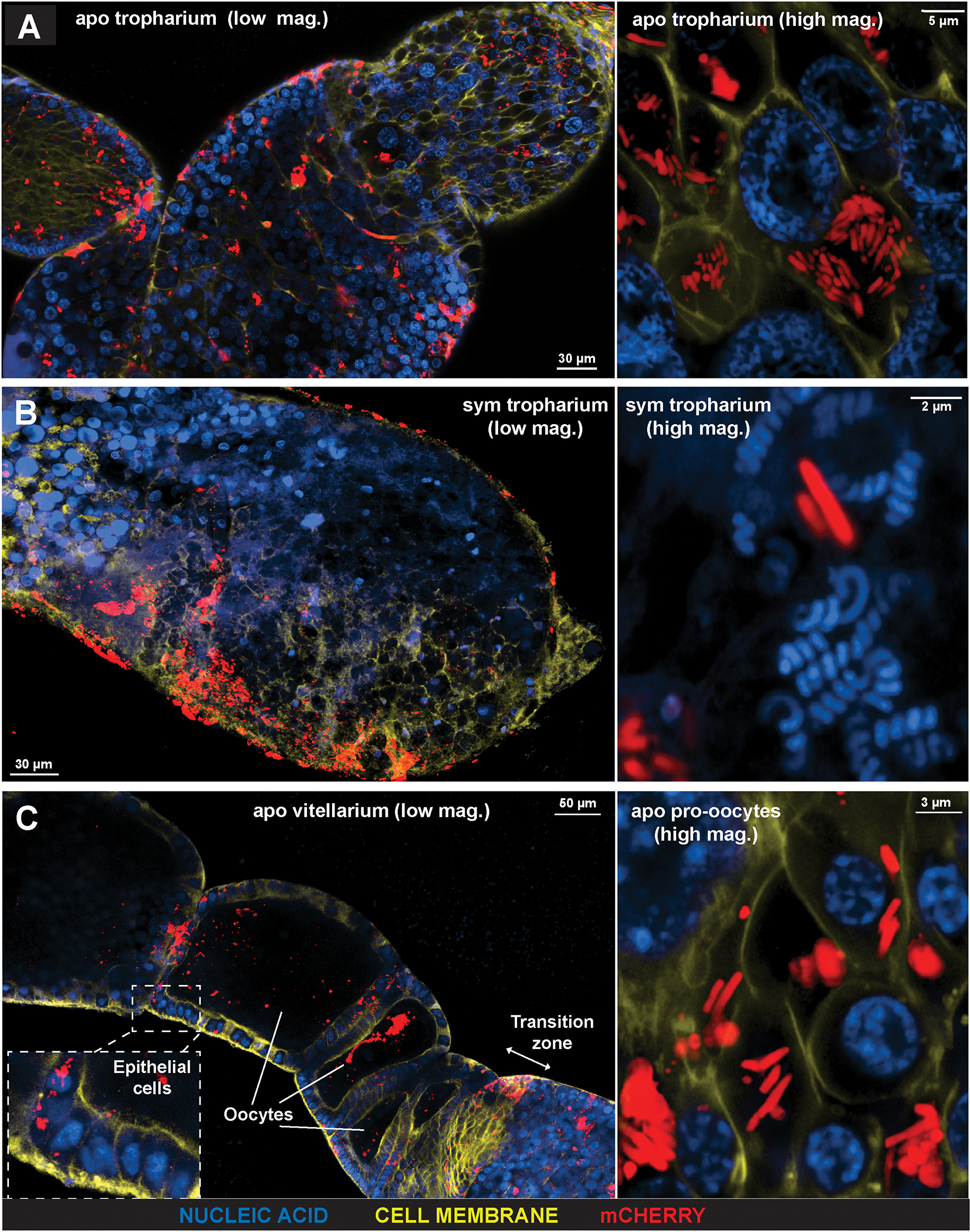
Figure 4:
Figure 4:. Low (left) and high (right) magnification confocal images of S. praecaptivus MC1 expressing mCherry (red) in ovaries of offspring from aposymbiotic (apo) and symbiotic (sym) weevils following egg microinjection.
Specimens were stained with Hoechst 33342 (blue: targeting nucleic acid) and CellMask Green (yellow: targeting cell membranes). (A) Tropharium from adult apo weevil, showing S. praecaptivus MC1 inside tropharium cells. (B) Tropharium from adult sym weevil, showing co-existence of S. praecaptivus MC1 and S. pierantonius. (C) Vitellarium from adult apo weevil, with S. praecaptivus MC1 in epithelial cells, developing oocytes and the tropharium/vitellarium transition zone containing pro-oocytes.
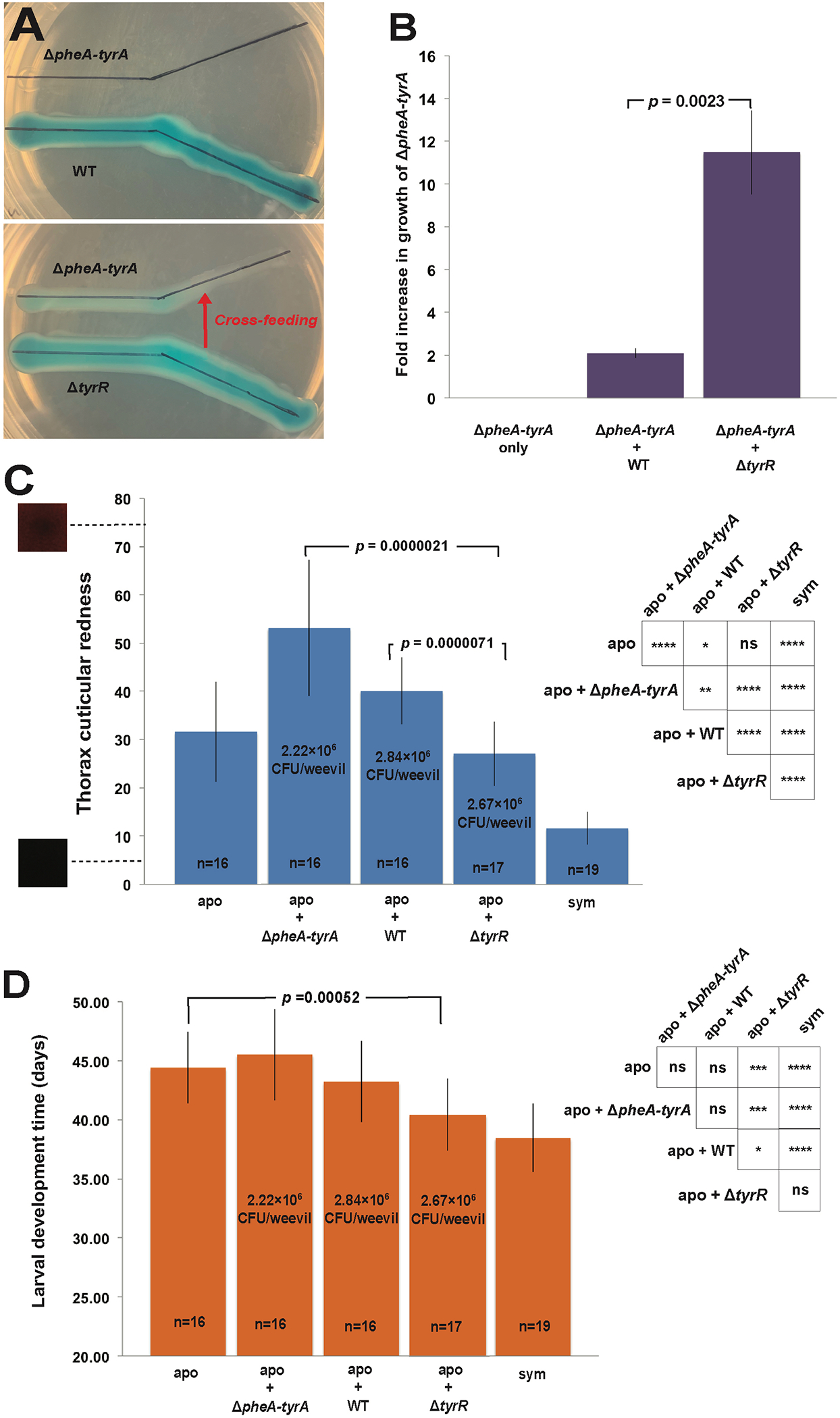
Figure 5:
Figure 5:. Characterization of S. praecaptivus strains with modified tyrosine and phenylalanine biosynthesis.
(A) Plate-based assay on minimal medium, showing a ΔtyrR overproducer cross-feeding ΔpheA-tyrA auxotroph. (B) Growth of an auxotrophic ΔpheA-tyrA strain over seven days in minimal medium alone or in the presence of wild type or ΔtyrR strains following inoculation of cells at equal densities. The auxotrophic ΔpheA-tyrA strain shows significant growth increase only in the presence of the ΔtyrR overproducer, relative to the wild type strain (>10 fold; p < 0.01). See additional data presented in Figure S3B. (C) Thorax cuticular redness of two-week-old sym weevils and their apo derivatives with and without ΔpheA-tyrA, WT and ΔtyrR strains of S. praecaptivus injected at egg stage. Boxes on left show the raw images associated with the highest and the lowest red values in the dataset. (D) Larval development time of sym weevils and apo counterparts with and without ΔpheAtyrA, WT and ΔtyrR strains injected at egg stage. Matrices show results of pairwise statistical analyses (t-test) indicating no significant difference and asterisks indicating significance of p < 0.05, p < 0.01, p < 0.001 and p < 0.0001. See also Figure S3.

Comment in

References

    1. Klepzig KD, Adams AS, Handelsman J, and Raffa KF (2009). Symbioses: A Key Driver of Insect Physiological Processes, Ecological Interactions, Evolutionary Diversification, and Impacts on Humans. Environ. Entomol. 38, 67–77. - PubMed
    1. Stork NS (2018). How Many Species of Insects and Other Terrestrial Arthropods Are There on Earth? Annu. Rev. Entomol. 63. 31–45. - PubMed
    1. Moran NA, Plague GR, Sandström JP, and Wilcox JL (2003). A genomic perspective on nutrient provisioning by bacterial symbionts of insects. Proc. Natl. Acad. Sci. U.S.A. 100, 14543–14548. - PMC - PubMed
    1. Douglas AE (1998). Nutritional interactions in insect-microbial symbioses: aphids and their symbiotic bacteria. Buchnera. Annu. Rev. Entomol. 43, 17–37. - PubMed
    1. Oliver KM, Russell JA, Moran NA, and Hunter MS (2003). Facultative bacterial symbionts in aphids confer resistance to parasitic wasps. Proc. Natl. Acad. Sci. U.S.A. 100, 1803–1807. - PMC - PubMed

Publication types

LinkOut - more resources