


Modeling the Recovery of Elective Waiting Lists Following COVID-19: Scenario Projections for England
- PMID: 35963839
- PMCID: PMC9365524
- DOI: 10.1016/j.jval.2022.06.016
Modeling the Recovery of Elective Waiting Lists Following COVID-19: Scenario Projections for England
Abstract
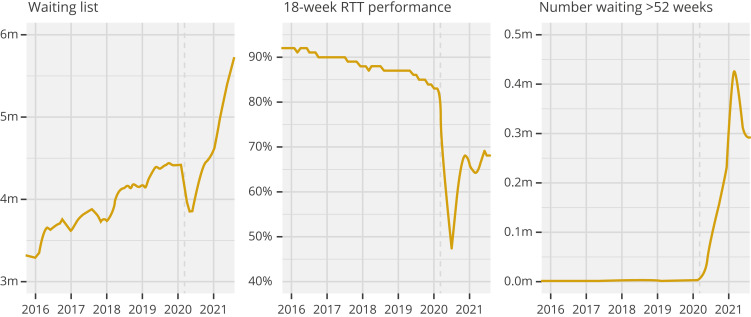
Objectives: A significant indirect impact of COVID-19 has been the increasing elective waiting times observed in many countries. In England's National Health Service, the waiting list has grown from 4.4 million in February 2020 to 5.7 million by August 2021. The objective of this study was to estimate the trajectory of future waiting list size and waiting times up to December 2025.
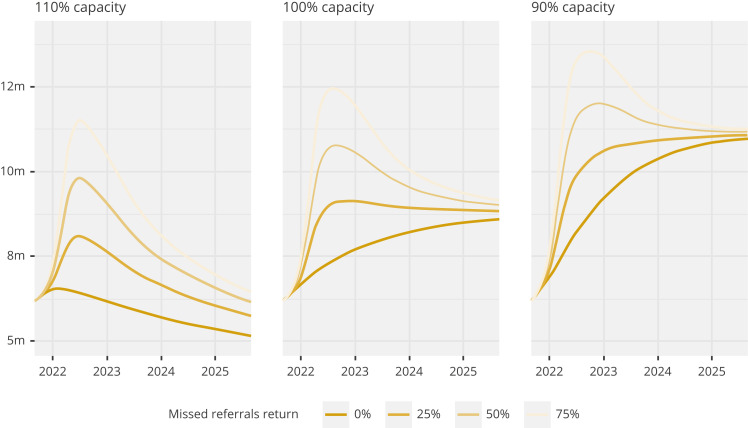
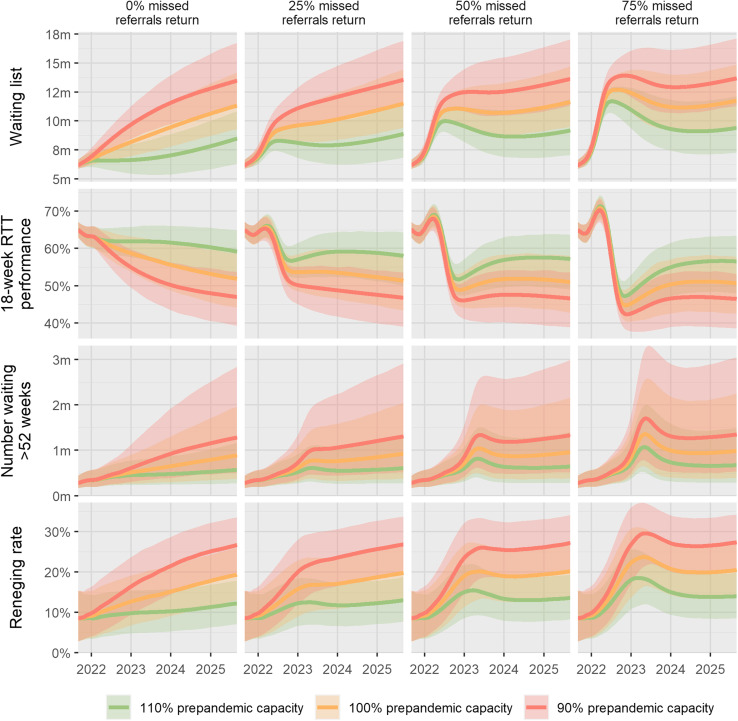
Methods: A scenario analysis was performed using computer simulation and publicly available data as of November 2021. Future demand assumed a phased return of various proportions (0%, 25%, 50%, and 75%) of the estimated 7.1 million referrals "missed" during the pandemic. Future capacity assumed 90%, 100%, and 110% of that provided in the 12 months immediately before the pandemic.
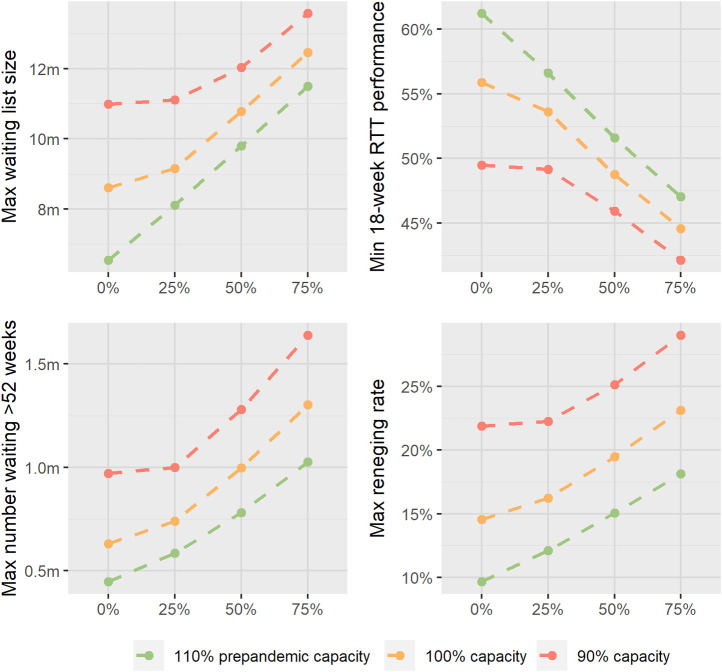
Results: As a worst-case scenario, the waiting list would reach 13.6 million (95% confidence interval 12.4-15.6 million) by Autumn 2022, if 75% of missed referrals returned and only 90% of prepandemic capacity could be achieved. The proportion of patients waiting under 18 weeks would reduce from 67.6% in August 2021 to 42.2% (37.4%-46.2%) with the number waiting over 52 weeks reaching 1.6 million (0.8-3.1 million) by Summer 2023. At this time, 29.0% (21.3%-36.8%) of patients would be leaving the waiting list before treatment. Waiting lists would remain pressured under even the most optimistic of scenarios considered, with 18-week performance struggling to maintain 60%.
Conclusions: This study reveals the long-term challenge for the National Health Service in recovering elective waiting lists and potential implications for patient outcomes and experience.
Keywords: COVID-19; computer simulation; elective backlog; elective performance; waiting lists; waiting times.
Copyright © 2022. Published by Elsevier Inc.
Figures

References
-
- Iacobucci G. COVID-19: all non-urgent elective surgery is suspended for at least three months in England. BMJ. 2020;368:m1106. - PubMed
-
- Health at a glance 2021: OECD indicators. OECD Publishing. https://www.oecd-ilibrary.org/social-issues-migration-health/health-at-a...
-
- Hirvonen J., Tuominen U., Seitsalo S., et al. The effect of waiting time on health-related quality of life, pain, and physical function in patients awaiting primary total hip replacement: a randomized controlled trial. Value Health. 2009;12(6):942–947. - PubMed
LinkOut - more resources
Full Text Sources
Research Materials
