Review
. 2022 Aug 13;15(1):93.
doi: 10.1186/s13048-022-01022-z.

Targeting purine metabolism in ovarian cancer

Affiliations
Review

Targeting purine metabolism in ovarian cancer

Jingchun Liu et al. J Ovarian Res. .

Abstract

Purine, an abundant substrate in organisms, is a critical raw material for cell proliferation and an important factor for immune regulation. The purine de novo pathway and salvage pathway are tightly regulated by multiple enzymes, and dysfunction in these enzymes leads to excessive cell proliferation and immune imbalance that result in tumor progression. Maintaining the homeostasis of purine pools is an effective way to control cell growth and tumor evolution, and exploiting purine metabolism to suppress tumors suggests interesting directions for future research. In this review, we describe the process of purine metabolism and summarize the role and potential therapeutic effects of the major purine-metabolizing enzymes in ovarian cancer, including CD39, CD73, adenosine deaminase, adenylate kinase, hypoxanthine guanine phosphoribosyltransferase, inosine monophosphate dehydrogenase, purine nucleoside phosphorylase, dihydrofolate reductase and 5,10-methylenetetrahydrofolate reductase. Purinergic signaling is also described. We then provide an overview of the application of purine antimetabolites, comprising 6-thioguanine, 6-mercaptopurine, methotrexate, fludarabine and clopidogrel. Finally, we discuss the current challenges and future opportunities for targeting purine metabolism in the treatment-relevant cellular mechanisms of ovarian cancer.

Keywords: Antimetabolites; Metabolizing enzyme; Ovarian cancer; Purine metabolism; Purinergic signaling.


Conflict of interest statement

The authors declare that they have no competing interests.

Figures
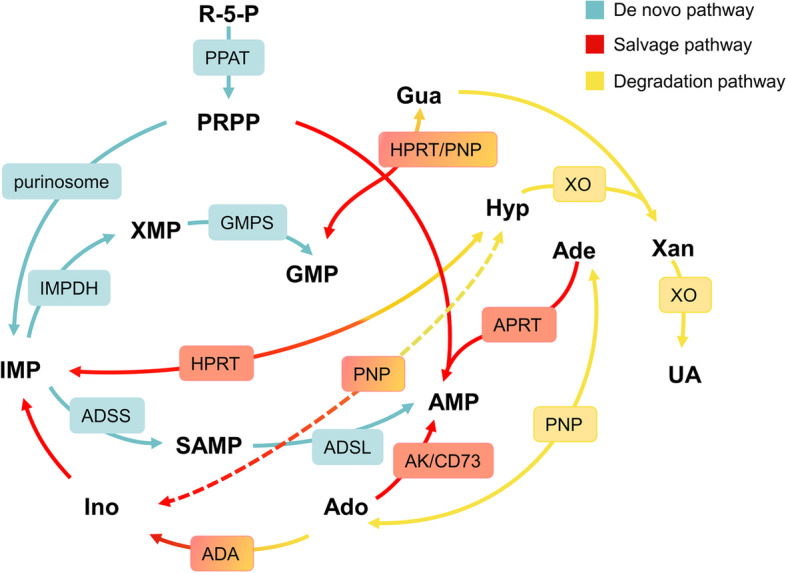
Fig. 1
Fig. 1
De novo, salvage and degradation pathways of purine nucleotides under the regulation of purine-metabolizing enzymes. The de novo pathway converts PRPP to IMP and, ultimately, GMP and AMP that further involve in nucleotide synthesis. The salvage pathway recovers purine bases and purine nucleosides to generate purine nucleotides. The degraded purine base becomes Xan with eventual conversion to UA. Cyan: de novo pathway; red: salvage pathway; yellow: degradation pathway; gradient color: involved in multiple metabolic pathways; arrows: purine metabolic pathways; squares: purine-metabolizing enzymes involved in related pathways. R-5-P: ribose 5-phosphate; PRPP: 5-phosphoribosyl-1-pyrophosphate; Gln: glutamine; THF: Tetrahydrofolate; Asp: aspartate; Hyp: hypoxanthine; Ino: Inosine; IMP: inosine monophosphate; Xan: xanthine; XMP: xanthosine monophosphate; Gua: guanine; GMP: guanosine monophosphate; Ade: adenine; Ado: adenosine; AMP: ado monophosphate; SAMP: succinyl-AMP; UA: uric acid; PPAT: phosphoribosyl pyrophosphate amidotransferase; IMPDH: IMP dehydrogenase; GMPS: GMP synthase; ADSS: adenylosuccinate synthase; ADSL: adenylosuccinate lyase; HPRT: Hyp Gua phosphoribosyltransferase; APRT: Ade phosphoribosyltransferase; ADA: Ado deaminase; AK: adenylate kinase; PNP: purine nucleoside phosphorylase; XO: xanthine oxidase
Fig. 2
Fig. 2
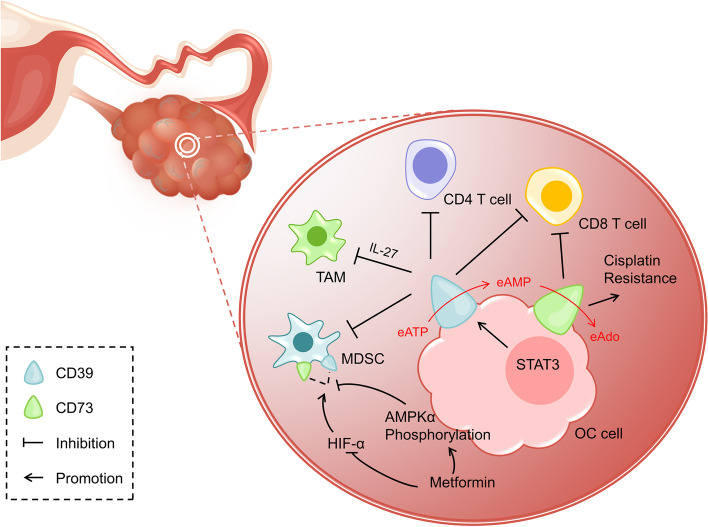
CD39 and CD73 in TME of OC. CD39 and CD73 localized on the surface of OC cells inhibit immune responses mediated by T cells, MDSC, and TAM in TME, and also induce cisplatin resistance. CD39 and CD73 dephosphorylate eATP to eAMP, ultimately converting it to eAdo. STAT3 induces cell surface acquiring CD39 in TME to promote immunosuppression. Metformin facilitates AMPKα phosphorylation and inhibits the HIF-α pathway to block the immunosuppression caused by high expression of CD39 and CD73 on MDSC. MDSC: myeloid-deriver suppressor cell; TAM: tumor-associated macrophage; TME: tumor microenvironment; eATP: extracellular ATP; eAMP: extracellular AMP; eAdo: extracellular Ado
Fig. 3
Fig. 3
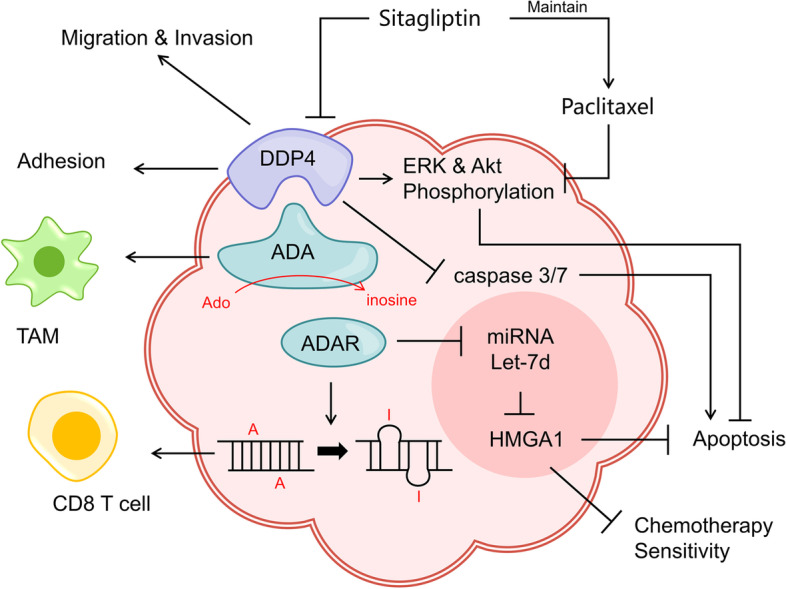
Role and mechanism of ADAR, ADA and its receptor DDP in OC. ADAR mediates A to I RNA editing to elicit CD8 T cell response and interferes with HMGA1 via miRNA Let-7d acting on OC apoptosis and chemotherapy sensitivity. ADA enhances the immune potency of TAM in TME with the capacity to convert Ado to inosine. DDP4, an important receptor for ADA, facilitates the migration, invasion and adhesion to mesothelial cells of OC. The DDP inhibitor Sitagliptin, increases caspase 3/7 activity to induce OC apoptosis on the one hand, and maintains the effect of paclitaxel on OC apoptosis via ERK and Akt pathways on the other hand
Fig. 4
Fig. 4
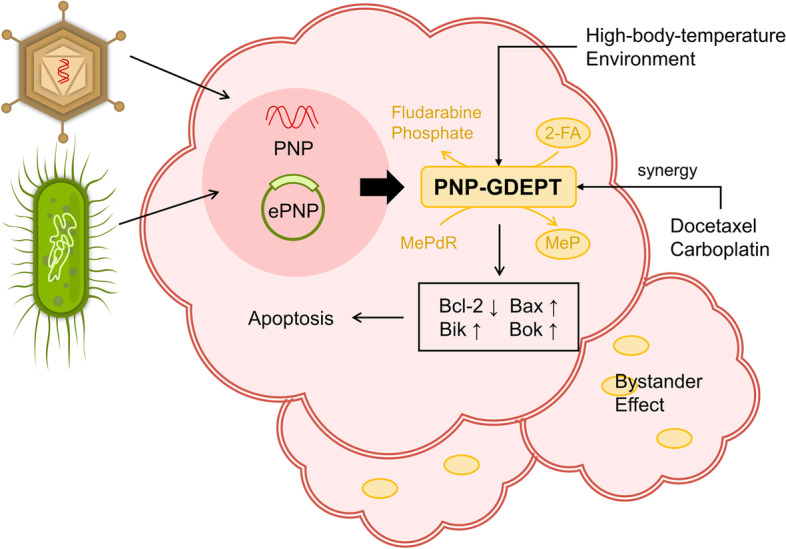
Application of PNP-GDEPT in OC. PNP cleaved MePdR and Fludarabine phosphate to the toxic products MeP and 2-FA. Implementation of GDEPT using ePNP or adenovirus-mediated PNP is able to induce apoptosis in OC cells and exert the bystander effect. PNP-GDEPT acts synergistically with docetaxel and cisplatin and high-body-temperature environment enhance the expression efficiency of ePNP. GDEPT: gene directed enzyme prodrug therapy; ePNP: E. coli PNP; MePdR: 6-methylpurine-2’-deoxyriboside; MeP: 6-methylpurine; 2-FA: 2-Fluoroadenine
Fig. 5
Fig. 5
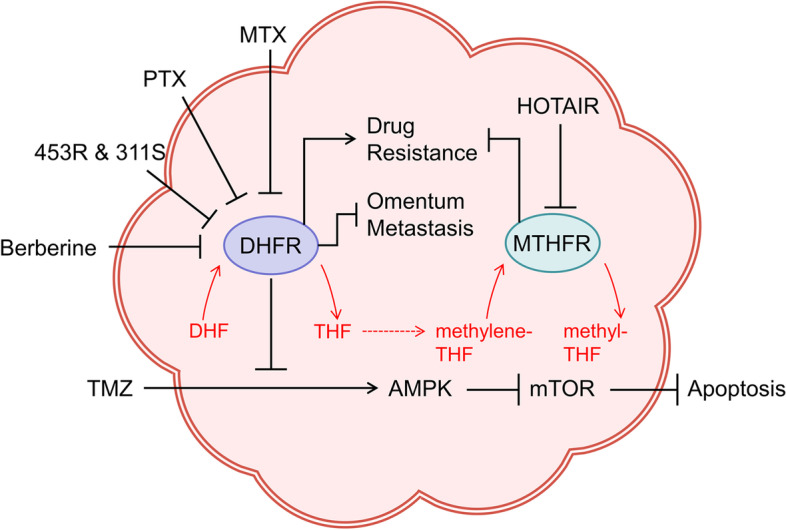
Role of DHFR and MTHFR in OC. DHFR and MTHFR are involved in the formation of important one-carbon units for purine metabolism. DHFR promotes drug resistance and inhibits omentum metastasis, while resisting apoptosis caused by TMZ through AMPK pathway activation and mTOR pathway inhibition. Berberine, PTX, MTX, and some quinoxalines (453R&311S) have been found to act as DHFR inhibitors. MTHFR inhibits FBP expression and enhances drug sensitivity, which is inhibited by HOTAIR. TMZ: temozolomide; PTX: pemetrexed; MTX: methotrexate; 453R: 3-methyl-7-trifluoromethyl-2(R)-[3,4,5-trimethoxyanilino]-quinoxaline; 311S: 3-piperazinilmethyl-2[4(oxymethyl)-phenoxy]-quinoxaline; FBP: folate binding protein
Fig. 6
Fig. 6
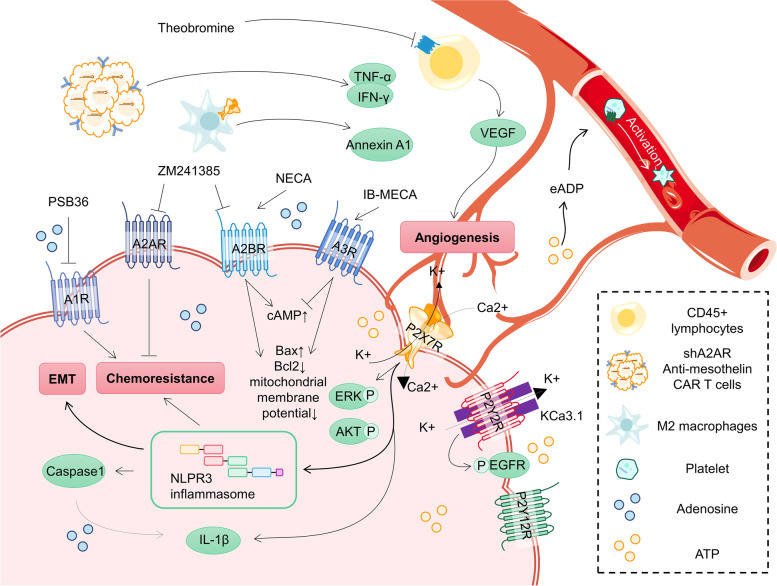
Purinergic signaling pathway in OC. Extra- and intracellular adenosine and ATP are key agonists. Purinergic receptors are expressed in a variety of cells in OC TME. Activation or antagonism of these receptors, as well as interaction with other signaling will ultimately affect the progression and malignant features of OC

References

    1. Doherty JA, Peres LC, Wang C, Way GP, Greene CS, Schildkraut JM. Challenges and opportunities in studying the epidemiology of ovarian cancer subtypes. Curr Epidemiol Rep. 2017;4(3):211–220. doi: 10.1007/s40471-017-0115-y. - DOI - PMC - PubMed
    1. Siegel RL, Miller KD, Fuchs HE, Jemal A. Cancer statistics, 2021. CA Cancer J Clin. 2021;71(1):7–33. doi: 10.3322/caac.21654. - DOI - PubMed
    1. Coleman RL, Monk BJ, Sood AK, Herzog TJ. Latest research and treatment of advanced-stage epithelial ovarian cancer. Nat Rev Clin Oncol. 2013;10(4):211–224. doi: 10.1038/nrclinonc.2013.5. - DOI - PMC - PubMed
    1. Hess JR, Greenberg NA. The role of nucleotides in the immune and gastrointestinal systems: potential clinical applications. Nutr Clin Pract. 2012;27(2):281–294. doi: 10.1177/0884533611434933. - DOI - PubMed
    1. De Vitto H, Arachchige DB, Richardson BC, French JB. The intersection of purine and mitochondrial metabolism in cancer. Cells-Basel. 2021;10(10):2603. doi: 10.3390/cells10102603. - DOI - PMC - PubMed