


Sex, Neuropsychiatric Profiles, and Caregiver Burden in Alzheimer's Disease Dementia: A Latent Class Analysis
- PMID: 35964175
- PMCID: PMC9535594
- DOI: 10.3233/JAD-215648
Sex, Neuropsychiatric Profiles, and Caregiver Burden in Alzheimer's Disease Dementia: A Latent Class Analysis
Abstract
Background: Neuropsychiatric symptoms (NPS) in Alzheimer's disease (AD) can be disruptive for patients and their families.
Objective: We aimed to classify patients based on NPS and to explore the relationship of these classes with sex and with caregiver burden.
Methods: The study cohort comprised individuals with AD dementia diagnosed at Ace Alzheimer Center in Barcelona, Spain, between 2011-2020. NPS were ascertained by using the Neuropsychiatric Inventory-Questionnaire. Latent class analysis was used to identify clusters of individuals sharing a similar NPS profile. We evaluated the caregiver burden using the Zarit Burden Interview. Multivariable regression models were used to obtain adjusted estimates of the association between sex, NPS classes, and caregiver burden.
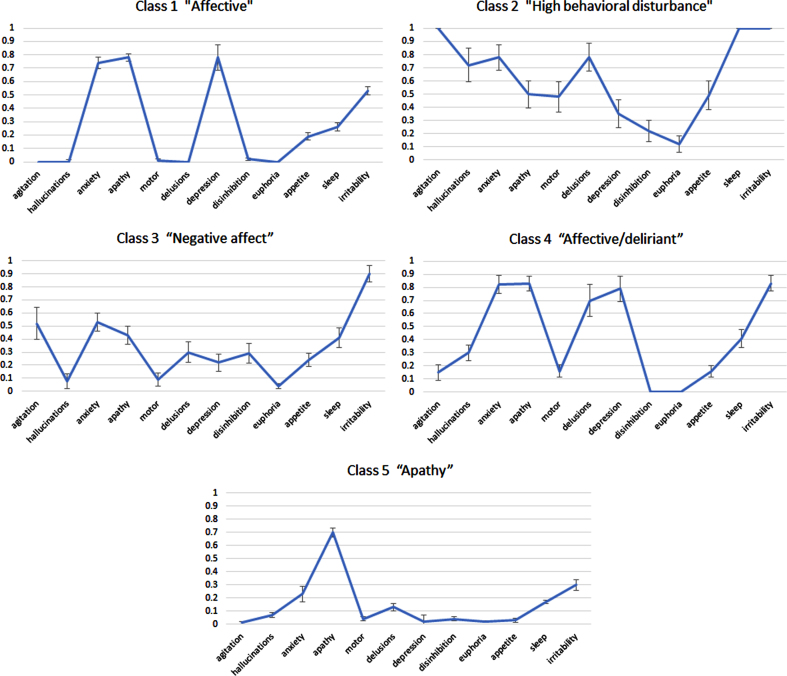
Results: A total of 1,065 patients with AD dementia and their primary caregivers were included. We classified patients into five different classes according to their NPS profile: "Affective", "High-behavioral-disturbance", "Negative-affect", "Affective/deliriant", and "Apathy". We found that age, sex, and type of AD diagnosis differed greatly across classes. We found that patients from the "High-behavioral-disturbance" (OR = 2.56, 95% CI: 1.00-6.56), "Negative-affect" (OR = 2.72, 95% CI: 1.26-3.64), and "Affective/deliriant" (OR = 2.14, 95% CI: 1.26-3.64) classes were over two times more likely to have a female caregiver than those in "Apathy" class. These three classes were also the ones associated to the greatest caregiver burden in the adjusted analyses, which seems to explain the increased burden observed among female caregivers.
Conclusion: Caregiver burden is highly dependent on the patient's NPS profiles. Female caregivers provide care to patients that pose a greater burden, which makes them more susceptible to become overwhelmed.
Keywords: Alzheimer’s disease; caregiver burden; gender; neurobehavioral manifestations; sex; women.
Conflict of interest statement
Authors’ disclosures available online (
Figures
References
-
- Patterson C (2018) World Alzheimer Report 2018. The state of the art of dementia research: New frontiers. Alzheimer’s Disease International, London.
-
- Alzheimer’s Association (2013) 2013 Alzheimer’s disease facts and figures. Alzheimers Dement 9, 208–245. - PubMed
-
- Arnold M, Nho K, Kueider-Paisley A, Massaro T, Huynh K, Brauner B, MahmoudianDehkordi S, Louie G, Moseley MA, Thompson JW, John-Williams LS, Tenenbaum JD, Blach C, Chang R, Brinton RD, Baillie R, Han X, Trojanowski JQ, Shaw LM, Martins R, Weiner MW, Trushina E, Toledo JB, Meikle PJ, Bennett DA, Krumsiek J, Doraiswamy PM, Saykin AJ, Kaddurah-Daouk R, Kastenmüller G (2020) Sex and APOE ɛ4 genotype modify the Alzheimer’s disease serum metabolome. Nat Commun 11, 1148. - PMC - PubMed
-
- Ferretti MT, Martinkova J, Biskup E, Benke T, Gialdini G, Nedelska Z, Rauen K, Mantua V, Religa D, Hort J, Santuccione Chadha A, Schmidt R (2020) Sex and gender differences in Alzheimer’s disease: Current challenges and implications for clinical practice: Position paper of the Dementia and Cognitive Disorders Panel of the European Academy of Neurology. Eur J Neurol 27, 928–943. - PubMed
MeSH terms
LinkOut - more resources
Full Text Sources
Medical
Miscellaneous
