


Mediating effect of circadian rhythm between work stress and sleep quality in Chinese shift-working nurses: A cross-sectional survey
- PMID: 35964326
- PMCID: PMC9834518
- DOI: 10.1002/nop2.1322
Mediating effect of circadian rhythm between work stress and sleep quality in Chinese shift-working nurses: A cross-sectional survey
Abstract
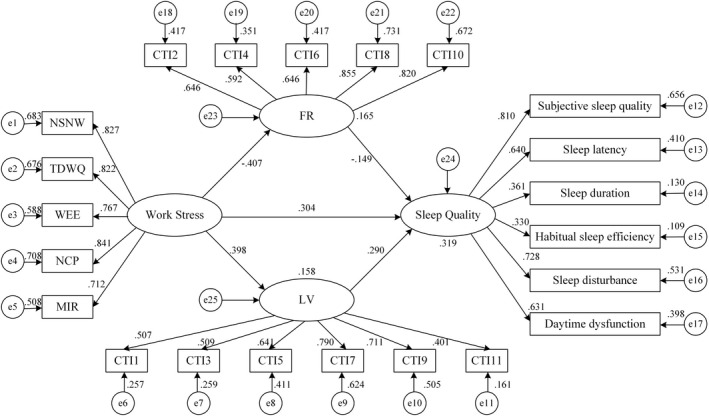
Aim: This study examined the mediating effect of circadian rhythm amplitude (LV) and stability (FR) between work stress and sleep quality among Chinese shift-working nurses (SWNs).
Design: A cross-sectional study.
Methods: Three-hundred and seventy-nine nurses working in shifts were investigated by convenient sampling from six hospitals in Shanghai, China. The mediating effect was analysed using the structural equation model with bootstrapping procedures.
Results: Work stress could directly affect shift nurses' sleep quality and indirectly affect sleep quality through circadian rhythm amplitude and stability. The total indirect effects of work stress on sleep quality accounted for 36.7% of the total effect. The study revealed that poor sleep quality is very common among SWNs, which deserves attention. The mediating effect of the circadian rhythm provides new insights to improve sleep quality, not only by lightening the work stress but also by improving circadian rhythm in SWNs.
Keywords: circadian rhythm; mediation analysis; occupational stress; shift work schedule; sleep quality.
© 2022 The Authors. Nursing Open published by John Wiley & Sons Ltd.
Figures
References
-
- Bagheri Hosseinabadi, M. , Ebrahimi, M. H. , Khanjani, N. , Biganeh, J. , Mohammadi, S. , & Abdolahfard, M. (2019). The effects of amplitude and stability of circadian rhythm and occupational stress on burnout syndrome and job dissatisfaction among irregular shift working nurses. Journal of Clinical Nursing, 28(9–10), 1868–1878. 10.1111/jocn.14778 - DOI - PubMed
Publication types
MeSH terms
LinkOut - more resources
Full Text Sources
Medical
