


Maternal diet quality moderates associations between parabens and birth outcomes
- PMID: 35964672
- PMCID: PMC10052883
- DOI: 10.1016/j.envres.2022.114078
Maternal diet quality moderates associations between parabens and birth outcomes
Abstract
Background/objective: Maternal paraben exposure and diet quality are both independently associated with birth outcomes, but whether these interact is unknown. We assessed sex-specific associations of parabens with birth outcomes and differences by maternal diet quality.
Methods: Illinois pregnant women (n = 458) provided five first-morning urines collected at 8-40 weeks gestation, which we pooled for quantification of ethylparaben, methylparaben, and propylparaben concentrations. We collected/measured gestational age at delivery, birth weight, body length, and head circumference within 24 h of birth, and calculated sex-specific birth weight-for-gestational-age z-scores and weight/length ratio. Women completed three-month food frequency questionnaires in early and mid-to-late pregnancy, which we used to calculate the Alternative Healthy Eating Index (AHEI)-2010. Linear regression models evaluated sex-specific associations of parabens with birth outcomes, and differences in associations by average pregnancy AHEI-2010.
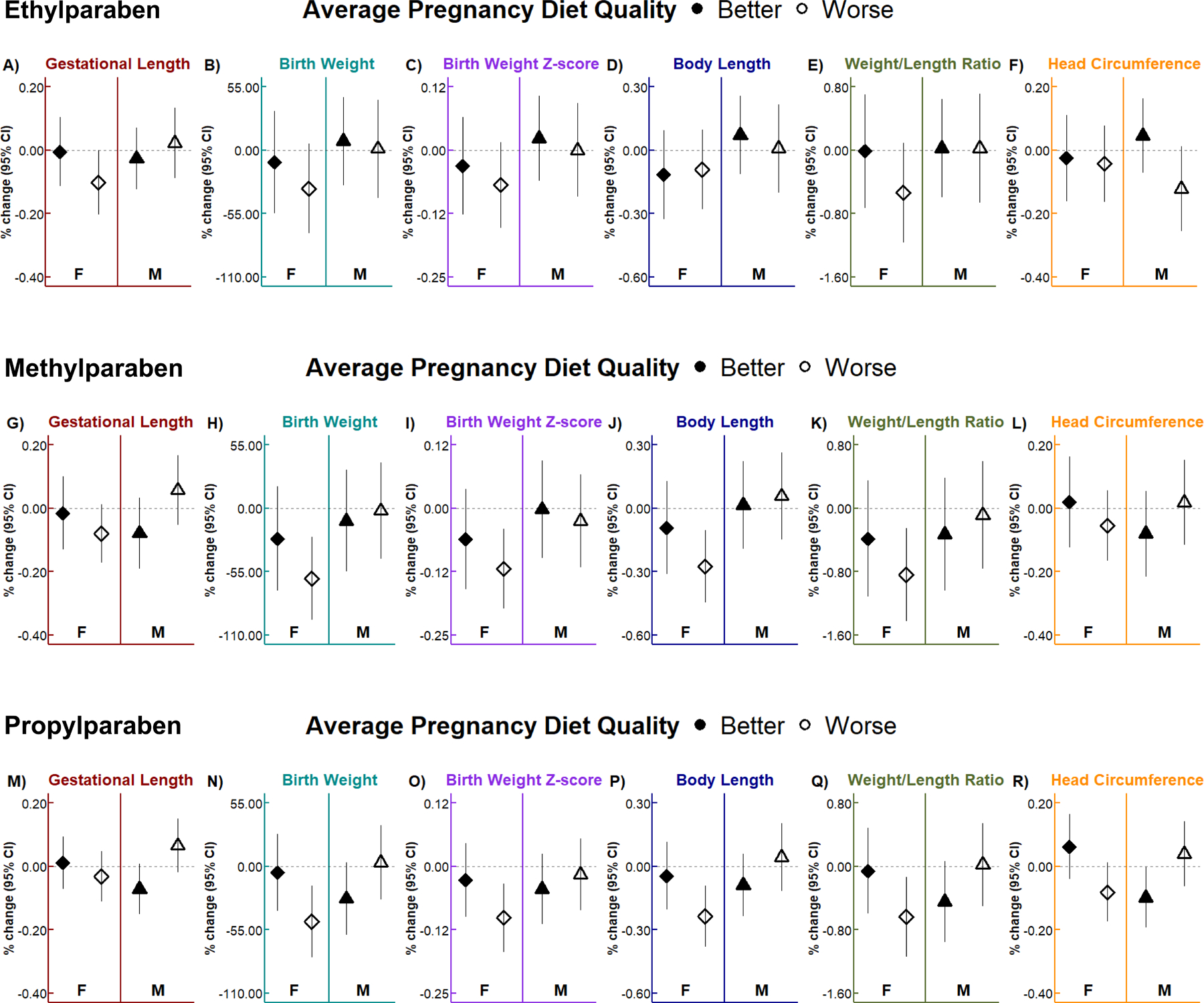
Results: In this predominately non-Hispanic white, college-educated sample, maternal urinary paraben concentrations were only modestly inversely associated with head circumference and gestational length. However, methylparaben and propylparaben were inversely associated with birth weight, birth weight z-scores, body length, and weight/length ratio in female, but not male newborns. For example, each 2-fold increase in methylparaben concentrations was associated with -46.61 g (95% CI: -74.70, -18.51) lower birth weight, -0.09 (95% CI: -0.15, -0.03) lower birth weight z-scores, -0.21 cm (95% CI: -0.34, -0.07) shorter body length, and -0.64 g/cm (95% CI: -1.10, -0.19) smaller weight/length ratio in females. These inverse associations were more prominent in females of mothers with poorer diets (AHEI-2010 < median), but attenuated in those with healthier diets (AHEI-2010 ≥ median). In newborn males of mothers with healthier diets, moderate inverse associations emerged for propylparaben with gestational length and head circumference.
Conclusions: Maternal diet may moderate associations of parabens with birth size in a sex-specific manner. Additional studies may consider understanding the inflammatory and metabolic mechanisms underlying these findings.
Keywords: Birth size; Gestational length; Head circumference; Maternal diet; Newborn sex; Parabens.
Copyright © 2022 Elsevier Inc. All rights reserved.
Conflict of interest statement
Declaration of competing interest The authors declare that they have no known competing financial interests or personal relationships that could have appeared to influence the work reported in this paper.
Figures
References
-
- 2015. Committee opinion no. 633: Alcohol abuse and other substance use disorders: ethical issues in obstetric and gynecologic practice. Obstet Gynecol 125, 1529–1537. - PubMed
-
- Ahn HJ, et al., 2012. Parabens inhibit the early phase of folliculogenesis and steroidogenesis in the ovaries of neonatal rats. Mol Reprod Dev 79, 626–36. - PubMed
Publication types
MeSH terms
Substances
Grants and funding
LinkOut - more resources
Full Text Sources
Medical
