


Influent carbon to phosphorus ratio drives the selection of PHA-storing organisms in a single CSTR
- PMID: 35965889
- PMCID: PMC9364015
- DOI: 10.1016/j.wroa.2022.100150
Influent carbon to phosphorus ratio drives the selection of PHA-storing organisms in a single CSTR
Abstract
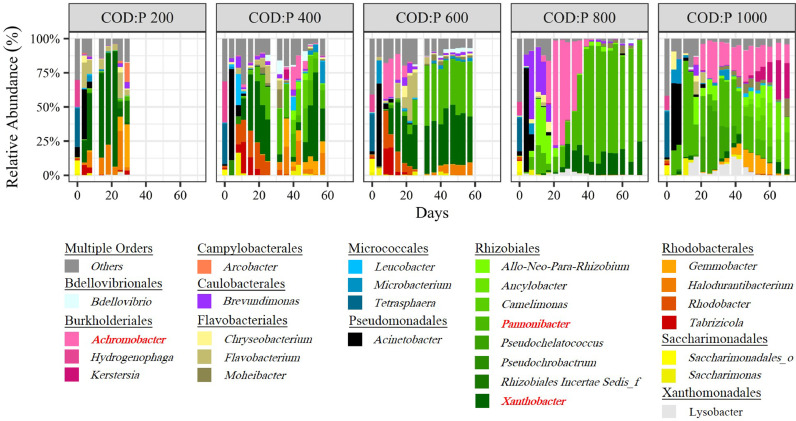
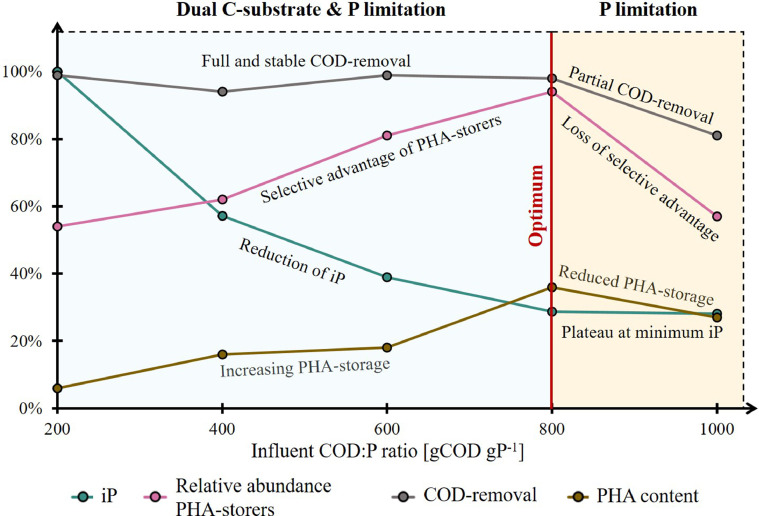
Enriching a biomass with a high fraction of polyhydroxyalkanoate-storing organisms (PHA-storers) represents an essential step in the production of PHAs (bioplastics) from municipal wastewater using mixed microbial cultures. A major challenge is however to create selective growth conditions that are favourable to PHA-storers. Our study thus investigates to what extent the influent COD to phosphorus (COD:P) ratio can be used as a tool for the robust selection of PHA-storers in a single continuous-flow stirred-tank reactor (CSTR). Therefore, we operated five CSTRs in parallel, fed with synthetic wastewater (50% acetate - 50% propionate) with different COD:P ratios (200-1000 gCOD gP-1), and performed a detailed analysis of the microbial communities over long-term (30-70 solid retention times). Our study demonstrates that efficient and robust selection of PHA-storers can be achieved in a single CSTR at high influent COD:P ratios. The selective advantage for PHA-storers increases with the influent COD:P ratio, but only if growth conditions remain limited by both C-substrate and P. In contrast, selection performance deteriorates when COD:P ratios are too high and growth conditions are limited by P only. At an optimal COD:P ratio of 800 gCOD gP-1, a stable microbial community consisting of >90% PHA-storers and dominated by Pannonibacter sp. was selected in the long-term. Finally, our results suggest that high COD:P ratios provide a selective advantage to microorganisms with low cellular P requirements, explaining why different PHA-storers (i.e., Xanthobacter sp. vs. Pannonibacter sp.) were selected depending on the influent COD:P ratio (i.e., 200 vs. 800 gCOD gP-1). Overall, our results provide relevant insights for the development of a new approach for selecting PHA-storers, based on the use of a single CSTR and control of the influent COD:P ratio.
Keywords: Biomass PHA content; Cellular phosphorus requirements; Dual carbon and phosphorus limitation; Growth conditions; Long-term selection; Polyhydroxyalkanoates (PHAs).
© 2022 The Author(s).
Conflict of interest statement
The authors declare that they have no known competing financial interests or personal relationships that could have appeared to influence the work reported in this paper.
Figures



References
-
- Albuquerque M.G.E., Concas S., Bengtsson S., Reis M.A.M. Mixed culture polyhydroxyalkanoates production from sugar molasses: the use of a 2-stage CSTR system for culture selection. Bioresour. Technol. 2010;101(18):7112–7122. - PubMed
-
- Albuquerque M.G.E., Torres C.A.V., Reis M.A.M. Polyhydroxyalkanoate (PHA) production by a mixed microbial culture using sugar molasses: Effect of the influent substrate concentration on culture selection. Water Res. 2010;44(11):3419–3433. - PubMed
-
- Alloul A., Ganigue R., Spiller M., Meerburg F., Cagnetta C., Rabaey K., Vlaeminck S.E. Capture-ferment-upgrade: a three-step approach for the valorization of sewage organics as commodities. Environ. Sci. Technol. 2018;52(12):6729–6742. - PubMed
-
- Bahreini G., Nazari L., Ho D., Flannery C.C., Elbeshbishy E., Santoro D., Nakhla G. Enzymatic pre-treatment for enhancement of primary sludge fermentation. Bioresour. Technol. 2020;305 - PubMed
LinkOut - more resources
Full Text Sources
