


Tourettic OCD: Current understanding and treatment challenges of a unique endophenotype
- PMID: 35966462
- PMCID: PMC9363583
- DOI: 10.3389/fpsyt.2022.929526
Tourettic OCD: Current understanding and treatment challenges of a unique endophenotype
Abstract
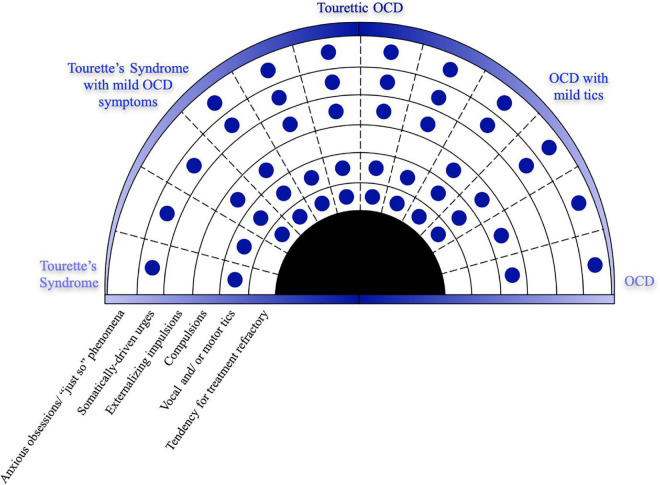
Obsessive compulsive disorder (OCD) and chronic tic disorders (CTD) including Tourette Syndrome (TS) are often comorbid conditions. While some patients present with distinct symptoms of CTD and/or OCD, a subset of patients demonstrate a unique overlap of symptoms, known as Tourettic OCD (TOCD), in which tics, compulsions, and their preceding premonitory urges are overlapping and tightly intertwined. The specific behaviors seen in TOCD are typically complex tic-like behaviors although with a compulsive and partially anxious nature reminiscent of OCD. TOCD is not classified within the Diagnostic and Statistical Manual of Mental Disorders fifth edition (DSM-5) as an independent diagnostic entity, but mounting evidence suggests that TOCD is an intermediate neuropsychiatric disorder distinct from either TS or OCD alone and as such represents a unique phenomenology. In this review of TOCD we discuss clinical, genetic, environmental, neurodevelopmental, and neurocircuit-based research to better characterize our current understanding of this disorder. TOCD is characterized by earlier age of onset, male predominance, and specific symptom clusters such as lower tendency toward compulsions related to checking, cleaning, and reassurance seeking and higher tendency toward compulsions such as rubbing, tapping, or touching associated with symmetry concerns or thoughts of exactness. Functional magnetic resonance imaging (fMRI) imaging suggests that TOCD symptoms may arise from involvement of an intermediate neurocircuitry distinct from classic OCD or classic CTD. Small cumulative contributions from multiple genetic loci have been implicated, as have environmental factors such as infection and perinatal trauma. In addition, this review addresses the treatment of TOCD which is especially complex and often treatment resistant and requires pharmacology and behavioral therapy in multiple modalities. Given the distressing impact of TOCD on patients' functioning, the goal of this review is to raise awareness of this distinct entity toward the goal of improving standards of care.
Keywords: OCD; TOCD; Tourette syndrome; Tourettic OCD; obsessive-compulsive disorder.
Copyright © 2022 Katz, Bui, Worhach, Bogut and Tomczak.
Conflict of interest statement
The authors declare that the research was conducted in the absence of any commercial or financial relationships that could be construed as a potential conflict of interest.
Figures


References
-
- APA. Diagnostic and Statistical Manual of Mental Disorders (Dsm-5®). 5th ed. New York, NY: American Psychiatric Association; (2013).
-
- Flow Psychology. Tourettic OCD. (2017). Available online at: https://flowpsychology.com/Tourettic-Ocd (accessed April 22, 2022).
Publication types
LinkOut - more resources
Full Text Sources
