Self-Assembling Oligo(2-oxazoline) Organogelators for the Encapsulation and Slow Release of Bioactive Volatiles
- PMID: 35967068
- PMCID: PMC9366986
- DOI: 10.1021/acsomega.2c02905
Self-Assembling Oligo(2-oxazoline) Organogelators for the Encapsulation and Slow Release of Bioactive Volatiles
Abstract
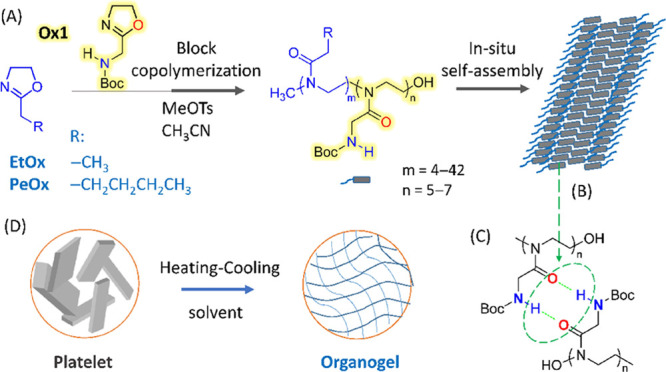
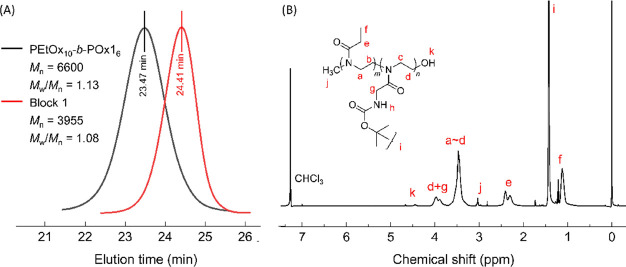
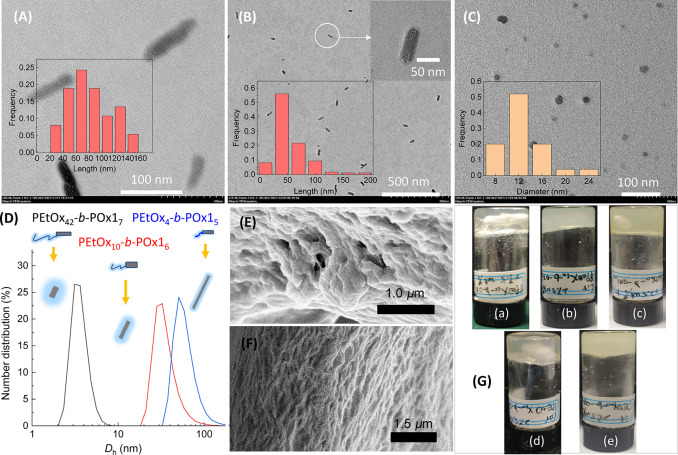
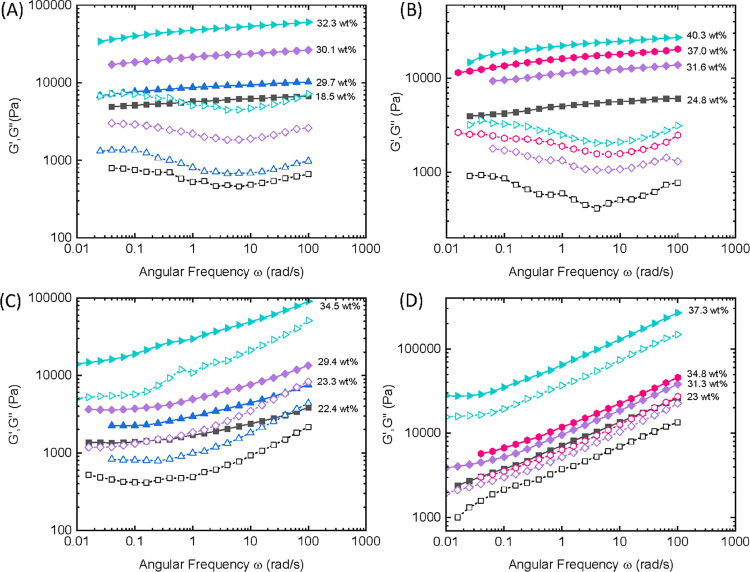
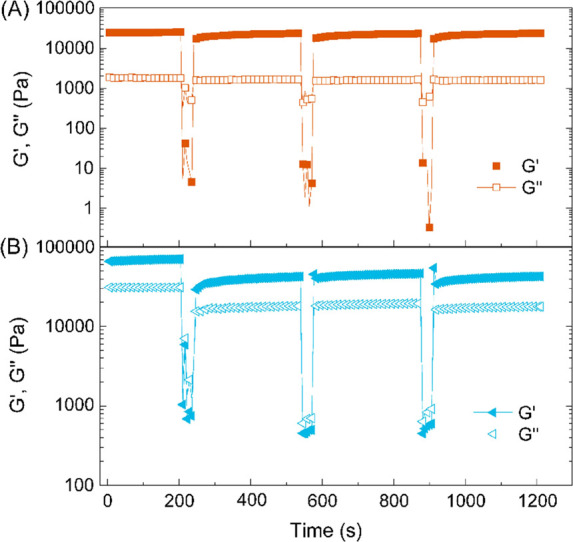
Herein, we report a class of distinctive supramolecular nanostructures in situ-generated from the cationic ring-opening polymerization of a particular 2-oxazoline monomer, i.e., 2-(N-tert-butyloxycarbonylaminomethyl)-2-oxazoline (Ox1). Driven by side-chain hydrogen bonding between neighboring molecules and van der Waals interactions, the growing oligomers of Ox1 precipitate in the form of macroscopic platelets when the degree of polymerization reaches 5-7. A similar self-assembly occurred in the block copolymerization of 2-ethyl-2-oxazoline (EtOx) or 2-pentyl-2-oxazoline (PeOx) and Ox1 as the second monomer. These polymeric aggregates were found to disassemble into rod-like nanoparticles under appropriate conditions, and to form stable organogels in some polar solvents like dimethylformamide as well as in natural liquid fragrances such as (R)-carvone, citronellal, and (R)-limonene. Scanning electron microscopy revealed that the morphology of their xerogels was solvent-dependent, mainly with a lamellar or fibrous structure. The rheology measurements confirmed the as-obtained organogels feature an obvious thixotropic character. The storage modulus was about 7-10 times higher than the loss modulus, indicating the physical crosslinking in the gel. The fragrance release profiles showed that the presented supramolecular gel system exhibits good sustained-release effect for the loaded bioactive volatiles.
© 2022 The Authors. Published by American Chemical Society.
Conflict of interest statement
The authors declare no competing financial interest.
Figures

References
LinkOut - more resources
Full Text Sources