Study of the Diffusion Law of Harmful Gases in Tunnel Construction on Plateaus and Optimization of Ventilation Parameters
- PMID: 35967075
- PMCID: PMC9366961
- DOI: 10.1021/acsomega.2c01397
Study of the Diffusion Law of Harmful Gases in Tunnel Construction on Plateaus and Optimization of Ventilation Parameters
Abstract
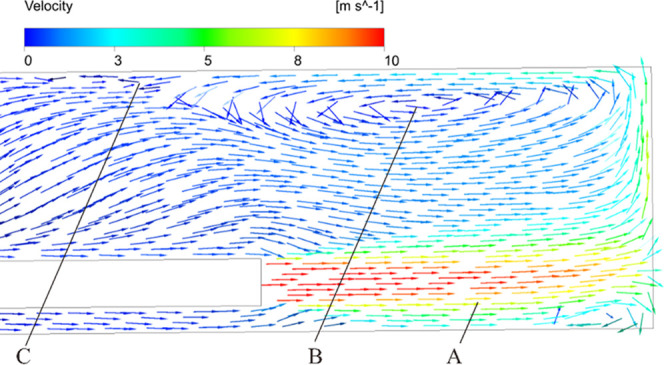
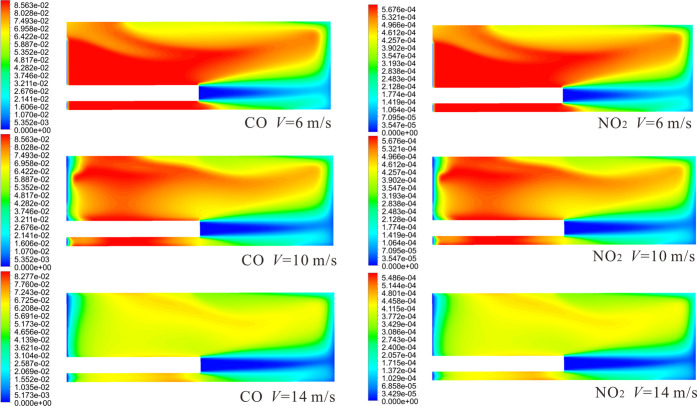
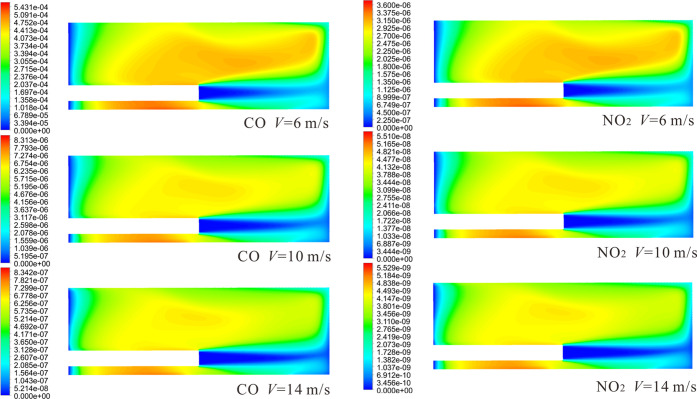
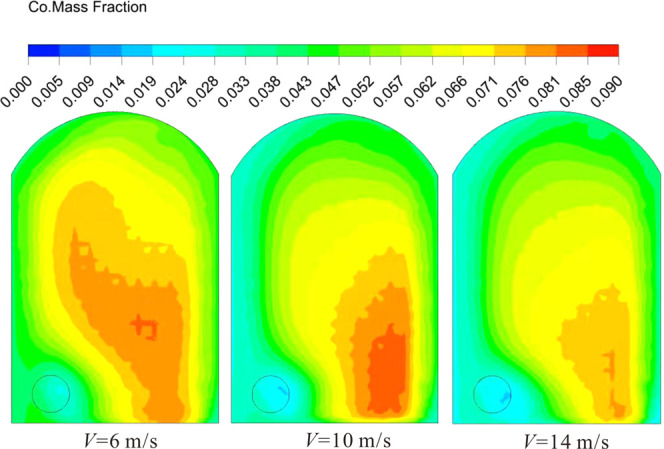
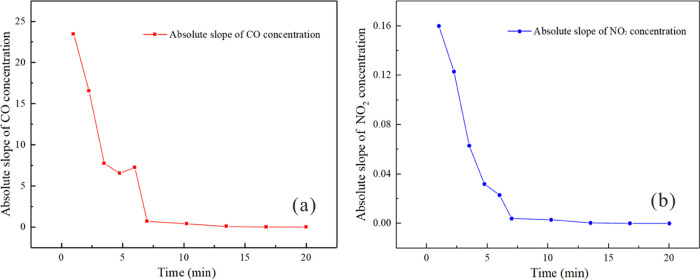
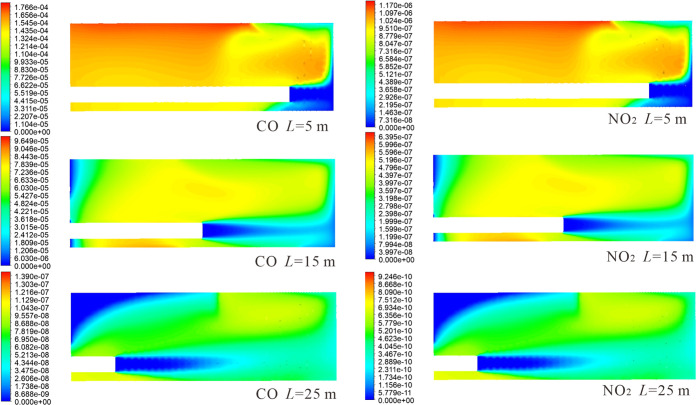
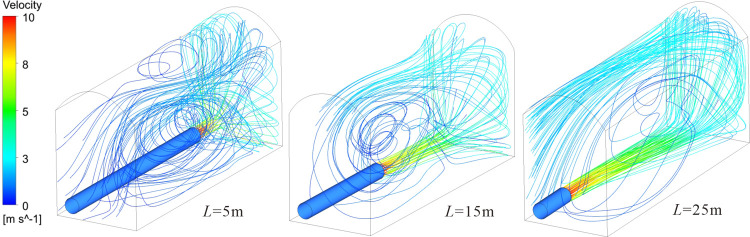
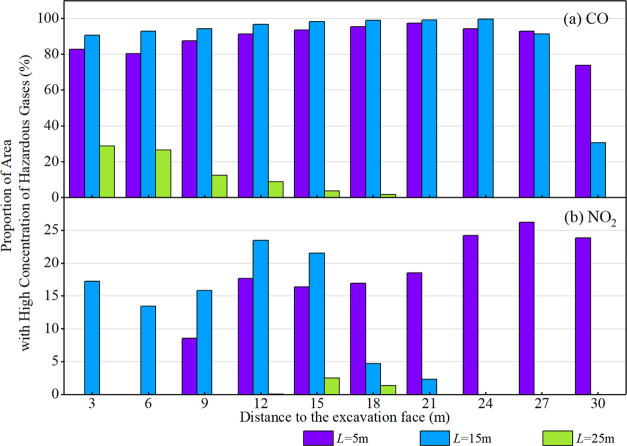
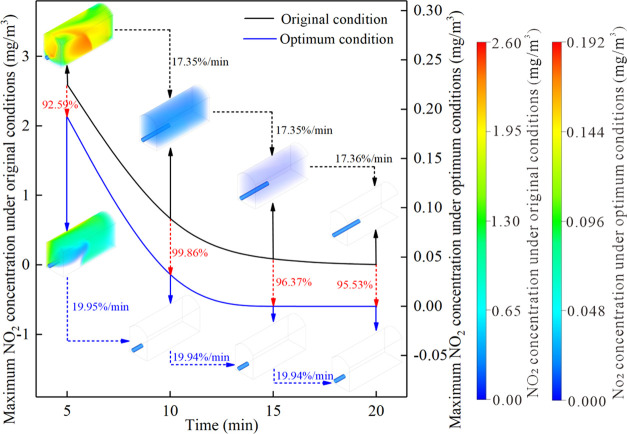
To explore the diffusion law of harmful gases near the excavation face in tunnel construction on plateaus, select the optimal ventilation parameters, and improve the ventilation efficiency, Ansys Fluent was used to set the environmental parameters according to the highland, where the tunnel is located, and simulate and curve fit the diffusion phenomenon of CO and NO2 based on the fluid control equations and species transport model. The effects of air velocity, ventilation time, and duct position on the diffusion law of harmful gases were analyzed, from which the optimal ventilation conditions were selected, and the ventilation effects under the optimal conditions were compared with those under the original conditions. The study shows that after the fresh airflow passes through the outlet, part of it flows out along the tunnel wall toward the cave entrance, and the other part interacts with the return air to form a vortex; when the air supply speed is 10 m/s and the distance from the duct outlet to the excavation face is 25 m, the maximum concentration of harmful gases decreases by 92-99% after 20 min of ventilation compared with that before optimization and the smoke exhaust efficiency increases by 2.5% per minute.
© 2022 The Authors. Published by American Chemical Society.
Conflict of interest statement
The authors declare no competing financial interest.
Figures






References
-
- Cao Z. M.; Liu X.; Niu B. C. Migration Characteristics of Dust during Construction Stage in Highway Tunnels at High Altitude Areas. Chin. J. Underground Space Eng. 2019, 15, 927–935.
-
- Chen J. S.; Jiang Z. A.; Tan C. Numerical simulation of dust removal and ventilation system in the rock comprehensive tunneling face. Harbin Polytech. Univ. J. 2015, 47, 98–103.
-
- Chen Z. C.; Yang P.; Lv W. S.; He L.; Men R. Y. Numerical simulation on the diffusion law of blasting fume during roadway tunneling across a vein in an alpine mine. Chin. J. Eng. 2011, 33, 521–525. 10.13374/j.issn1001-053x.2011.05.003. - DOI
-
- Jiang Z. A.; Yang B.; Zhang G. L.; Zeng F. B.; Wang Y. P. Analysis of dust pollution effect of cutting dust and ventilation control parameters at the heading face in plateau mines. J. China Coal Soc. 2021, 46, 2146–2157.
-
- Liu J.; Song Y.; Liu H. M.; Liu Y. H.; Deng L. J. Experimental study on distribution laws of wind velocity in straight roadway section based on LDA. J. Saf. Sci. Technol. 2015, 11, 65–71.
LinkOut - more resources
Full Text Sources