


The Effect of Video-Based Preanaesthetic Preparation Versus Conventional Approach on Parental Anxiety in Paediatric Dental Procedures: A Prospective Cohort Study
- PMID: 35967189
- PMCID: PMC9366023
- DOI: 10.7759/cureus.26768
The Effect of Video-Based Preanaesthetic Preparation Versus Conventional Approach on Parental Anxiety in Paediatric Dental Procedures: A Prospective Cohort Study
Abstract
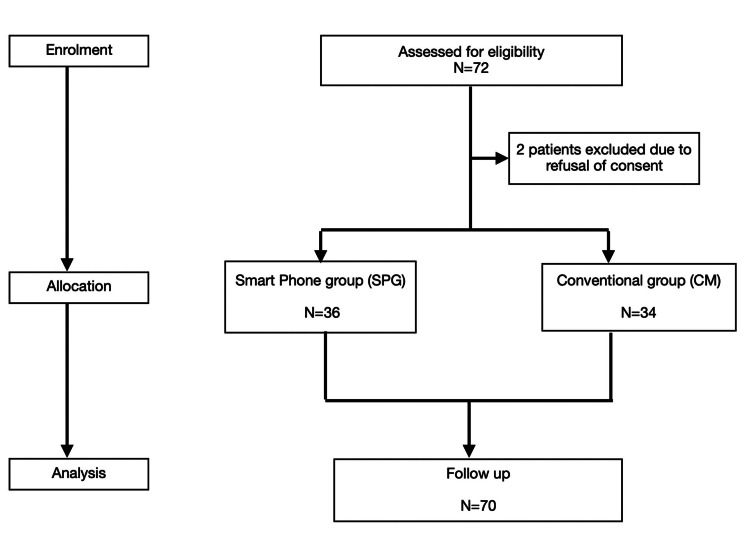
Background Parental anxiety has been identified as a risk factor affecting the behaviour of children before operative intervention. A preanaesthetic visit is a standard component of preoperative preparation, which may reduce parental anxiety. The use of audiovisual aids to demonstrate the conduct of anaesthesia may help improve parental education and reduce anxiety. Patient and methods We analysed data from a prospective randomised trial conducted at a tertiary care hospital. Parents of children posted for day care dental procedures were enrolled in the study. Children could be of either gender, aged 2-6 years, and categorised as American Society of Anesthesiologists Physical Status (ASA-PS) 1 or 2. Parents' anxiety regarding the surgical and anaesthesia procedure was assessed using the Amsterdam Preoperative Anxiety and Information Scale (APAIS). The first APAIS scoring was recorded on arrival in the preoperative holding area. Thereafter, the participants were randomly allocated into two groups; one group was shown a short video on a smartphone of a dental operating theatre (OT), dental chair and anaesthesia equipment (SPG group), while the other group was verbally explained the dental procedure (conventional management or CM group). The second APAIS scoring was done in the postoperative recovery area one hour after the procedure. Demographic characteristics, socio-economic conditions and history were recorded. Anxiety scores were compared between the two groups, and any change was analysed. Results Seventy parents were included in the study, with 36 randomised to the SPG group and 34 to the CM group. Both groups were comparable in terms of demographic characteristics. There was a statistically significant decrease in anxiety scores in the SPG group, from a mean of 25.47 at the preoperative assessment to 14.92 at the postoperative timepoint (p<0.001). In the CM group, the mean APAIS score decreased from 25.26 to 24.56 (p=0.059). Conclusion There was a significant reduction in anxiety scores in the postoperative period among parents who were shown an operating room video in the preoperative period.
Keywords: dental anxiety; operating room; paediatrics; parents; parents’ knowledge; video recording.
Copyright © 2022, Phaneendra et al.
Conflict of interest statement
The authors have declared that no competing interests exist.
Figures


Similar articles
-
Video Distraction and Parental Presence for the Management of Preoperative Anxiety and Postoperative Behavioral Disturbance in Children: A Randomized Controlled Trial.Anesth Analg. 2015 Sep;121(3):778-784. doi: 10.1213/ANE.0000000000000839. Anesth Analg. 2015. PMID: 26176357 Clinical Trial.
-
Can Verbal Interview Decrease Preoperative Anxiety and Postoperative Discomfort in Oral and Maxillofacial Surgery Patients?: A Randomized Clinical Trial.J Oral Maxillofac Surg. 2024 Nov;82(11):1425-1432. doi: 10.1016/j.joms.2024.06.178. Epub 2024 Jun 29. J Oral Maxillofac Surg. 2024. PMID: 39009060 Clinical Trial.
-
Preoperative informational video reduces preoperative anxiety and postoperative negative behavioral changes in children.Minerva Anestesiol. 2016 May;82(5):534-42. Epub 2015 Oct 16. Minerva Anestesiol. 2016. PMID: 26474268 Clinical Trial.
-
[Video-assisted patient education in anaesthesiology: possibilities and limits of a new procedure for improvement of patient information].Anaesthesist. 2008 Jun;57(6):546-54. doi: 10.1007/s00101-008-1381-3. Anaesthesist. 2008. PMID: 18509609 Review. German.
-
Preoperative parental information and parents' presence at induction of anaesthesia.Minerva Anestesiol. 2006 Jun;72(6):461-5. Minerva Anestesiol. 2006. PMID: 16682916 Review.
References
-
- Pre-operative parental anxiety. Thompson N, Irwin MG, Gunawardene WM, Chan L. Anaesthesia. 1996;51:1008–1012. - PubMed
-
- Preoperative parental anxiety predicts behavioural and emotional responses to induction of anaesthesia in children. Bevan JC, Johnston C, Haig MJ, et al. Can J Anaesth. 1990;37:177–182. - PubMed
-
- Predicting which child-parent pair will benefit from parental presence during induction of anesthesia: a decision-making approach. Kain ZN, Caldwell-Andrews AA, Maranets I, Nelson W, Mayes LC. Anesth Analg. 2006;102:81–84. - PubMed
-
- Effects of background stress and anxiety on postoperative recovery. Liu R, Barry JE, Weinman J. Anaesthesia. 1994;49:382–386. - PubMed
LinkOut - more resources
Full Text Sources